Korea Health Industry Development Institute Releases Survey Results
Strong Perceived Impact on Improving Work Flow
It has been found that 1 out of 2 doctors in Korea has experience using medical artificial intelligence (AI), such as for image interpretation. While doctors highly value the improvement of work flow brought by AI, they are most concerned about the ambiguity of legal responsibility in the event of medical accidents.
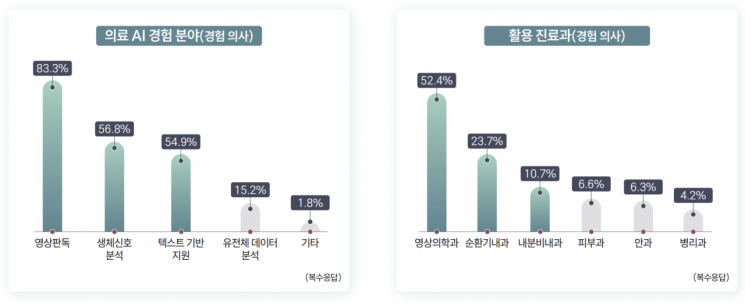
The Korea Health Industry Development Institute, with the cooperation of the Korean Medical Association, released on the 26th the results of the "2025 Medical AI Utilization Survey," conducted online with 2,125 doctors from October 16 to 21 last year. This survey was carried out to identify doctors' utilization experience and perception levels at a time when the use of medical AI in clinical settings is expanding.
According to the survey, 47.7% of doctors responded that they had experience using medical AI, which is close to half of all respondents.
Doctors who had used medical AI were utilizing it for image interpretation (83.3%), biosignal analysis (56.8%), and text-based support (54.89%). The main purposes of use were diagnosis (68.0%) and screening (51.2%), followed by treatment (33.4%) and follow-up observation (24.1%).
As for the perceived effectiveness of medical AI, doctors rated improvement in work flow (82.3%) the highest. This was followed by improved accuracy (46.2%) and efficient use of human resources (39.2%).
For doctors without experience using medical AI, the reasons for non-use included lack of information (54.4%), lack of accessibility (48.2%), and reliability issues (37.6%).
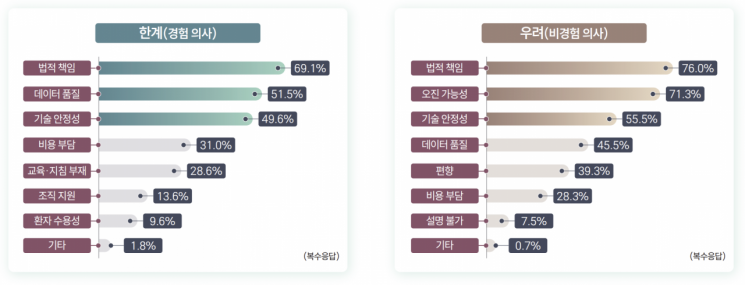
As for the limitations of medical AI, the most frequently cited concern was the lack of clarity regarding legal responsibility in the event of medical accidents (69.1% among experienced doctors and 76.0% among inexperienced doctors).
Regardless of whether they had experience with medical AI, doctors were most worried about the ambiguity of who is responsible when an accident occurs, and there was a strong perception that responsibility should be shared rather than borne by individual doctors. In the event of an accident, respondents tended to view the responsible party as joint responsibility (35.3%) or the AI development company (26.9%), rather than the individual doctor (18.0%).
Doctors viewed clarification of liability and compensation standards (69.4%) as the most necessary step to promote the use of medical AI. This was followed by strengthening approval and certification standards (59.6%), data quality management (51.7%), and establishing post-marketing monitoring systems (47.9%).
The Korea Health Industry Development Institute stated, "The results of this survey show that the key tasks for the successful introduction of medical AI are securing legal clarity, creating a trust-based ecosystem, and establishing a systematic education system," adding, "We will support the incorporation of these issues into medical AI policy, while continuing to secure in-depth and objective policy evidence through follow-up surveys on evolving AI technologies and the changing medical environment."
© The Asia Business Daily(www.asiae.co.kr). All rights reserved.