Base Rate Kept at 2.50%... Sixth Consecutive Hold Since July Last Year
Semiconductors Soar and Domestic Demand Recovers, Growth Outlook Raised to 2.0%
K-Style Dot-Plot Rate Projections Introduced, Hold Scenario Dominant
Minor Possibility of a Cut and Very Small Possibility of a Hike Also Considered
The Bank of Korea has revised its forecast for this year’s Korean economic growth upward to 2.0%. This figure is in line with the upper end of the potential growth rate range of 1.8% to 2.0%. The upward revision mainly reflects that export performance, led by semiconductors, is improving more sharply than previously expected, and that domestic demand is gradually improving on the back of recovering consumer sentiment. The base rate was kept unchanged at 2.50% per annum by unanimous vote of all Monetary Policy Board members. Under the new K-style dot-plot interest rate projection introduced at this meeting, the probability of a rate hold in six months was seen as the highest, while a minority saw the possibility of a cut and a very small minority considered the possibility of a hike.
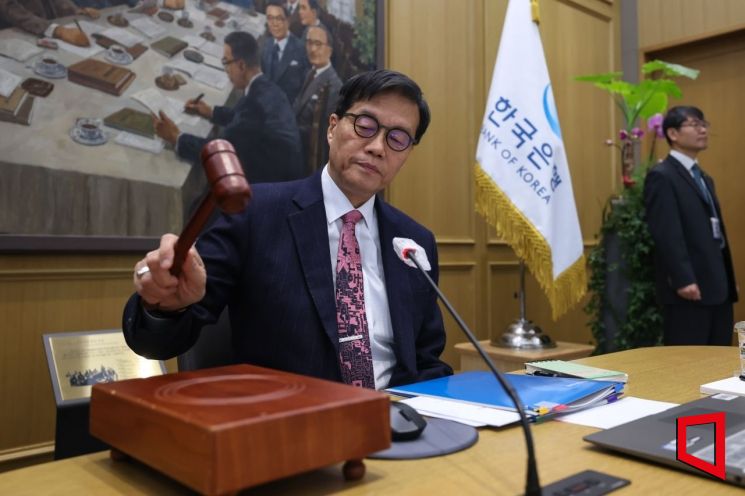 Lee Changyong, governor of the Bank of Korea, is tapping the gavel at the plenary session of the Monetary Policy Committee held at the Bank of Korea headquarters in Jung-gu, Seoul, on the 26th. Photo by the Joint Press Photographers' Pool.
Korean Economy Expected to Grow 2.0% This Year... Strong Exports Driven by Semiconductors
In its economic outlook released on the 26th after the Monetary Policy Board meeting on monetary policy held at the Bank of Korea headquarters in Jung-gu, Seoul, the Bank of Korea projected that the Korean economy will grow 2.0% this year. This comes three months after it raised its November 2025 forecast of 1.8% by 0.2 percentage point, and it is now projecting an additional 0.2 percentage point increase. The growth forecast for next year was revised down by 0.1 percentage point from 1.9% to 1.8%.
This year’s 2.0% growth forecast is the same as the projection recently announced by the government, and higher than the 1.9% forecasts recently released by the International Monetary Fund (IMF) and the Korea Development Institute (KDI). However, it is slightly below the 2.1% projection of the Organisation for Economic Co-operation and Development (OECD).
The Bank of Korea revised the growth forecast upward this time because it judged that both exports and domestic demand have stronger upside factors than at the time of the November 2025 projection. In particular, the better-than-expected semiconductor cycle is cited as the single biggest factor behind the higher growth forecast. The sharp recovery in the semiconductor sector is expected to boost exports and facility investment, thereby strengthening overall growth momentum. Bank of Korea Governor Lee Changyong said in a report to the National Assembly on the 23rd that "despite uncertainties related to U.S. tariff policy, this year’s growth rate will be significantly higher than last year as export growth continues on the back of a favorable semiconductor cycle."
In fact, Korea’s export performance so far this year has remained solid. According to the Korea Customs Service, exports in January amounted to 65.8 billion dollars, up 33.8% from a year earlier, with semiconductor exports (20.69 billion dollars) surging 102.5% and leading the overall increase. From February 1 to 20, total exports reached 43.5 billion dollars, up 23.5% from the same period a year earlier. In particular, semiconductor exports during the same period jumped 134.1%, with their share of total exports expanding to 34.7%.
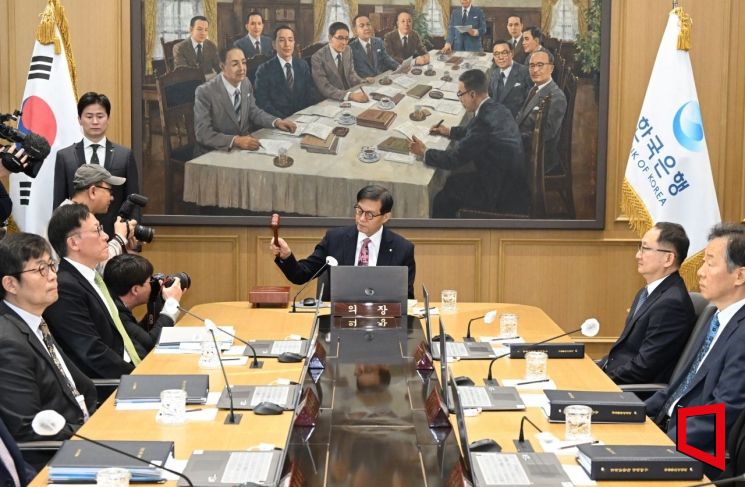 Lee Changyong, Governor of the Bank of Korea, is striking the gavel at the Monetary Policy Board plenary meeting held on the 26th at the Bank of Korea headquarters in Jung-gu, Seoul. Photo by the Joint Press Photographers
KOSPI 6000 Era and Recovery in Consumer Sentiment... Hopes for Stronger Domestic Demand
Expectations for an improvement in domestic demand driven by a recovery in consumer sentiment also supported the upward revision of the growth forecast. Along with robust exports centered on semiconductors, bullish stock markets, including the KOSPI breaking through the 6,000-point level, have increased optimistic views on the economy and are positively affecting consumer sentiment. The Composite Consumer Sentiment Index (CCSI) released by the Bank of Korea stood at 112.1 in February, rising for the second consecutive month. According to the National Data Office (formerly Statistics Korea), retail sales, a key indicator of domestic consumption trends, rose 0.5% last year, rebounding for the first time in four years.
However, uncertainty factors that could dampen growth remain. Despite the conclusion of U.S.-Korea trade negotiations, risks related to U.S. tariff policy are still present, and the high dependence on semiconductors for growth is cited as a key risk factor. Construction investment, which dragged down last year’s growth rate, is also a downside factor. Construction investment is expected to see some easing of last year’s contraction, but there are concerns that the recovery could be slower than expected, as construction orders are not sufficiently translating into actual groundbreakings and regional real estate markets remain sluggish.
The forecast for consumer price inflation was revised up to 2.2%, a slight increase of 0.1 percentage point from the November 2025 projection. The forecast for next year was kept at 2.0%. Although this year’s projection was revised up slightly, the Bank of Korea expects inflation to remain stable around the 2% target level amid offsetting upward and downward forces from falling international oil prices and a strong won exchange rate. Consumer price inflation in January was 2.0%, the lowest in five months.
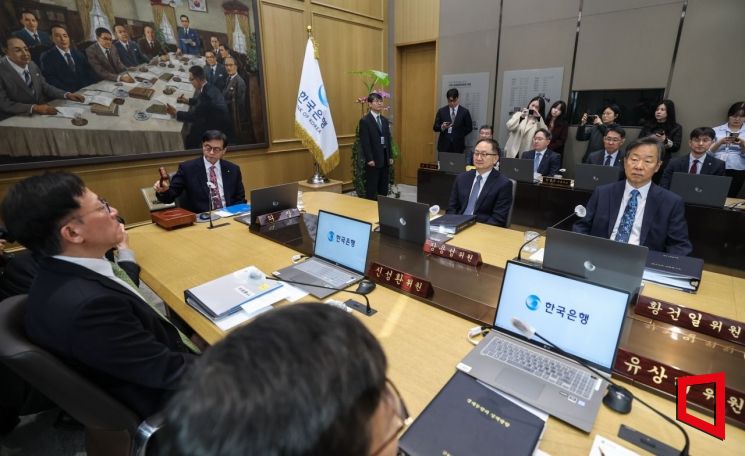 Lee Changyong, Governor of the Bank of Korea, is striking the gavel at the Monetary Policy Committee plenary session held at the Bank of Korea's main building in Jung-gu, Seoul, on the 26th. Photo by Joint Press Pool
Rate Hold in February, 'Hold Highly Likely' Over the Next Six Months, With "Hike Scenario Also Considered"
At its meeting on this day, the Monetary Policy Board kept the base rate unchanged at 2.50% per annum and judged that there is a high likelihood that the current rate will be maintained six months from now as well.
Starting with this meeting, the Bank of Korea introduced a six-month K-style dot-plot as part of the Monetary Policy Board members’ conditional base rate projections, or forward guidance. Including the Governor, all seven members of the Board place three dots each at specific rate levels for six months ahead, taking into account the baseline outlook and upside and downside risks. They may place all three dots at the same rate level or at different levels. The distribution of the total 21 dots allows markets to gauge Board members’ views on the future path of interest rates.
According to the K-style dot-plot projections, 16 of the 21 dots pointed to an unchanged base rate in six months, accounting for 76% of the total. Four dots indicated a rate cut to 2.25% in six months. A small possibility of a rate hike was also explored, with one dot at 2.75%, assigning some weight to the possibility of a higher rate than now. Market participants, however, generally viewed the likelihood of a hike in the dot-plot as low, noting that the growth forecast was raised to 2.0% but remains within the expected range, and that next year’s forecast was revised down by 0.1 percentage point. The single dot at a higher rate is interpreted as a "hawkish scenario from the most hawkish Board member," suggesting that the actual probability of a hike is slim. By contrast, the four dots indicating a cut imply that at least two members see some possibility of easing, so the market reaction regarding rate hikes leaned more toward relief than concern.
In the market, many also expect that the rate hold will be extended for the rest of the year, with a prolonged period of unchanged rates. After this holding phase, views on the direction of monetary policy diverge between a hike and a cut. Choyonggu, researcher at Shinyoung Securities, said, "For the time being, it is necessary to take into account the overheated housing market in the Seoul metropolitan area from a financial stability perspective, the ample liquidity in financial markets, and the weak won," adding, "As government policy responses are focused on stabilizing the real estate market and the exchange rate, interest rates are likely to remain on hold for a considerable period." Han Junhee, senior researcher at NH Financial Research Institute, also noted, "In the current situation, the need for additional monetary easing is limited," and "a cautious stance is likely to be maintained."
Meanwhile, the rate hold on this day marked the sixth consecutive decision to keep rates unchanged, following July, August, October, and November last year and January this year. The outcome was in line with market expectations. In a prior expert survey by The Asia Business Daily, all 15 respondents had predicted that rates would be kept on hold this month. The decision was supported by the fact that inflation is stable near the 2.0% target, that the growth forecast for this year has been revised up to 2.0%, indicating a more optimistic view of the economy than before, and that lingering instability in the foreign exchange and real estate markets argues for maintaining the current rate.
The Monetary Policy Board stated, "With inflation remaining on a stable path near the target level and growth expected to continue a better-than-expected recovery, and given that risks to financial stability persist, we judge it appropriate to maintain the current base rate while monitoring domestic and external policy conditions," adding that, going forward, monetary policy will continue to support the recovery in growth, while decisions will be made by assessing changes in domestic and external policy conditions, the resulting inflation path, and financial stability conditions throughout this process.
Factors that could undermine financial stability, such as the exchange rate, real estate, and household debt, remain a source of concern. According to the Korea Real Estate Board, apartment sale prices in Seoul in the third week of February (as of the 16th) rose 0.15% from the previous week. Although the overall rate of increase slowed by 0.07 percentage point as apartment prices in Gangnam-gu, Seoul, rose only 0.01% amid the government’s strong real estate measures and President Lee Jaemyung’s pressure on multi-home owners, prices are still on an upward trend.
In the Seoul foreign exchange market the previous day, the won-dollar exchange rate closed at 1,429.4 won at the weekly closing price (3:30 p.m.), down 13.1 won from the previous trading day, and moved slightly lower in early trading on this day, hovering in the mid-1,420 won range. Compared with late last year, when the rate exceeded 1,480 won and threatened to break above 1,500 won, the level has fallen substantially. However, heightened volatility continues, with geopolitical risks such as possible conflict between the United States and Iran and net selling of Korean stocks by foreign investors remaining as sources of instability. From the start of this month through the previous day, the average daily trading range of the won-dollar exchange rate reached 8.4 won. This is higher than in December last year (5.3 won), when the rate climbed close to 1,500 won, and in January this year (6.6 won), when volatility also remained elevated.
© The Asia Business Daily(www.asiae.co.kr). All rights reserved.