Declaration of AI Vision and Four Major Strategies
Announcing a Leap into a Global Hub for Manufacturing Innovation
Full-Scale Transformation of the Gumi National Industrial Complex into an Advanced AI Manufacturing Base
Applying AI to Key Industries such as Semiconductors and Defense
"Securing Global Competitiveness"
Creating the "Gumi-type Industrial AI Ecosystem" through Industry-Academia-Research-Government Cooperation
On February 25, Gumi City in North Gyeongsang Province declared its leap forward beyond being South Korea's leading industrial city to becoming a "Global Manufacturing AI Data City" that integrates artificial intelligence technologies.
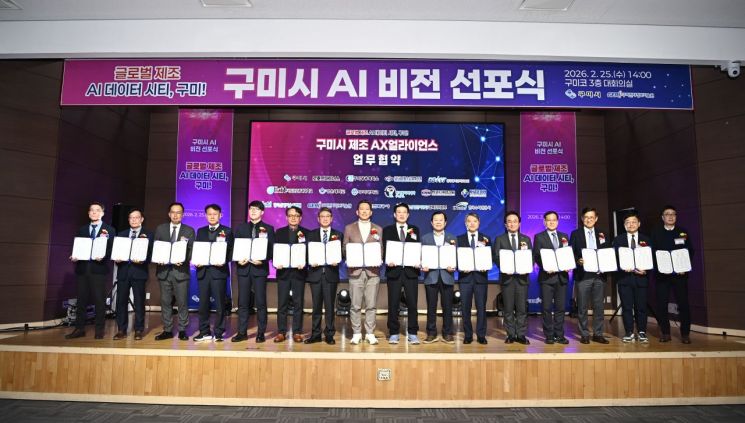
The city announced its commitment to transform the Gumi National Industrial Complex into a global manufacturing AX cluster by holding the "Gumi City AI Vision Launch Ceremony" in the main conference hall of GumiCo, attended by around 100 participants including local business leaders, executives and staff from AI companies, officials from universities and research institutes, and citizens. In particular, based on the region's solid manufacturing foundation in advanced industries such as semiconductors, defense, secondary batteries, and robots, the city plans to combine data infrastructure with AI technology and be reborn as a city that leads data standards for industrial AI.
In addition, recognizing that it is difficult for companies to independently adopt AI due to high costs and a shortage of specialized personnel, the city plans to establish a support system focused on practical problem solving and quickly introduce AI across the entire industrial sector to innovate productivity and quality.
■ Gumi declares itself a central city for a major industrial transformation to seize the golden time of manufacturing AX
Under the vision of "Global Manufacturing AI Data City, Gumi! - Leap into a Global Hub for Super-Gap Manufacturing Innovation," Gumi City presented its goals of converting 10 manufacturing anchor companies to AX by 2032, fostering 100 upstream and downstream AI companies, and training 1,000 practical AI personnel. To achieve this, the city will promote 26 strategic tasks across four key areas (▲Building AI infrastructure ▲Leading manufacturing AX ▲Establishing an AI data hub ▲Creating an AI ecosystem).
The core tasks under Gumi City's Manufacturing AI HYPER four major strategies are as follows.
First, in the field of building AI infrastructure, the city will promote in tandem its core projects: the creation of a "Manufacturing Innovation AI Cluster" and the establishment of a "Hyper AI Data Cluster."
The "Manufacturing Innovation AI Cluster" will be developed as an industrial hub where AI companies, research institutes, and manufacturing companies collaborate, while the "Hyper AI Data Cluster" will be built as a core digital infrastructure equipped with high-performance computing resources specialized for manufacturing and a stable base of power, communications, and energy. Through this, the city plans to establish an integrated manufacturing AI innovation hub that supports the entire process from research and development to demonstration and commercialization, and to implement an intelligent manufacturing platform that connects and utilizes data across the industrial sector.
Next, in the field of intelligent manufacturing transformation, the city will promote as key tasks the creation of a "National Flagship Manufacturing AX Demonstration Complex" and the "Development and Dissemination of the Gumi-type MAX Foundation Model."
The "National Flagship Manufacturing AX Demonstration Complex" project will convert the entire Gumi Industrial Complex into a field-centered demonstration space where manufacturing AI technologies are tested, verified, and disseminated. Based on Gumi's strategic industries, manufacturing AI technologies such as process automation and quality prediction will be applied to actual production lines, and the resulting achievements will be spread.
The "Gumi-type MAX Foundation Model Development Project" goes beyond the general level of AI adoption applicable across various industries and aims to deliver tangible productivity innovation by developing and applying models optimized to data from Gumi's key local industries such as electronics, defense, and semiconductors. This strategy is designed to build a virtuous cycle that links product development, on-site demonstration, and industrial dissemination, thereby positioning Gumi as the representative model for South Korea's manufacturing AX transition.
In the field of expanding manufacturing data, the city will simultaneously promote the establishment of a "Manufacturing AI Data Space," the construction of an "Industrial AI Data Processing Support Platform," and a "Demand-Supply Company Collaboration Project." Through these initiatives, the city will establish a system for collecting, processing, and utilizing manufacturing data and create a foundation that enables companies to safely share and use the data they possess. In addition, through collaborative projects in which AI demand companies and AI supply companies jointly participate, the city will identify the data needed on the ground and develop and apply customized AI solutions. Based on this, the city plans to accelerate the spread of manufacturing AX by transforming the entire industrial sector into a data-driven decision-making structure.
Lastly, in the field of value-creating AI ecosystems, the city will create a "Manufacturing AX Scale-Up Field" to build a demonstration environment in which companies can verify and disseminate AI in real production sites, and, through the "Physical AI Startup Field," it plans to intensively foster innovative companies in robots, intelligent equipment, and autonomous manufacturing. This will dramatically lower the barriers for companies to adopt AI and establish a support system that allows small and medium-sized enterprises, as well as mid-sized companies, to use AI without burden.
The city will also promote the establishment of an "AI Next Leader Campus" to cultivate talent, which is the core of the AI ecosystem. This education platform will nurture practical AI professionals who understand manufacturing sites, with local universities, research institutes, and companies collaborating to operate industry-focused education and project-based training. By providing customized education tailored to corporate demand, the city will build a system that connects education with on-site deployment and will continuously produce key talent to lead Gumi's manufacturing AX transition.
In this way, the four major strategies are not independent tasks but will be implemented as an organically connected execution system that links infrastructure development, on-site application, data expansion, and ecosystem creation.
■ Gumi, a city that will lead future industries through industrial AI
Along with the vision declaration, the "Gumi-type Manufacturing AX Alliance" is also being launched. AI data center construction and operation companies, universities and research institutes, infrastructure organizations such as power and land providers, and economic organizations will work together to promote win-win AX transition for large, mid-sized, and small companies, human resource development, and expansion of AI cooperation networks. In particular, centered on data centers, industry-academia-research-government partners will identify joint projects and establish an implementation structure that spreads demonstration results across the entire industrial complex.
■ Keynote speeches and panel discussions with renowned AI experts... Proposals for the Gumi-type AX strategy
Prior to the vision launch ceremony, the city held keynote speeches and a panel discussion at the same venue with prominent domestic experts in the field of artificial intelligence.
For the keynote speech, Choi Jaesik, Head of the Center for Explainable Artificial Intelligence at KAIST (who also serves as a professor at the KAIST AI Graduate School and CEO of Inigie Co., Ltd.), took the podium and delivered a lecture on the theme of "Strategies for AI Innovation in Manufacturing and Securing Competitiveness." He presented the latest domestic and international AX technologies and commercialization trends, the status of AI utilization by base regions such as Daegu and North Gyeongsang Province and other domestic hubs, and offered suggestions on strategies for Gumi City to secure competitiveness in manufacturing AI.
In the subsequent panel discussion, five panelists from the Korea Productivity Center, Kumoh National Institute of Technology, InterX, the Korea Industrial Intelligence Association, and the Gumi Electronics & Information Technology Research Institute engaged in an in-depth exchange of views on the theme of "Manufacturing AI Gumi Regional Hub Strategy," with Park Chansu, Vice President of the Science and Technology Policy Institute, serving as moderator.
Mayor Kim Jangho of Gumi said, "In the midst of the massive structural changes in industry brought about by the great AI transformation, applying AI is not a choice but a necessity. Using the vision we have declared today as our compass, we will implant the brain of AI into Gumi's world-class manufacturing infrastructure and make Gumi into South Korea's leading manufacturing AI city, where companies find the best environment to take on challenges and grow."
Starting from this vision launch ceremony, Gumi City plans to make an all-out effort to attract large-scale national AI projects from the central government, while continuously identifying and promoting effective AI support policies that companies can tangibly feel.
© The Asia Business Daily(www.asiae.co.kr). All rights reserved.

















