Letter to Minister of Land, Infrastructure and Transport Kim Yoon-duk Made Public
Raises Fairness Concerns over Redevelopment Volume Restrictions in Bundang
Stresses Need to Include Metropolitan Rail Network Plans
On the 25th, Seongnam City in Gyeonggi Province (Mayor Shin Sangjin) released the letter it had delivered to Minister of Land, Infrastructure and Transport Kim Yoon-duk, urging the government to make a forward-looking decision to achieve the city’s key priorities of "expanding metropolitan transportation networks" and "normalizing the reconstruction of the Bundang New Town."
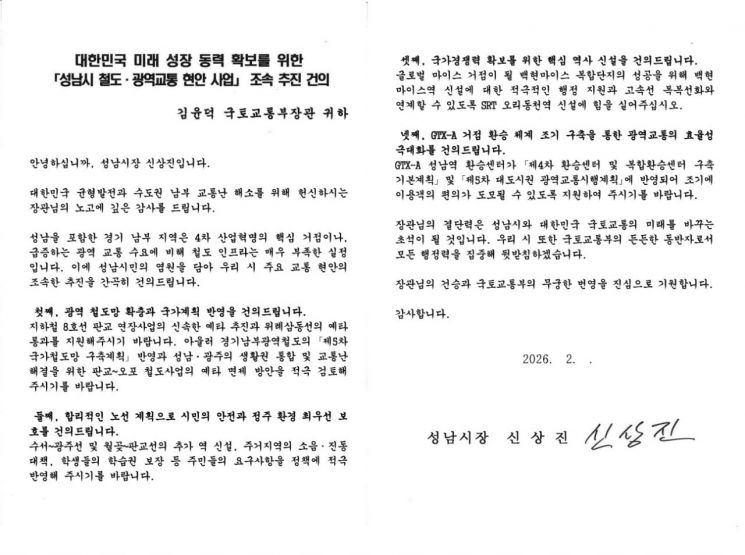 Letter Requesting Prompt Advancement of Seongnam City's Rail and Metropolitan Transportation Projects. Provided by Seongnam City
In the letter signed by Seongnam Mayor Shin Sangjin, the city stressed the need to swiftly move forward on these key issues, stating, "Seongnam is a core hub of the Fourth Industrial Revolution in the Republic of Korea. However, despite the rapidly increasing transportation demand, some areas still lack sufficient rail infrastructure, and the aging of Bundang New Town is an urgent issue that threatens residents' safety."
In particular, the letter identified the abolition of the "annual cap on scheduled redevelopment volumes" related to the Bundang New Town maintenance project as a core task.
The city pointed out that while the government has significantly expanded this year’s redevelopment volume for other first-phase new towns, it has frozen only Bundang, where housing demand is the highest, at "zero increase in volume," which it says is inconsistent with the principle of fairness. It noted that when pilot districts were invited in 2024, applications were filed for approximately 59,000 housing units, about seven times the reference volume at the time, underscoring strong resident demand. Under these circumstances, the city argues that artificially capping the volume risks infringing on property rights and could significantly delay urban renewal over the long term.
In response, the city proposed the following alternatives: the complete abolition of the annual volume cap; flexible management of relocation demand at the project implementation and management/disposition approval stages rather than at the district designation stage; and the introduction of a realistic management system that expands the scope of relocation demand analysis to the wider metropolitan living area.
In addition, the city highlighted the reality that, although Seongnam is a core hub of the Fourth Industrial Revolution, it still lacks sufficient rail infrastructure to handle the rapidly growing metropolitan transportation demand, and it called for active support at the national level.
The city strongly requested an expedited preliminary feasibility study for the extension of Subway Line 8 to Pangyo and the successful completion of the preliminary feasibility study for the Wirye-Samdong Line. In particular, for the Gyeonggi Southern Metropolitan Railway, a key line connecting Seoul’s Gangnam area with southern Gyeonggi Province, the city urged that it be included in and approved as part of the "Fifth National Rail Network Master Plan." It also called for a review of exempting the Pangyo-Opo rail project, which is central to integrating the Seongnam-Gwangju living area, from preliminary feasibility studies.
The city also stressed the need to build new stations to strengthen future urban competitiveness and address transportation blind spots. It proposed the following: establishing the tentatively named Dochon-Yatap Station on the Suseo-Gwangju Line; establishing the tentatively named Baekhyeon MICE Station to invigorate the Baekhyeon MICE Complex; establishing the tentatively named Pangyo-dong Station on the Wolgot-Pangyo Line; and building the SRT Ori-Dongcheon Station along with promoting the quadruple-tracking of the high-speed line.
The city further presented measures to improve convenience for rail users and protect the residential environment. It requested that the transfer center at GTX-A Seongnam Station be included in and implemented early under the "Fifth Metropolitan Area Wide-Area Transportation Implementation Plan," and it called for policies to protect residents’ safety and learning rights, including measures to reduce noise and vibration in residential areas during rail construction.
Mayor Shin Sangjin stated, "The expansion of Seongnam City’s rail network is not merely a local issue, but a task that will enhance the overall efficiency of national land use," adding, "A decisive move by the Ministry of Land, Infrastructure and Transport will be an important turning point that changes Seongnam’s future."
© The Asia Business Daily(www.asiae.co.kr). All rights reserved.

















