Gyeonggi Province Governor Kim Dongyeon has presented a vision for "Gyeonggi-style public housing."
Governor Kim, who began his second on-site tour focused on people's livelihoods and the real economy on the 25th, held the "Gyeonggi-style Public Housing: Gyeonggi All Care Vision Announcement and Town Hall Meeting" at Gyeonggi Unity in Namyangju on this day, where he exchanged views with residents of the province on the topic of public housing.
Governor Kim explained the background of announcing the Gyeonggi-style public housing vision, saying, "Last year, I traveled 3,200 km on the Daldal Bus, visiting Namyangju in August and listening to about 350 suggestions from 31 cities and counties, of which 70% have been resolved," and added, "The theme of today’s Daldal Bus is public housing. As the central government's No. 1 partner in state affairs, Gyeonggi Province is providing the fastest and most proactive support for the government’s measures to stabilize the real estate market."
The three core visions of Gyeonggi-style public housing presented by Governor Kim are: a people-centered approach, serving as hubs for spatial welfare, and providing an affordable housing ladder.
People-centered public housing refers to apartment complexes that go beyond uniform, one-size-fits-all designs and instead feature Gyeonggi Province’s own specialized layouts that combine the latest housing trends with public responsibility. It guarantees the basic right to housing by supplying large-sized units for multi-person households and securing minimum floor space for single-person households. In particular, the minimum floor area for single-person households will be expanded 1.8 times, from 14 square meters to 25 square meters.
Public housing that functions as a "spatial welfare hub" integrating housing, care, health, and leisure embodies the intent to make Gyeonggi’s public housing the spatial foundation for the central government’s "integrated care" policy.
The very case in which integrated care has been realized through public housing is "Gyeonggi Unity," the venue of the event held on this day. Gyeonggi Unity is a community space for intergenerational integration created in December last year within the Gyeonggi Happy Housing complex at Dasanjigeum A5 in Namyangju. It serves as a regional hub designed so that everyone from infants to the elderly can enjoy care, health, and leisure together in a single building. In the unused spaces of public housing owned by Gyeonggi Housing and Urban Development Corporation (GH), private organizations with professional expertise operate services such as childcare, play and activity spaces, health classes for older adults, and leisure and exercise facilities.
Public housing that provides an affordable housing ladder focuses on reducing the burden of home purchase through measures such as the Gyeonggi-style Installment Savings Housing.
The Gyeonggi-style Installment Savings Housing is a new model of public pre-sale housing in which residents accumulate equity in their homes each month as if paying into an installment savings account, eventually acquiring 100% ownership after 20 to 30 years. Its key feature is that the sale price is paid in installments over a long period, greatly reducing the initial financial burden.
The nation’s first Installment Savings Housing project is underway in Gwanggyo, Suwon, with a target move-in date in the first half of 2029.
Gyeonggi Province plans to review the policy effectiveness of this project and then supply it to the third-generation new towns in which GH participates, as well as to Gyeonggi Opportunity Towns.
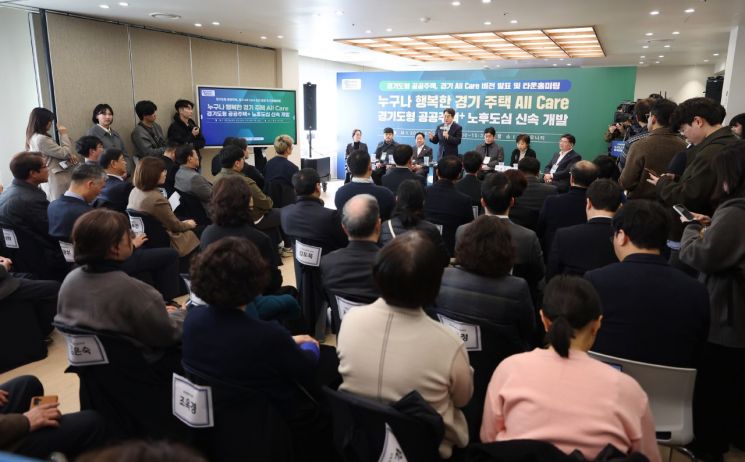 Kim Dongyeon, Governor of Gyeonggi Province, opened the "Gyeonggi-style public housing, Gyeonggi All Care vision announcement and town hall meeting" at Gyeonggi Unity in Namyangju on the 25th and is discussing public housing with residents. Provided by Gyeonggi Province.
More specifically, in addition to continuously supplying Gyeonggi-style Installment Savings Housing for young people and newlyweds, the province plans to provide customized public housing that responds to local characteristics and demand, including senior-friendly housing, youth-focused housing, and housing linked to employment opportunities.
Governor Kim emphasized, "This year, Gyeonggi Province is paying close attention to reducing living expenses for our residents. The major components of living cost reduction are housing, transportation, and care," and continued, "We will set a good example by implementing new approaches to both pre-sale and rental housing in the directions I have just described, taking on initiatives that other local governments have not tried, starting here in Gyeonggi Province."
He added, "We will not only establish a new direction for housing for residents of Gyeonggi Province, but also work together in the hope that the central government’s housing stabilization measures will achieve great success."
On this day, in line with the central government’s policy direction of expanding housing supply in urban centers, Gyeonggi Province also announced the "Gyeonggi All Care" plan to accelerate redevelopment projects in aging new towns and old downtown areas.
Gyeonggi All Care is a measure designed to improve the prolonged project timelines (currently averaging 10 to 15 years) and weakened project momentum caused by complex administrative procedures and conflicts among stakeholders in redevelopment projects for aging planned cities, including first-generation new towns, and old downtown areas.
At the basic planning stage, which is the early phase of a project, the province aims to shorten the required time by 80% (from six months to one month) through prior consultations with the Gyeonggi Provincial Urban Planning Committee and basic planning consulting. At the special maintenance planning stage, it plans to reduce the time required by 60% (from 30 months to 12 months) through public-private consultative bodies and consulting on the redevelopment of multi-family housing. The core of the initiative is to establish a support system that covers the entire project cycle, from the formulation of the basic redevelopment plan to completion.
© The Asia Business Daily(www.asiae.co.kr). All rights reserved.

















