Visa Easing and Expansion of Local Airports
Regional Tourism Transformation with Tailored Strategies for China and Japan
The government is moving to transform the overall structure of the tourism industry in order to bring forward the era of 30 million inbound tourists. With the expansion of demand for visiting Korea and the revitalization of regional tourism as its two main pillars, it plans to drive sweeping innovation ranging from improvements to immigration procedures and the development of regional airports, to overhauling the accommodation system and expanding high value-added tourism content.
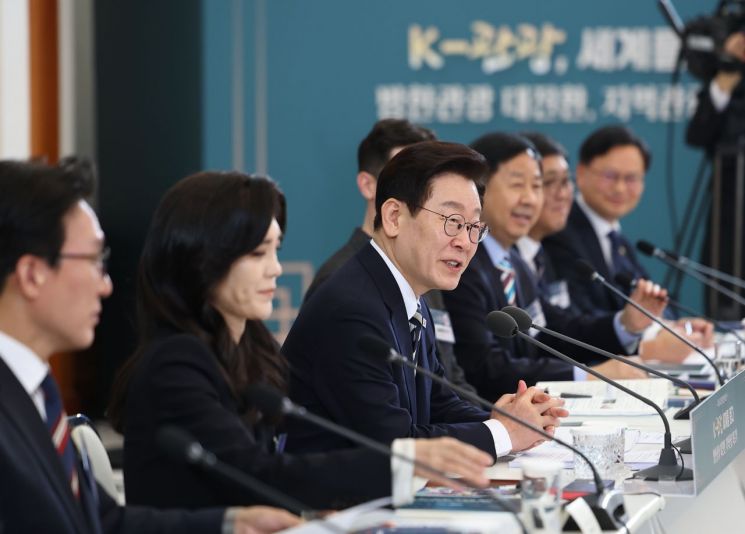 President Lee Jaemyung is speaking at the Expanded National Tourism Strategy Meeting held at the Blue House on the 25th. Yonhap News
The 11th National Tourism Strategy Meeting, held on the 25th, was attended by President Lee Jaemyung, Prime Minister Kim Minseok, ministers and vice ministers from relevant ministries, as well as representatives from the tourism industry, associations and organizations, and private companies. The Ministry of Culture, Sports and Tourism assessed the spread of K-culture and favorable external conditions as a "golden time" for tourism growth, and announced the "Grand Transformation of Tourism to Korea and Great Leap Forward in Regional Tourism Plan," prepared through a pan-government joint effort.
The government first plans to lower the threshold for visiting Korea by improving immigration procedures. It will pursue a pilot introduction of visa-free entry for group tourists of three or more people from Indonesia, and will expand the issuance of five-year multiple-entry visas for nationals of major countries in China and Southeast Asia who have previously visited Korea, as well as 10-year multiple-entry visas for residents of major cities. The automated immigration clearance system will be expanded to major countries including the European Union (EU), and airport waiting times will be reduced by increasing the number of immigration counters.
The strategy to develop regional airports as inbound hubs will also be put into full swing. The government will strengthen supply capacity by expanding direct international routes, reducing airport facility usage fees, and increasing slots at Gimhae Airport and Cheongju Airport. To improve the convenience of domestic travel for passengers arriving at Incheon Airport, it will simultaneously increase domestic flight frequencies, expand late-night bus routes, and extend the advance reservation period for KTX high-speed rail. It will also promote the development of customized tour products linked to regional direct flights and the operation of region-specific promotional ambassadors.
Market-specific customized strategies have also been detailed. For China, the largest source market for visitors to Korea, the government will develop charter tour products that connect third- and fourth-tier cities with regional airports, and will tap new demand in inland Chinese cities with multidimensional products that combine local transportation networks and ferries to Korea. For Japan, it will disperse repeat-visit demand to the regions through marketing of the "30 Selected Small Local Cities in Korea" and by strengthening exchanges among future generations. In addition, the government plans to promote a "Visit Korea Year" campaign between 2027 and 2029 through a public-private partnership.
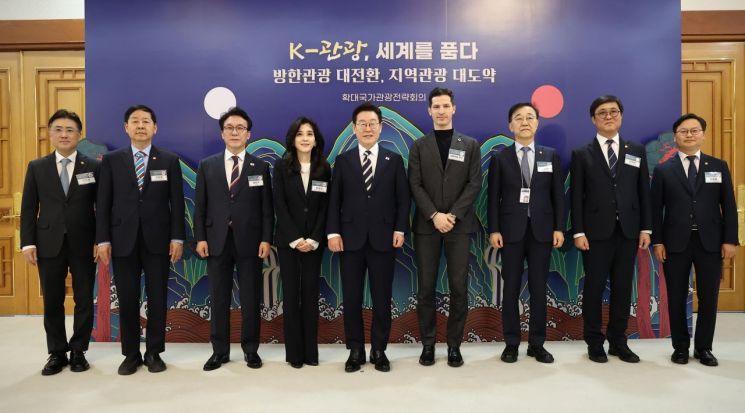 President Lee Jaemyung is posing for a commemorative photo with participants at the expanded National Tourism Strategy Meeting held at Cheong Wa Dae on the 25th. Yonhap News
Measures to improve readiness for cruise tourism are also included. The government plans to increase the length of regional stays by introducing expedited screening for cruises with multiple port calls, expanding on-board immigration inspections for large vessels, reviewing the construction of a new cruise terminal at Busan North Port, and piloting 24-hour operations.
Accommodation policy will be reorganized from a tourism-accommodation-centered system into one that also encompasses general and residential accommodations. The government will induce the supply of high-quality lodging by introducing a quality certification system, expanding loans for new hotel construction and renovation, adjusting traffic generation coefficients, and easing regulations on hotels near universities. It will also strategically foster high value-added tourism sectors with high per-capita spending, such as medical tourism and meetings, incentives, conferences, and exhibitions (MICE).
Measures to eradicate overcharging and restore trust in the tourism market will proceed in parallel. These include strengthening sanctions on businesses that fail to display prices or do not comply with displayed prices, introducing a prior voluntary price-reporting system for accommodation businesses, regulating reservation cancellations and unfair fares, excluding violating businesses from government support programs, and providing incentives.
Through these measures, the government plans to shift the tourism structure from one centered on the Seoul metropolitan area to one centered on the regions, and to drive a great leap forward in regional tourism by comprehensively innovating immigration procedures, transportation, accommodation, content, and price order.
An official from the Ministry of Culture, Sports and Tourism said, "We will work closely with relevant ministries and local governments to swiftly implement the detailed tasks."
© The Asia Business Daily(www.asiae.co.kr). All rights reserved.


















