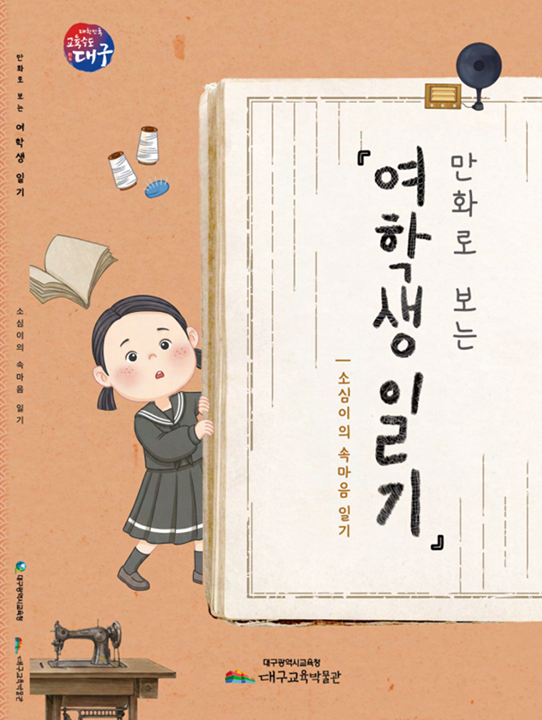
The Daegu Metropolitan Office of Education’s Education Museum, headed by Director Hong Jin-geun, published on the 25th a newly adapted comic-book version of the Korean translation Female Student's Diary, which was first released at the time of the museum’s opening in 2018, so that teenagers can understand it more easily and feel closer to it.
The original diary on which this comic book is based was written over a period of about 11 months in 1937 by a female student attending Daegu Public Girls' High School (the predecessor of today’s Gyeongbuk Girls' High School). It became known to the world after Professor Osamu Ota of Doshisha University in Japan discovered it in a secondhand bookstore in Seoul in 2007.
This material is regarded as a highly concrete and empirical historical source that shows the reality of education during the Japanese colonial period. The original diary is written entirely in honorific Japanese and was subject to homeroom teacher censorship, vividly testifying to the imperial-subject-making education and the Japanese surveillance system that had deeply penetrated school settings at the time.
The comic version of Female Student's Diary consists of 12 episodes, selected from the original translated text for their high educational and historical significance. It is divided into the “outer diary,” which contains the actual diary entries written in refined language with the teacher’s censorship in mind, and the “inner diary,” which imagines and expresses the protagonist’s inner conflicts. Through this, it provides a multidimensional portrayal of the psychology of students who had to live through the Japanese colonial period.
Through the diary of the protagonist “Sosimi,” readers can naturally sense the reality of the Japanese colonial era. In particular, scenes such as compulsory Shinto shrine worship, the making of comfort packages for Japanese soldiers, and the forced sale of stamps to raise funds for fighter plane production clearly show the historical circumstances in which students lived at the time. At the same time, the work depicts ordinary aspects of life that are no different from those of today’s teenagers, such as worries about grades, concerns about future paths, and school trips, allowing readers to familiarly experience the everyday lives of students of that era, which history has not fully recorded.
In addition, two animated videos linked to the comic book have been produced to enhance visual immersion. Through the production of this comic book and animations, the Daegu Education Museum hopes that teenagers will develop an interest in history through the familiar medium of comics and gain educational benefits that connect with their curriculum studies as well.
Starting on the 27th, the Daegu Education Museum plans to distribute the Female Student's Diary comic book to the first 50 people on a first-come, first-served basis. The comic book will also be available on the Daegu Education Museum website, and the animations can be viewed at any time through the Daegu Education Museum YouTube channel.
Director Hong Jin-geun said, “Going forward, the Daegu Education Museum will continue to plan diverse content that reinterprets our collections with high historical and educational value in ways tailored to teenagers, thereby broadening the base of history education.”
© The Asia Business Daily(www.asiae.co.kr). All rights reserved.

![Clutching a Stolen Dior Bag, Saying "I Hate Being Poor but Real"... The Grotesque Con of a "Human Knockoff" [Slate]](https://cwcontent.asiae.co.kr/asiaresize/183/2026021902243444107_1771435474.jpg)















