1.8-Fold Improvement in SOT Efficiency with β-W-Ti Alloy-Based Devices...Patent Applications Filed in Korea, the United States, Japan, and the EU
A next-generation spin memory material and device technology has been developed that operates stably even in extreme environments ranging from -55°C to 150°C, while reducing the drive current to about half of the conventional level. It is being evaluated as an original technology targeting the automotive semiconductor and low-power non-volatile memory markets.
The National Research Foundation of Korea (NRF) announced that a research team led by Professor Kim Younggeun at Korea University has designed a beta-tungsten-titanium (β-W-Ti) alloy-based heterojunction structure and implemented it as a thin-film device, successfully achieving a significant improvement in spin-orbit torque (SOT) drive efficiency.
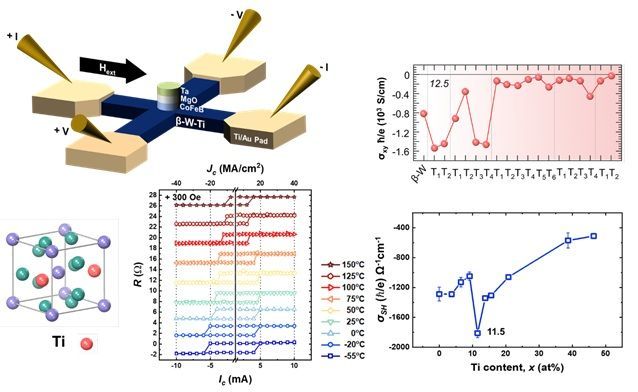 Using theoretical calculations in collaboration with the University of Ulsan, the optimal composition of titanium (Ti) was determined, and beta-W-Ti/CoFeB/MgO thin-film devices were fabricated to verify improved spin-orbit torque efficiency and reduced critical current. Stable operation was also confirmed across the entire 55 C to 150 C range. Bottom right: schematic of the beta-W lattice structure with Ti substitution. Image provided and described by Kim Younggeun, Professor at Korea University.
This research was carried out with support from the Core Technology Development Program for National Semiconductor Research Labs, promoted by the Ministry of Science and ICT and the National Research Foundation of Korea. The results were published in February 2025 in Applied Surface Science, an international journal in the field of materials and surface engineering, and a domestic patent was registered on October 21, 2025. Applications have also been filed in the United States, Japan, and Europe to obtain tri-regional patents.
Spintronics is a technology that stores and processes information by utilizing the magnetic property of an electron called "spin" (rotation). Magnetoresistive random-access memory (MRAM) based on this technology is a non-volatile memory that retains data even when the power is turned off, and it enables low-power, high-speed operation, making it a strong candidate for next-generation memory.
In particular, SOT-based MRAM offers higher speed and better power efficiency than the conventional spin-transfer torque (STT) approach. However, to apply it to automotive semiconductors, there has been a challenge to ensure stable operation with low current over a wide temperature range. The key to the device is the "spin current generation material," which efficiently converts charge current into spin current.
The research team focused on the fact that conventional β-tungsten materials exhibit crystal structure and property changes that are highly sensitive to process conditions, and that their reliability under extreme temperatures has not been sufficiently verified. To address this, they designed a β-W-Ti alloy by adding a small amount of titanium to β-tungsten.
After determining the optimal composition through theoretical calculations and fabricating actual thin-film devices for experiments, the team achieved a damping-like spin-orbit torque efficiency of 0.54 at a titanium composition of about 11.5%. This represents an improvement of about 1.8 times compared with conventional β-tungsten. The critical current density required to reverse the magnetization direction was also reduced to about half, demonstrating that the memory can be driven with significantly lower power.
The research team confirmed stable switching operation across the entire temperature range from -55°C to 150°C and the devices also passed repeated operation tests. They explained that the devices meet the reliability requirements demanded for automotive semiconductors.
Professor Kim Younggeun of Korea University said, "It is meaningful that we optimized the spin current generation material at the alloy design stage, thereby achieving both low-power operation and stability under extreme temperatures," adding, "This will provide an important foundation for realizing high-reliability next-generation memory, including for automotive semiconductors."
© The Asia Business Daily(www.asiae.co.kr). All rights reserved.

















