National Assembly special committee adjourns after holding only a public hearing the previous day
Business community urges that "reducing uncertainty" be the top priority
Some in academia call for "ensuring strategic flexibility"
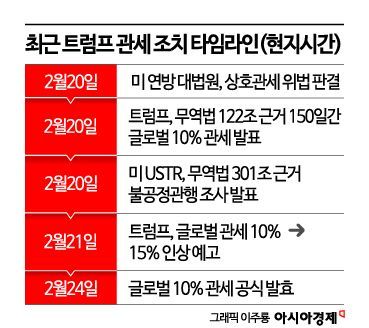
As volatility in the global trade environment increases following the U.S. Supreme Court ruling that reciprocal tariffs are illegal, domestic debate is intensifying over the legislative direction of the Special Act on Investment in the United States, which is being promoted as a countermeasure. The business community is calling for swift legislation to reduce uncertainty and to strengthen Korea's negotiating power with the United States, while some in academia are arguing for a strategy of cautious deliberation in line with the rapidly changing situation.
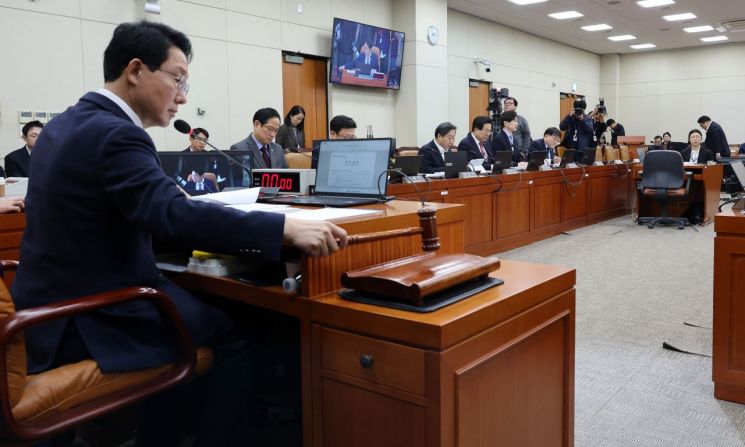 Kim Sanghun, chairman, is striking the gavel at the plenary meeting of the special committee to pass the Special Act on Investment in the U.S., held at the National Assembly on the 24th. Photo by Yonhap News
According to the National Assembly on the 25th, the second plenary meeting of the "Special Committee for the Passage of the Special Act on Investment in the United States" (Special Committee on U.S. Investment), held the previous day, fell into disarray due to clashes between the ruling and opposition parties over judicial reform bills. The committee had originally planned to introduce nine Special Act on Investment in the United States bills proposed by the ruling and opposition parties, form a bill review subcommittee, and begin full-scale deliberations from the 25th. However, the meeting was adjourned after only holding a public hearing with trade and commerce experts.
The business community urged legislative measures to reduce uncertainty. Kim Changbeom, Executive Vice Chairman of the Federation of Korean Industries, said at a business breakfast meeting hosted by the People Power Party the previous day, "It feels like we are in a thick fog," adding, "It is important to move forward promptly with what can be done and send a signal to the U.S. side."
Hyundai Motor President Sung Kim said, "The automobile industry alone paid 7.2 trillion won in tariffs last year," and stressed, "Since we do not know when tariff hikes by product category will take place, swift deliberation on the bills is necessary."
An official from the business community said, "Even just in terms of enhancing Korea-U.S. cooperation and reducing uncertainty, we hope the bills will be handled as soon as possible."
Industry and academia also expressed differing views on the speed of legislation. Heo Jung, a professor in the Department of Economics at Sogang University, argued at the public hearing for swift passage, saying, "Follow-up legislation is needed to protect industries linked to investment in the United States." In contrast, Kim Yanghee, a professor in the Department of Economics, Finance and Trade at Daegu University, urged caution, saying, "If the National Assembly ratifies memoranda of understanding related to investment in the United States, it may become difficult to respond flexibly to future changes in circumstances."
However, many experts agreed that the National Assembly must play a role in maintaining the current level of existing agreements between Korea and the United States and in reducing uncertainty. Jung Chul, President of the Korea Economic Research Institute, said, "At a time when the public and private sectors need to form a one-team response strategy, we must consider whether delays in the bills are in the national interest," adding, "In relations with the United States, it is important to show that we are implementing what has been agreed upon."
Kim Taehwang, a professor in the Department of International Trade at Myongji University, also said, "The National Assembly should establish an institutional foundation so that the level of what has already been agreed does not deteriorate," and mentioned the need to discuss amendments to the Telecommunications Business Act and bills related to online platforms.
Shin Wonkyu, Senior Research Fellow at the Korea Economic Research Institute, assessed that "after the ruling, there is a high likelihood that the Trump tariff policy will shift to a model that focuses on top surplus items in Korea's trade with the United States and concentrates on specific countries and industries with large spillover effects."
He went on to say, "At this point, it is urgent to enhance the negotiating power of Korean companies through swift legislative support under the single objective of the national interest," adding, "By clearly conveying messages about the implementation of investment in the United States in areas such as shipbuilding and nuclear power (energy), reaffirming that Korea is a 'reliable partner in U.S. economic security' could help us avoid becoming a target of Trump tariffs and overcome the current complex crisis."
© The Asia Business Daily(www.asiae.co.kr). All rights reserved.

![Clutching a Stolen Dior Bag, Saying "I Hate Being Poor but Real"... The Grotesque Con of a "Human Knockoff" [Slate]](https://cwcontent.asiae.co.kr/asiaresize/183/2026021902243444107_1771435474.jpg)
















