AI-Based Wind Power Generation Forecasting Model
Achieving 92% Forecast Accuracy in Jeju
Analyzing Performance Deviations by Turbine
LS ELECTRIC has succeeded in developing a technology that predicts renewable energy generation based on artificial intelligence (AI).
On the 25th, LS Electric announced that it has developed an "AI-based wind power generation forecasting model" and recently completed its demonstration. Among renewable energy sources, wind power is an area where generation output fluctuates significantly depending on weather variables, making accurate forecasting difficult.
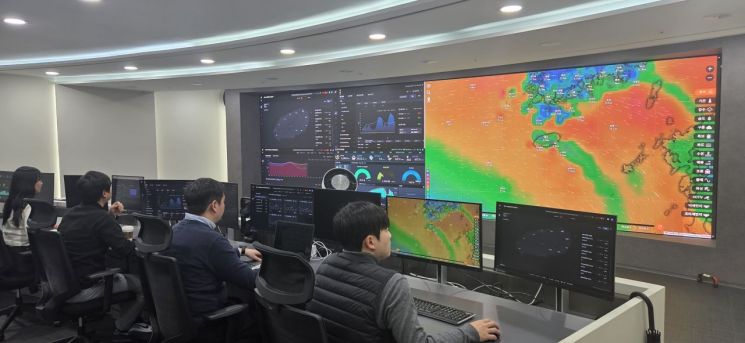 LS Electric officials are checking renewable energy generation forecast results at the control center located in the Anyang R&D Center. LS Electric
When this technology was applied to a wind farm in Jeju at the end of last year, it achieved a forecasting accuracy of about 92% even in November, when weather volatility is high. This reduced the typical forecasting error rate from around 10% to 8%. This level of accuracy qualifies power generation operators to receive incentives under the Korea Power Exchange's "Renewable Energy Generation Forecasting System."
LS Electric succeeded in precisely forecasting changes in wind power output through a "dual forecasting structure" that uses machine learning and deep learning algorithms to integrate and analyze: (1) extensive weather information and regional characteristics such as terrain, altitude, and slope, and (2) performance deviations for each turbine caused by subtle differences in individual turbine characteristics.
Based on this technology, LS Electric plans to accelerate its entry into power brokerage businesses such as "virtual power plants (VPP)."
A VPP is a system that uses digital technology to integrate and operate various physically dispersed renewable energy sources as if they were a single power plant. It predicts the generation output of distributed resources based on AI and optimizes supply strategies, thereby offsetting the volatility of renewable energy.
The advancement of AI-based technologies that improve the accuracy of generation forecasting has recently become essential in the power brokerage business. This is because renewable energy operators can obtain additional compensation when their forecasting error rates are low.
When renewable energy operators participate in a VPP, they forecast solar and wind power generation one day in advance under the "Renewable Energy Generation Forecasting System." If the error rate between the forecast and the actual generation the following day meets the reference threshold, they receive settlement payments.
An LS Electric official said, "We expect a triple benefit from our more advanced wind power generation forecasting technology: resolving the intermittency issues of renewable energy, contributing to the stabilization and efficiency of the domestic power grid, and maximizing the profitability of renewable energy power generation operators. Ahead of the implementation of the onshore renewable energy bidding system, we will accelerate our VPP business by providing renewable energy operators with highly accurate forecasting technologies and innovative solutions that are essential for them."
© The Asia Business Daily(www.asiae.co.kr). All rights reserved.
![Clutching a Stolen Dior Bag, Saying "I Hate Being Poor but Real"... The Grotesque Con of a "Human Knockoff" [Slate]](https://cwcontent.asiae.co.kr/asiaresize/183/2026021902243444107_1771435474.jpg)
















