Lisa Cook: "Growth can remain solid even if AI raises unemployment"
Need for non-monetary policies in education and labor
Waller: "AI is controllable"
Federal Reserve (Fed) Board members have expressed differing views on the impact that artificial intelligence (AI) will have on the economy. Some expect a phase in which productivity gains from AI drive economic growth while the unemployment rate rises at the same time, and they project that it will be difficult to address unemployment with conventional monetary policy. Others counter that AI’s impact on employment may be smaller than many fear.
"Even if AI-driven productivity gains raise unemployment, growth can be sustained"
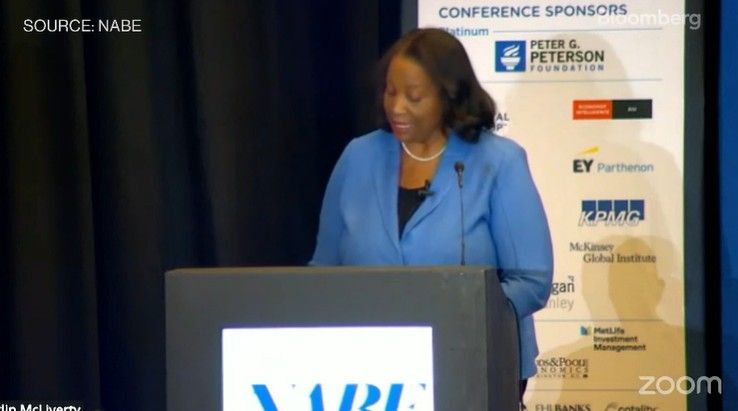
Governor Lisa Cook said in a speech at the National Association for Business Economics (NABE) annual meeting in Washington, D.C., on the 24th (local time), "If AI continues to boost productivity, economic growth can remain strong even if the unemployment rate rises." She added, "In such periods of productivity booms, a higher unemployment rate may not necessarily signal an economic downturn," and observed, "It may be difficult to alleviate AI-induced unemployment with standard demand-side monetary policy tools."
Typically, when the unemployment rate rises, household income falls and aggregate demand declines, leading to a recession. In such cases, central banks have cut policy rates to stimulate demand and support employment. However, if AI becomes the main driver of production, this formula may no longer hold. Governor Cook instead explained that non-monetary tools, such as education policy and labor market policy, may be better suited to addressing the problem.
Governor Cook also drew a line, saying that the rise in unemployment associated with AI adoption is not yet at a level of serious concern. "In recent years, the unemployment rate among new college graduates has increased," she said, "but the overall unemployment rate remains low at 4.3%, and recent layoff figures are still subdued."
Earlier, U.S. nonfarm payrolls for January were reported to have increased by 130,000 from the previous month, far exceeding the market consensus of 66,000. The unemployment rate also fell to 4.3%, down from 4.4% in the previous month.
Fed Governor Christopher Waller: "Concerns about AI and employment are overblown"
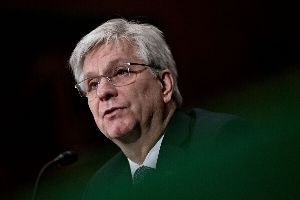
On the same day, Fed Governor Christopher Waller addressed concerns about employment related to AI adoption, calling them "exaggerated."
Speaking via video at a Boston Fed conference discussion, Governor Waller said, "I do not think humans will become completely irrelevant, with AI doing everything and leaving us all to work at McDonald’s drive-thru windows."
Governor Waller acknowledged that AI will shock certain industries, but added, "That does not mean life will get worse and that people will not be able to find jobs doing other kinds of work."
Regarding AI’s impact on the labor market, he expressed optimism: "In the end, people will figure out how to use this tool to make our lives better, more productive, and more efficient, and we will also have more time to do other things."
© The Asia Business Daily(www.asiae.co.kr). All rights reserved.
![Clutching a Stolen Dior Bag, Saying "I Hate Being Poor but Real"... The Grotesque Con of a "Human Knockoff" [Slate]](https://cwcontent.asiae.co.kr/asiaresize/183/2026021902243444107_1771435474.jpg)

















