AI-Based Counseling for Workers Unable to Return to Their Original Workplace
The government is pushing ahead with an integrated program that provides one-on-one support throughout the entire process of treatment, rehabilitation, and return to work for workers who have suffered industrial accidents. The aim is to manage the full cycle, from the early stage of medical care to returning to the original workplace and maintaining employment after the return, in order to reduce employment instability and long-term absence following industrial accidents.
The Ministry of Employment and Labor, the Ministry of Strategy and Budget, and the Korea Workers' Compensation and Welfare Service announced on the 25th that they will fully implement the "Total Care for Vocational Return" project from this year to help injured workers return stably to the labor market. This project goes beyond simple treatment- and compensation-centered support, and is an integrated program that provides customized, step-by-step services by comprehensively considering each individual’s health condition and job characteristics, ranging from psychological counseling, establishing a vocational return plan, and strengthening job competencies to support for returning to the original workplace and re-employment, and post-management.
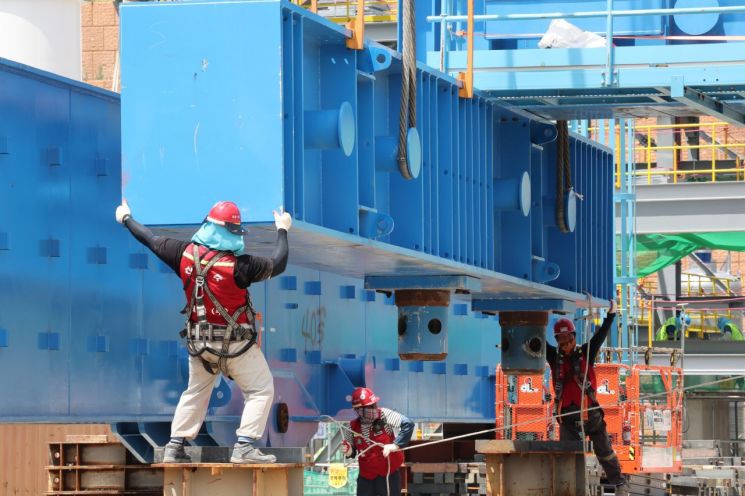 On July 3, 2025, workers were working at the S-Oil Shahin Project construction site in Onsan-eup, Ulju-gun, Ulsan. Yonhap News.
In the first stage of the program, immediately after approval of an industrial accident case, workers are given information on the industrial accident compensation system and possible vocational return pathways, along with psychological counseling support. In the second stage, during the treatment process, the program provides consulting for employers, supports the establishment of return-to-work plans, and connects workers with specialized rehabilitation treatment. The third stage targets workers who find it difficult to return to their original workplace and provides services such as artificial intelligence (AI)-based suitable job counseling, job placement, and support for resume writing and interviews. In the final fourth stage, the program monitors for three months whether employment is maintained after returning to work and continues to provide re-employment support for those who leave their jobs in the short term.
The support targets include workers with industrial accidents who are expected to have disabilities (a condition in which physical functional impairment remains) and employers at their original workplaces. Private organizations staffed with professionals such as vocational counselors and social workers will deliver the services. Vocational return guides will be responsible for psychological counseling, setting return pathways, and maintaining relationships with employers, while re-employment guides will focus on supporting the re-employment process, including vocational training and job placement.
The government stressed that this project is part of a policy to strengthen the state’s responsibility under the industrial accident insurance system. Ryu Hyuncheol, head of the Occupational Safety and Health Headquarters, said, "We will actively support workers injured in industrial accidents so that they can quickly return to their workplaces and resume their daily lives." Acting Minister and Vice Minister Lim Gigeun of the Ministry of Strategy and Budget also stated, "We expect that workers injured in industrial accidents will be able to return in a stable manner without experiencing employment instability or a sense of loss."
© The Asia Business Daily(www.asiae.co.kr). All rights reserved.
![Clutching a Stolen Dior Bag, Saying "I Hate Being Poor but Real"... The Grotesque Con of a "Human Knockoff" [Slate]](https://cwcontent.asiae.co.kr/asiaresize/183/2026021902243444107_1771435474.jpg)
















