JW Pharmaceutical, Olix, Chong Kun Dang Speed Up Clinical Trials
Aiming to Lead the Global Market with Next-Generation Mechanisms
Clinical Efficacy and Insurance Reimbursement Will Be Decisive
Domestic pharmaceutical and biotech companies are successively entering the race to develop next-generation hair loss drugs. In a market where no therapies with new mechanisms of action have emerged for decades, a series of candidate substances that could overcome the limitations of existing treatments are progressing through clinical stages one after another. As discussions on including hair loss drugs under the national health insurance system have also surfaced, expectations are rising both inside and outside the market.
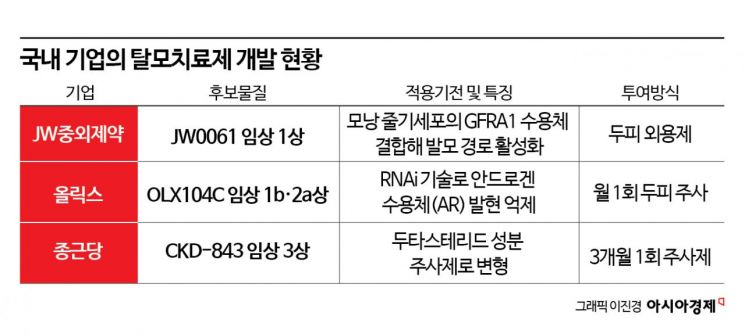
According to the pharmaceutical and biotech industry on February 25, JW Pharmaceutical recently received approval from the Ministry of Food and Drug Safety for a phase 1 clinical trial plan (IND) for its hair loss treatment candidate "JW0061." JW0061 is a first-in-class innovative drug candidate that directly binds to the GFRA1 receptor of hair follicle stem cells to induce hair growth. Because it activates a hair-growth pathway different from existing therapies, it is being developed as a topical formulation that can be used by both men and women. Seoul National University Hospital will soon begin the phase 1 clinical trial.
Olix recently completed the first patient dosing in the Australian phase 1b/2a trial of its RNA interference (RNAi) technology-based hair loss treatment candidate "OLX104C." OLX104C works by inhibiting the expression of androgen receptors (AR) that cause hair loss. Unlike existing finasteride and dutasteride, which suppress the production of male hormones, this mechanism is assessed as being able to avoid side effects such as decreased sexual function and depression at the mechanistic level. Administered locally to the scalp once every four weeks, it also reduces the inconvenience of daily oral dosing. The company plans to complete the phase 1b trial by 2026 and the phase 2a trial by 2027.
Development of improved drugs that dramatically enhance the convenience of existing medications is also gaining speed. Chong Kun Dang is in phase 3 clinical trials for "CKD-843," a reformulated injectable version of dutasteride. It is expected to deliver an effect equivalent to existing oral medications with just one injection every three months. The goal is to reduce the burden of frequent dosing and minimize systemic side effects.
The reason the industry is putting so much effort into developing new hair loss drugs lies in the market's steep growth potential. According to global market research firm Grand View Research, the global hair loss treatment market is projected to grow to 16 billion dollars (about 23 trillion won) by 2030. The only male-pattern hair loss drugs approved by the U.S. Food and Drug Administration (FDA) are minoxidil, approved in 1988, and finasteride, approved in 1997. Since there have effectively been no therapies with new mechanisms of action, many expect that the first movers will enjoy substantial market preemption effects.
Discussions on applying national health insurance coverage to hair loss treatments have also emerged as a variable. President Lee Jaemyung previously gave direct instructions to review the application of health insurance coverage for hair loss drugs during a Ministry of Health and Welfare work briefing. However, at a senior presidential aides' meeting on February 12, he called for further discussion by designating the coverage of hair loss treatments as a subject for public debate, effectively moving to adjust the pace. As the government must overcome issues such as fiscal burden and priority-setting, it is expected to take time before policy details take shape. Nevertheless, if insurance coverage is concretely implemented, the industry anticipates a significant increase in patient inflow and a corresponding rise in pharmaceutical companies' profitability.
The key will be the clinical results. Candidate substances that tout new mechanisms must prove both efficacy and safety in order to reshape the market landscape. Observers point out that, in a market dominated by low-priced generic drugs, there are considerable hurdles for new drugs to clear before they can also secure price competitiveness.
© The Asia Business Daily(www.asiae.co.kr). All rights reserved.
![Clutching a Stolen Dior Bag, Saying "I Hate Being Poor but Real"... The Grotesque Con of a "Human Knockoff" [Slate]](https://cwcontent.asiae.co.kr/asiaresize/183/2026021902243444107_1771435474.jpg)
















