Launch of Integrated Lotte-Hyundai Chemical Corporation Planned
Government to Provide Comprehensive Financial and Tax Support Worth 2.1 Trillion Won
The restructuring of the petrochemical industry has entered full swing. The government has approved Lotte Chemical's suspension of operations at its 1.1 million-ton NCC (naphtha cracking center) as the "Petrochemical Industry Business Restructuring Project No. 1," and is rolling out a support package worth more than 2.1 trillion won, including financial, tax, and cost support. This is the first implementation case since the restructuring roadmap was announced last year.
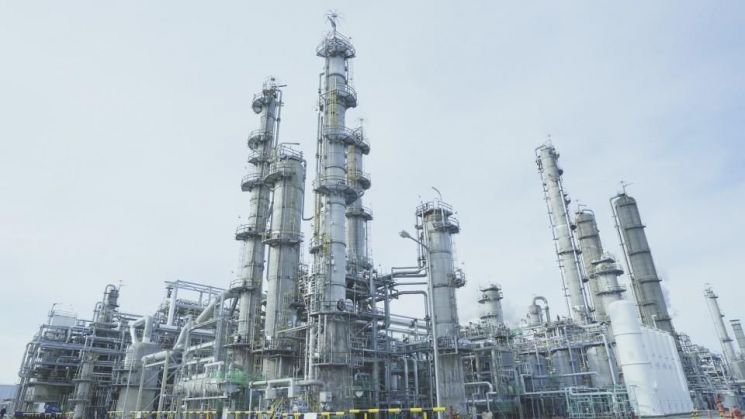
The Ministry of Trade, Industry and Energy announced on the 25th that it approved the final version of the business restructuring plan submitted by HD Hyundai Oilbank, HD Hyundai Chemical, and Lotte Chemical at the Ministers' Meeting on Industrial Competitiveness Enhancement.
According to the business restructuring plan, Lotte Chemical will spin off its Daesan plant and then merge it with Hyundai Chemical to integrate the operation of NCC and downstream facilities. HD Hyundai Oilbank (the largest shareholder of Hyundai Chemical) and Lotte Chemical will inject a total of 1.2 trillion won (600 billion won each) in new capital into the newly integrated company. As a result, the shareholding structure will be adjusted from the current 6:4 to 5:5.
The key objective is to resolve oversupply. Lotte Chemical will suspend one NCC unit with an annual capacity of 1.1 million tons and will also gradually reduce overlapping and loss-making downstream facilities focused on commodity products. Through this, the companies aim to ease the ethylene oversupply within the Daesan Industrial Complex and raise the operating rate of the remaining facilities to improve efficiency.
The government, together with relevant agencies, has prepared comprehensive support measures covering finance, taxation, permits, cost structure, local economy and employment, and technology development. In the financial sector, support of up to 2 trillion won will be pursued. Creditor financial institutions will provide up to 1 trillion won in new funding and convert up to 1 trillion won of existing loans into perpetual bonds to improve financial soundness. Korea Development Bank will finalize specific support measures in consultation with creditor financial institutions.
On the tax side, the government will ease local tax burdens arising from the spin-off, merger, and asset acquisition processes. It will reduce acquisition tax and registration license tax by 75% to 100% and lower the overall tax burden by extending the deferral period for corporate tax on asset sales (from a 4-year grace period with 3-year installment payments to a 5-year grace period with 5-year installment payments). The measures also include applying accelerated depreciation and expanding the limit on deductions for tax loss carryforwards.
Support for improving the cost structure will range from 69 billion won to 115 billion won. By utilizing the Distributed Energy Special Zone system, electricity rates that are 4% to 5% lower than Korea Electric Power Corporation tariffs will be applied, and regulations prohibiting overlapping steam supply will be eased to expand access to cheaper sources. These measures will be accompanied by expanding the scope of direct-import LNG for fuel use, extending the zero-tariff (0%) period on crude oil and naphtha, and broadening the application of quota tariffs on crude oil used for naphtha production.
In terms of permits and approvals, the government will shorten the period for merger review from 120 days to 90 days and minimize the risk of plant shutdowns by allowing the succession of permits obtained prior to the restructuring and simplifying related procedures.
The company will shift its portfolio away from a structure centered on commodity products toward a focus on high value-added and eco-friendly products. It will expand production of high-elasticity lightweight materials for power cables and communication cables and organic solvents for secondary battery electrolytes, promote the production of eco-friendly products using bio-naphtha, and push for the introduction of ethane feedstock that can reduce carbon emissions by up to 50%.
Technology development support will also be fully launched. Starting this year, a total of 26 billion won will be invested in two projects, and in the mid- to long term, the government will promote large-scale R&D in areas such as advanced material development, AI-based material design, process innovation, and transition to bio-based feedstocks.
The government expects that, through integrated operation and self-help efforts, operating profit, which recorded a loss in 2025, will return to the black after the three-year restructuring period, and that the debt ratio will also improve significantly.
The Ministry of Trade, Industry and Energy plans to use this approval as a starting point to accelerate follow-up projects. It will help companies supplement the restructuring plans they submitted last December so they can file final versions, and will swiftly establish the institutional foundation by promptly enacting the enforcement decree of the special act.
Minister of Trade, Industry and Energy Kim Jeong-gwan said, "The Daesan Project No. 1 is the first achievement derived from close cooperation between the government and industry," adding, "We will accelerate restructuring by promptly moving forward with follow-up projects as well."
© The Asia Business Daily(www.asiae.co.kr). All rights reserved.
![Clutching a Stolen Dior Bag, Saying "I Hate Being Poor but Real"... The Grotesque Con of a "Human Knockoff" [Slate]](https://cwcontent.asiae.co.kr/asiaresize/183/2026021902243444107_1771435474.jpg)
















