On the 24th (local time), Ambassador to the United States Kang Kyung-wha stated regarding President Trump's imposition of global tariffs, "While closely monitoring the Trump administration's follow-up measures, I will support efforts to ensure that consultations with the United States proceed in a friendly manner."
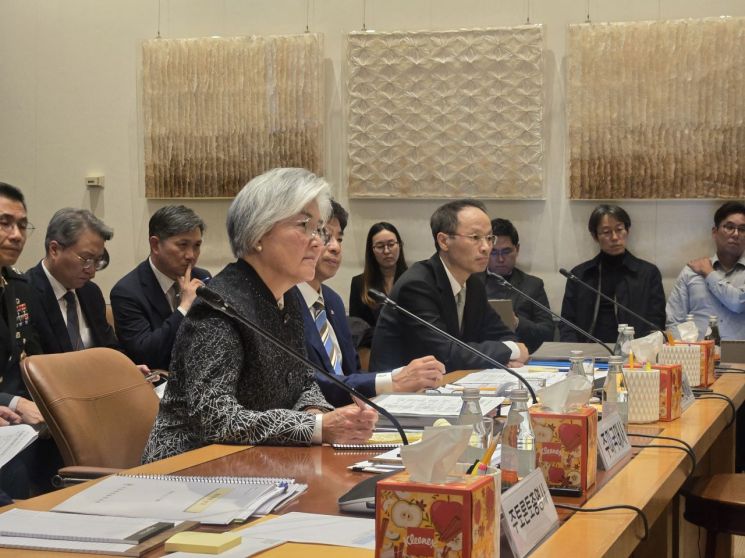
At a meeting with Korean correspondents held at the Korean Cultural Center in Washington, D.C., she said, "With regard to the Supreme Court ruling, our government will respond in the way that best serves our national interest."
On the issue of reciprocal tariff refunds, for which no clear standard was presented in the ruling, she pointed out that "procedural uncertainty still remains." She then stressed, "We will work closely with Korean companies operating in the United States and with business organizations so that accurate information can be delivered to our companies in a timely manner."
President Trump has taken action to impose global tariffs of up to 15% for 150 days based on Section 122 of the Trade Act. At the same time, he has announced that, under Section 301 of the Trade Act and Section 232 of the Trade Expansion Act, he will investigate whether there are 'unfair trade practices' and 'national security threats' and will consider imposing additional tariffs.
Among these, Section 301 of the Trade Act is also the provision cited by investors in Coupang in the United States, who became the subject of an investigation in Korea following a large-scale personal data leak incident, when they requested an investigation from the Office of the United States Trade Representative (USTR). In Washington diplomatic circles, there is no ruling out the possibility that the USTR could launch a Section 301 investigation based on that request.
The Trump administration has publicly stated that, following the Supreme Court ruling, wide-ranging investigations could be conducted targeting major trading partners. In the case of Coupang, some observers note that there is room for the USTR to judge that the matter falls under the 'possibility of discrimination against digital goods and services,' which is a key focus of Section 301 investigations.
The U.S. House Judiciary Committee conducted a closed-door deposition targeting Coupang the previous day. Prior to that, it had requested an explanation from the Korean government regarding this matter. The Korean government is known to have conveyed to the Committee its position on the background of the investigation and the current situation.
However, even if the USTR officially launches a Section 301 investigation in early next month, it must go through a process of hearing the views of the Korean government. Since the initiation of an investigation does not immediately lead to the imposition of tariffs, diplomatic circles are watching the situation carefully.
Separately from the global tariff issue arising from the reciprocal tariff ruling, follow-up measures to the Korea-U.S. investment agreement are also underway concerning the implementation of the bilateral "Joint Fact Sheet." The Korean government’s working-level negotiation team is reported to have returned home after exchanging views with the U.S. side on investment projects last week.
The special bill on investment in the United States, which is pending in the National Assembly, currently faces no major disagreements between the ruling and opposition parties. There are also projections that the first and second Korea-to-U.S. investment projects could be announced immediately after the bill passes.
As for implementation of the security-related agreements included in the Fact Sheet, such as nuclear-powered submarines, nuclear energy enrichment and reprocessing, and cooperation in shipbuilding, the formation of the U.S. negotiating team is being delayed more than expected. The two sides are currently in the stage of coordinating the timing. If necessary, it is known that the Korean negotiating team is also considering a visit to the United States.
Regarding the implementation of the security-related agreements, Ambassador Kang said, "The embassy will faithfully serve as a bridge so that things can move forward with a sense of speed," adding, "We will also actively explain the legislative process of the special bill on investment in the United States to the U.S. side and carefully manage related issues."
Meanwhile, regarding President Trump's planned visit to China in late March to early April, Ambassador Kang said, "As for the possibility of dialogue between North Korea and the United States, we are keeping all possibilities open and closely watching developments." She added, "We are comprehensively taking into account multiple variables, including the Russia-Ukraine war, U.S.-China relations, and North Korea-China relations."
She said, "We are in frequent communication with the U.S. administration, including the White House National Security Council (NSC) and the State Department, sharing information on North Korea's moves and discussing the direction of North Korea policy," and continued, "The United States has consistently stated that there is no change in its policy toward North Korea, and it has said it will communicate closely so that there will be nothing that could come as a surprise to Korea."
However, the possibility that actual contact between North Korea and the United States will take place during President Trump's visit to China is currently not considered high, and no meaningful movement has been detected. The visit to the United States by Jung Yeondu, Director General of the Foreign Strategy and Intelligence Bureau and the government's chief representative on North Korean nuclear issues, is also known not to be directly related to this matter.
Regarding the U.S. initiative to build a "critical minerals trade bloc" in response to China's controls on rare earth exports, the Korean government's position is that it will participate in discussions aimed at a binding agreement, but will determine its final participation with national interest as the top priority.
In particular, a cautious mood is evident with respect to the "price floor" for critical minerals proposed by the United States. This is because, if a price floor is introduced, it could increase cost burdens for domestic industries that consume large volumes of critical minerals, such as semiconductors, batteries, and electric vehicles, and the possibility of Chinese retaliation could also act as a variable.
© The Asia Business Daily(www.asiae.co.kr). All rights reserved.
![Clutching a Stolen Dior Bag, Saying "I Hate Being Poor but Real"... The Grotesque Con of a "Human Knockoff" [Slate]](https://cwcontent.asiae.co.kr/asiaresize/183/2026021902243444107_1771435474.jpg)
















