Yangju City Holds Midterm Briefing on
Preliminary Feasibility Study for GTX-C Yangju Station Stop
GTX-C Yangju Station Stop Records B/C Ratio of 3.98
Strategic Review Needed on Profit Generation and Cost Sharing
for the Integrated
Yangju City in Gyeonggi Province has secured strong momentum for negotiations with central government ministries by deriving the optimal plan that maximizes economic efficiency relative to project costs in the preliminary feasibility study for having a stop at Yangju Station on the GTX-C Line.
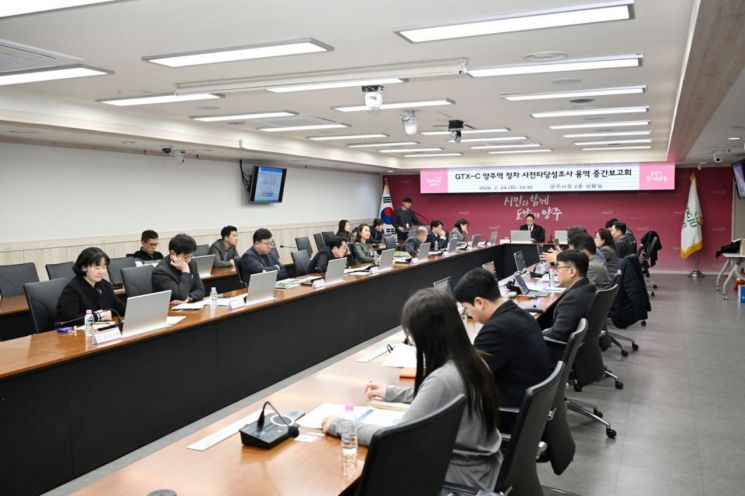 Yangju City held an interim report meeting for the Great Train eXpress Yangju Station Stop Preliminary Feasibility Study in the City Hall Situation Room on the 23rd. Photo by Yangju City
On the 24th, at an interim report meeting for the "Great Train eXpress Yangju Station Stop Preliminary Feasibility Study" held in the City Hall Situation Room, Yangju City announced project alternatives depending on whether the station building would be expanded, along with detailed feasibility analysis results.
The analysis showed that economic viability, measured by alternative, ranged from 2.9 to 3.98, with both options far exceeding the feasibility threshold of 1.0 and thereby demonstrating the justification for the project. In particular, the alternative that expands only the platform without enlarging the station building recorded an overwhelming benefit-cost (B/C) ratio of 3.98 with an efficient project cost of 42.7 billion won, proving it to be a "low-cost, high-efficiency" project.
However, the financial analysis (revenue-cost, R/C ratio of 0.53 to 0.73) indicated that the costs for expanding the station building and securing additional facilities are highly likely to fall on the city under the cost-bearer-pays principle. Accordingly, the city plans to concurrently review practical funding measures.
Through this briefing, the city underscored the justification for having GTX trains stop at Yangju Station. First, Yangju Station is directly connected to Local Route 98 and is expected to serve as a catalyst for balanced regional development, driving growth in western areas such as Baekseok and Gwangjeok. In particular, GTX accessibility for residents in the western area, where 34% of the city’s population lives, and for citizens in Yangju 1-dong and Yangju 2-dong will be greatly improved, providing tangible benefits such as reducing travel time by more than 10 minutes without the inconvenience of transferring at Uijeongbu Station.
In addition, the station area is expected to become a key hub that will drive local economic revitalization in connection with the Yangju Station Area Development and the Yangju Technovalley. Considering the long 12.3 km distance between Uijeongbu Station and Deokjeong Station, the city also made it clear that a stop at Yangju Station is essential from an equity standpoint, similar to the case of Uiwang Station, where a stop has already been confirmed.
An official from Yangju City stated, "A stop at Yangju Station is the key link connecting Yangju Technovalley and the development of the western part of the city," adding, "The B/C ratio of 3.98 will be a powerful bargaining chip that the Ministry of Land, Infrastructure and Transport and private project operators cannot easily reject. We will meticulously prepare financial supplementation measures to minimize the city’s burden while ensuring that we successfully secure the station stop."
Based on the opinions raised at this briefing, the city plans to refine the final report and begin full-fledged negotiations with the Ministry of Land, Infrastructure and Transport and private investors.
© The Asia Business Daily(www.asiae.co.kr). All rights reserved.

















