Advertised ordinary foods as if they were obesity treatments
All 16 products found to have no weight loss effect
Also used AI-generated fake doctor images
Products advertised with phrases such as "drinkable Wegovy" turned out to be ordinary foods that do not actually help with weight loss.
On the 24th, the Korea Consumer Agency announced that it had examined 16 food products on the market that were advertised for dieting, and found that none of them had any weight-loss effect. All 16 products investigated were ordinary foods without any diet effect, such as beverages and processed fruit and vegetable products. Nevertheless, all of these products carried online advertisements that could be mistaken for obesity treatments, using phrases such as "GLP-1 boosting," "drinkable Wegovy," and "Nabi Tablets."
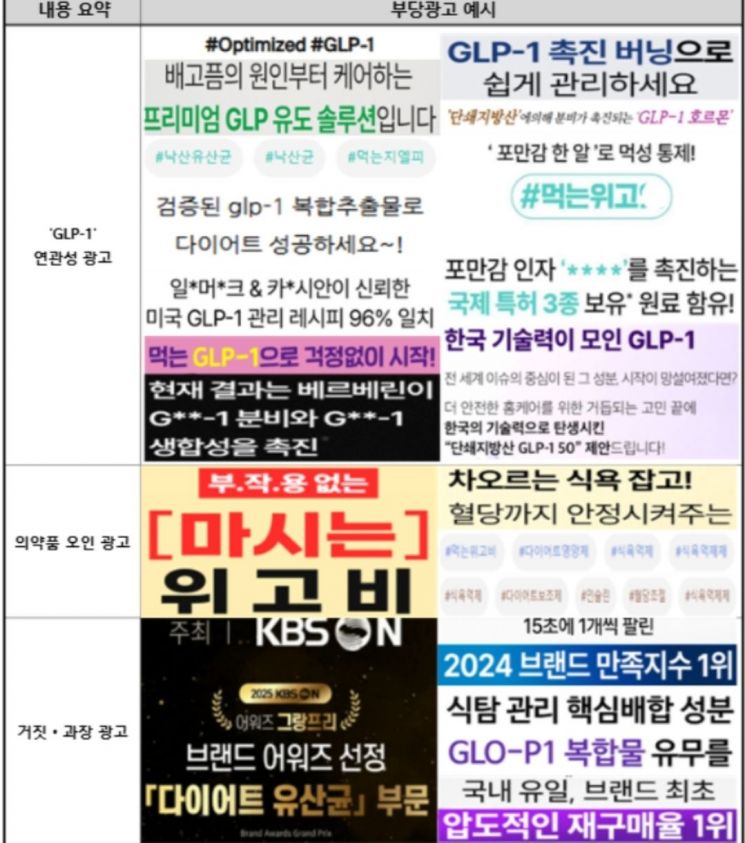
In particular, 14 products, accounting for 88% of the total, were sold in tablet form, raising concerns that consumers might mistake them for pharmaceuticals or health functional foods. Under the Act on Labeling and Advertising of Foods, ordinary foods must be labeled and advertised in a way that does not cause them to be mistaken for pharmaceuticals or health functional foods.
Twelve products were advertised as if they contained pharmaceutical ingredients related to appetite control, but it was found that they did not actually contain GLP-1, diethylpropion, or any other related ingredients. Four products labeled as "prolonged satiety" did contain dietary fibers such as cellulose and glucomannan, but the daily intake amount ranged only from 0.9 g to 3.2 g, which was confirmed to be insufficient to induce a feeling of fullness.
There were also problems involving unfair advertising using artificial intelligence (AI). Five of the products investigated used AI-generated fake doctors or influencer images in their advertisements. These ads included misleading content, such as an AI doctor in a medical gown explaining the product's weight-loss effects. In addition, there were cases where social networking service (SNS) posts were created to lure consumers. The Korea Consumer Agency recommended that the businesses behind the products subject to the investigation suspend sales or correct their unfair advertising.
The Korea Consumer Agency stated, "Although the Basic Act on AI has been enacted, there are still insufficient specific regulations on AI-generated content used in food labeling and advertising," adding that it "plans to ask the Ministry of Food and Drug Safety to prepare measures to manage such manipulated AI content." The agency also urged, "Consumers should be sure to check the list of ingredients and the health functional food certification mark when purchasing foods for weight loss."
© The Asia Business Daily(www.asiae.co.kr). All rights reserved.
![Clutching a Stolen Dior Bag, Saying "I Hate Being Poor but Real"... The Grotesque Con of a "Human Knockoff" [Slate]](https://cwcontent.asiae.co.kr/asiaresize/183/2026021902243444107_1771435474.jpg)
















