"A Patchwork Bill Stripped of Legislative, Fiscal, Organizational, and Regional Planning Powers"
"Administrative consolidation without core powers such as legislative, fiscal, organizational, and regional planning authority is an empty shell that cannot guarantee genuine local self-reliance."
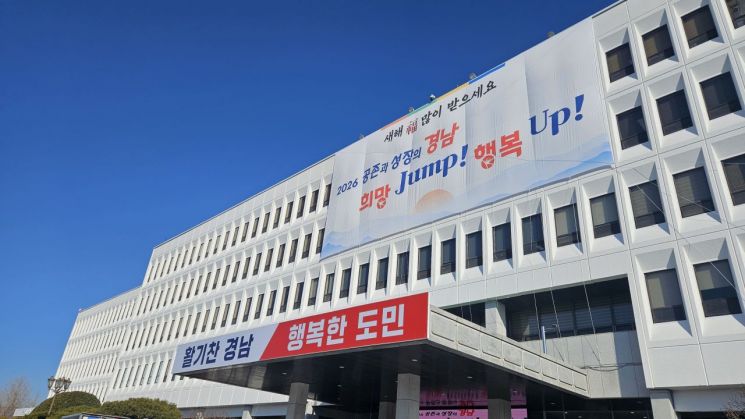
The Gyeongsangnam-do Provincial Government assessed the special administrative consolidation bill currently under discussion in the National Assembly in these terms, and urged the central government and the National Assembly to adopt a more forward-looking stance.
On the 24th, through a statement, the Gyeongsangnam-do Provincial Government criticized that "in the recent deliberations of the National Assembly's Public Administration and Security Committee, key powers stipulated in the special consolidation act have been drastically deleted or reduced to the extent that it calls into question the government's commitment to decentralization and locally led growth."
It went on to point out that the administrative consolidation under the special act as derived from the committee deliberations would result in: ▲only nominal autonomy with local legislative power effectively missing ▲a hollow consolidation with the loss of independent fiscal authority ▲a passive consolidation with organizational operations bound hand and foot ▲a subordinate consolidation with regional planning authority stripped away.
The provincial government stated, "The essence of local decentralization lies in allowing regions to autonomously resolve the issues they face through ordinances they themselves enact," and added, "However, while the special consolidation act formally transfers legislative authority to local ordinances, it shackles that authority by requiring prior consultation with, or consent from, the relevant central government ministers on every important matter."
It also said, "Permanent measures to secure tax revenues, such as transferring portions of national taxes to local taxes, have been deleted, the legal basis for the fiscal incentives promised by the government has not been reflected, and only vague provisions stating that support may be provided remain."
It continued, "Transitioning to a supra-regional administrative system requires flexible and robust organizational management capable of responding to a surge in administrative demand," and expressed concern that "this bill is bound by the outdated constraint of a total personnel cost ceiling, which will prevent the design of creative organizations, make proper staffing and the enhancement of expertise impossible, and reduce the new body to an administrative organization that relies solely on central government guidelines."
It further pointed out, "Decision-making authority over planning, including urban planning, is still blocked by the hurdle of requiring central government consent," and added, "The deletion of provisions exempting large-scale infrastructure projects from preliminary feasibility studies and of the authority to lift development restriction zones is extremely critical."
The Gyeongsangnam-do Provincial Government stressed, "In pursuing administrative consolidation with Busan, speed is important, but we have been preparing step by step since the launch of the 8th popularly elected local administration in order to ensure substance and to reflect the will of city and provincial residents rather than partisan calculations," and added, "The transfer of national taxes to local taxes, exemptions from preliminary feasibility studies, and organizational authority are the minimum conditions for achieving the genuine local autonomy that Gyeongsangnam-do and Busan are aiming for."
It went on, "To break the capital area-centered monocentric structure and achieve balanced development led by the regions, the government must boldly relinquish central authority," and added, "Like the special administrative regions of Hong Kong, Shanghai, and Dubai, we must turn this into an opportunity for the development of the Republic of Korea through the complete transfer of autonomous powers."
The provincial government stated, "In a recent in-house public opinion survey, 75.7% of provincial residents said that consolidation should be decided through a referendum, and 73% of city and provincial residents said they want gradual consolidation after local elections," and added, "We will secure the legitimacy of consolidation by holding a referendum based on a special act that fully reflects the views of city and provincial residents."
It added, "Together with Busan, Gyeongsangnam-do will prepare a substantive draft special consolidation act that includes local legislative authority and independent fiscal authority, and we will concentrate all our capabilities to ensure that the bill passes in its original form so that the special act can become a real cornerstone of decentralization."
© The Asia Business Daily(www.asiae.co.kr). All rights reserved.
![Clutching a Stolen Dior Bag, Saying "I Hate Being Poor but Real"... The Grotesque Con of a "Human Knockoff" [Slate]](https://cwcontent.asiae.co.kr/asiaresize/183/2026021902243444107_1771435474.jpg)
















