153 New Projects Identified
Targeting Sectors such as Energy and AI
Pre-Feasibility Studies, Public Offerings, and System Reforms in Parallel
Ensuring Stable Continuation of the 10 Trillion Won National Funding Era
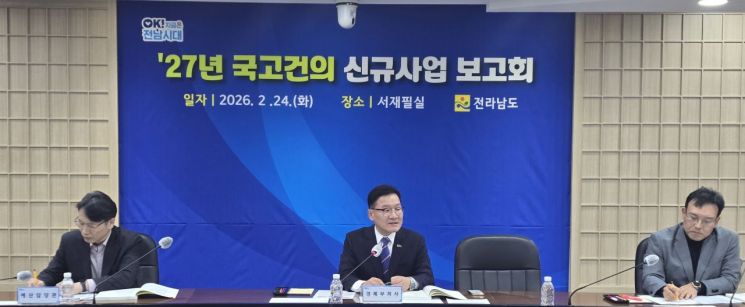
On the 24th, Jeollanam-do held the "2027 New National Budget Proposal Project Briefing" presided over by Vice Governor for Economic Affairs Kang Wiwon, and began full-scale efforts to secure national funding for 153 new projects worth 553.7 billion won in next year's central government budget (with a total project cost of 27.0787 trillion won).
Following its achievement of securing a record-high 10.0042 trillion won in national funding for 2025, Jeollanam-do plans to proactively respond to major pending issues such as new and ongoing projects, preliminary feasibility study (pre-feasibility) target projects, and competitive public offering projects in order to sustain the "10 trillion won national funding era" that will underpin the next 100 years of the province's future.
Through a preliminary briefing on national budget proposal projects held in January, the province supplemented the justification and necessity of the projects, trends at relevant ministries, response logic, and cities and counties' policy vision projects. It also specified budget acquisition strategies for key sectors such as social overhead capital (SOC), future energy, artificial intelligence (AI), semiconductors and advanced strategic industries, and agriculture, fisheries, and livestock, and prepared a balanced growth plan for its 22 cities and counties.
The plan also includes integrated linkage and cooperation projects between Jeollanam-do and Gwangju, and the province will work to secure synergies in preparation for a future integrated launch. Jeollanam-do plans to complete its proposals to central government ministries by May, provide explanations to the Ministry of Economy and Finance from June to August, and respond to the National Assembly from September to November, thereby increasing the reflection rate of its projects in the national budget through a step-by-step strategy.
By sector, new SOC projects include three projects that have been incorporated into national plans and designated as targets for preliminary feasibility studies: the Honam High-Speed Line-Gyeongjeon Line connecting line (total project cost 323 billion won), the Yeosu-Suncheon Expressway (1.9601 trillion won), and the Yeongam-Gwangju Ultra-High-Speed Expressway (2.6 trillion won). In addition, the four-lane expansion of National Route 15 between Goheung and Bongnae (652.1 billion won) is planned to move forward by securing 15 billion won in 2027.
In the field of leading the global energy transition, the projects include: development and demonstration of an energy-efficiency-improving direct-current logistics center platform (total project cost 35.7 billion won, with 4.3 billion won to be reflected in 2027); a next-generation power equipment interoperability test center (20 billion won, 2.5 billion won in 2027); localization development of small offshore wind service operation vessels (SOVs) (49 billion won, 3.5 billion won in 2027); and establishment of a national power K-high-power laser demonstration infrastructure (25 billion won, 1 billion won in 2027).
In the area of advancing as a hub for space aviation and cutting-edge strategic industries, the projects include: development of AI-based safety management technology for the chemical industry (39.2 billion won, 7 billion won in 2027); establishment of an AI autonomous-operation shipyard innovation hub (tentatively 300 billion won, 10 billion won in 2027); construction of a cyclotron plant (100 billion won, 500 million won in 2027); and establishment of national test and evaluation facilities for jamming (radio interference) and anti-jamming for drones and AAM (advanced air mobility) aircraft (14.3 billion won, 1.5 billion won in 2027).
In the agri-fisheries-livestock bioindustry sector, the projects include: establishment of a green bio integrated support system (20 billion won, 4.2 billion won in 2027); creation of an AI advanced livestock convergence valley (tentatively 675.4 billion won, 500 million won in 2027); a demonstration project for establishing an Arctic Ocean route at Yeosu-Gwangyang Port (45 billion won, 5 billion won in 2027); creation of a Korean Gim (K-GIM) export complex (80 billion won, 2.2 billion won in 2027); and creation of a Blue Food Tech smart complex (40 billion won, 1.1 billion won in 2027).
The artificial sun research facility (1.5484 trillion won), the Yeojaman National Marine Ecological Park (169.7 billion won), the Jeolla Line high-speed railway (1.9326 trillion won), and the 6th integrated national highway and national supporting road project package (2.6324 trillion won) are currently undergoing preliminary feasibility studies, while the Heuksan Airport construction project (641.1 billion won) is undergoing a re-assessment of feasibility. The Space Launch Vehicle Science Complex (290 billion won) and the Gwangyang Port-Yulchon Industrial Complex connecting road (345.6 billion won) are projects scheduled to be submitted.
The province also plans to make an all-out effort to be selected for national competitive public offering projects by leveraging Jeollanam-do's comparative advantages in areas such as AI and semiconductors and specialized zones for distributed energy.
Vice Governor Kang Wiwon stated, "As Phase 2 of the Honam High-Speed Railway is scheduled for completion in 2027 and construction on National Route 77 is slated for completion in 2028, I ask that we pool our efforts to identify large-scale substitute SOC projects and ensure early approval of projects subject to preliminary feasibility studies," adding, "We will also pursue institutional improvements such as permanent preservation of projects transferred through decentralization and raising the ceiling on the portion of the Regional Balanced Development Special Account allocated to local governments, and we must ensure that projects that residents can truly feel are reflected in a balanced manner."
© The Asia Business Daily(www.asiae.co.kr). All rights reserved.
![Clutching a Stolen Dior Bag, Saying "I Hate Being Poor but Real"... The Grotesque Con of a "Human Knockoff" [Slate]](https://cwcontent.asiae.co.kr/asiaresize/183/2026021902243444107_1771435474.jpg)
















