The opening of the mega-sized mixed-use shopping mall 'The Hyundai Gwangju' is expected to be delayed by more than one year from the original plan. As the project schedule has been adjusted, the target completion date has also been changed.
According to Gwangju City and others on February 24, the project operator of The Hyundai Gwangju received a construction commencement report certificate from Buk-gu on January 22 and has begun foundation work. This comes about two months after the groundbreaking ceremony held in November 2025. The target completion date stated in the construction commencement report is May 2029.
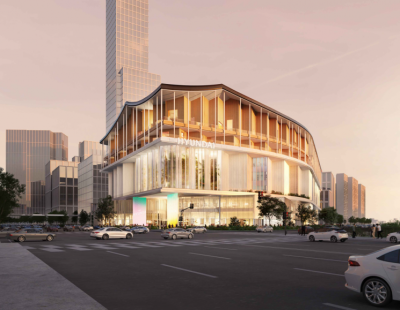
Previously, Gwangju City and Hyundai Department Store had presented a roadmap targeting construction commencement in October 2025, completion by the end of 2027, and opening in the first half of 2028. However, delays in the selection of the construction company and in the construction commencement schedule led to an overall adjustment of the timeline. Accordingly, there are now expectations that the opening, originally planned for 2028, may be pushed back to 2029.
With the construction period extended, the expected total construction cost is also forecast to increase. It is now being discussed at around 1.5 trillion won, up from the previous level in the 1.2 trillion won range.
The Hyundai Gwangju is planned as a mixed cultural complex to be built on the former Jeonbang and Ilsin Spinning (Jeonil Spinning) site in Im-dong, Buk-gu, Gwangju. It is designed with a total floor area of 272,955 square meters, consisting of six basement levels and eight above-ground floors. This is about 1.4 times larger than The Hyundai Seoul.
The construction period is expected to be about 40 months, during which up to 3,000 construction jobs per day are anticipated. After opening, approximately 5,000 direct jobs are expected, including 150 directly employed staff, 4,000 partner company employees, and 850 subcontractor employees. Including indirect employment, the project is expected to generate employment effects for about 20,000 people.
The annual number of visitors is estimated at about 30 million, including 15 million visitors from outside the region. The economic ripple effect is analyzed to be around 7 trillion won, including 2.5894 trillion won in consumption and expenditure, 3.3016 trillion won in induced production, and 1.7118 trillion won in induced added value.
As for the residential-commercial complex development project being promoted in parallel on the Jeonil Spinning site, the main contractors are being reselected after Posco and Daewoo Engineering & Construction gave up their status as preferred bidders. Champions City Complex Development PFV is continuing negotiations with major construction companies, aiming for the first round of sales in May 2026.
© The Asia Business Daily(www.asiae.co.kr). All rights reserved.
![Clutching a Stolen Dior Bag, Saying "I Hate Being Poor but Real"... The Grotesque Con of a "Human Knockoff" [Slate]](https://cwcontent.asiae.co.kr/asiaresize/183/2026021902243444107_1771435474.jpg)
















