Organizations Need Wellness Programs Optimized to Their Members... Boosting Work Efficiency and Engagement
When Wellness Is Embedded for Over Three Months, It Becomes "Routinized"... Higher Preference for Composite Programs over Single Programs
B2B wellness solution "Dalraem" released the "2026 Corporate Wellness Report" and stated that, for corporate wellness programs to take root, it is crucial to design operations that match the moments when demand peaks, to analyze core user segments, and to build routines through continuous operation.
Heseudeuritji, the operator of Dalraem, produces an annual report that organizes insights needed for the establishment and development of wellness programs, based on user data accumulated during program operation and client case studies. By summarizing usage patterns and operational challenges that are repeatedly observed in the field, the company helps support decision-making during the introduction and operation of wellness programs.
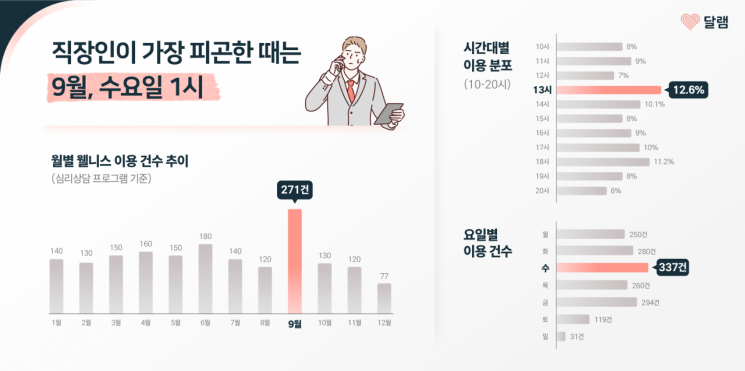
According to the report, the timing when office workers need wellness the most tends to be concentrated in specific months, days of the week, and times of day. An analysis of 4,264 program usage logs found that September recorded the highest level of wellness usage over the course of a year, while Wednesday had the largest share by day of the week. By time of day, 1 p.m. recorded the peak.
The report emphasized that this concentration pattern is a signal indicating "when employees need wellness." September is the period when employees return to their routines after summer vacation, while simultaneously dealing with backlogged work, second-half performance targets, and organizational restructuring. During this time, employees show a stronger tendency to relieve stress. Wednesday is the day when work fatigue accumulated since Monday peaks, and 1 p.m. is the time slot when concentration drops the most after lunch.
At the same time, the fact that usage rates are significantly lower on weekends and after working hours shows that employees are using wellness programs as productivity tools to boost their concentration during work hours. The report suggested that, if wellness is designed as a recovery routine that can be used intermittently during work, it can enhance organizational operating efficiency.
The report also presented an analysis of "who seeks wellness most actively." Based on usage data from psychological counseling programs, an analysis of usage distribution by age group showed that users in their 30s accounted for the largest share at 52.3%. Usage was also strong among those in their 20s and 40s-50s, with the 40s-50s group in particular accounting for about 26% of the total. The report explained that, accordingly, program design needs to place those in their 30s at the core, while also encompassing the condition-management needs of those in their 20s and the recovery and stress-management needs of employees in their 40s and older.
Furthermore, Dalraem suggested that such data can serve as insight not only into who needs rest and when, but also into how wellness programs optimized for different employee segments and delivered at the right time can improve organizational operating efficiency and employee engagement.
Going further, "consistency" was highlighted as the key to embedding wellness programs. The report pointed out that, for wellness not to remain a one-off initiative, it is important to operate programs for at least three months and go through a process of forming routines. This is supported by the fact that 44.7% of all respondents answered that, when programs are operated for more than three months, the rate of diffusion within the organization rises and demand for program extensions also surges. The report explained that, as the operating period continues, employees become more accustomed to participating and operations stabilize, and a culture of actively utilizing wellness programs begins to form within the organization.
In addition, citing the finding that composite users and long-term users show higher satisfaction levels, the company stated that, even if an organization starts with a single program at the initial introduction stage, cases in which it later transitions to "composite operation" by adding more programs according to needs have shown a tendency toward improved participation rates, satisfaction, and reuse rates. Users of a single wellness program gave an average satisfaction score of 8.5 out of 10, whereas users of two or more composite wellness programs gave a score of 9.6, significantly boosting both satisfaction and re-participation rates.
A representative of Heseudeuritji said, "For wellness, it is more important to embed it stably within the organization than merely to introduce it," adding, "We will continue to present a roadmap based on data so that companies can build wellness operating systems tailored to the needs of their employees."
© The Asia Business Daily(www.asiae.co.kr). All rights reserved.
![Clutching a Stolen Dior Bag, Saying "I Hate Being Poor but Real"... The Grotesque Con of a "Human Knockoff" [Slate]](https://cwcontent.asiae.co.kr/asiaresize/183/2026021902243444107_1771435474.jpg)
















