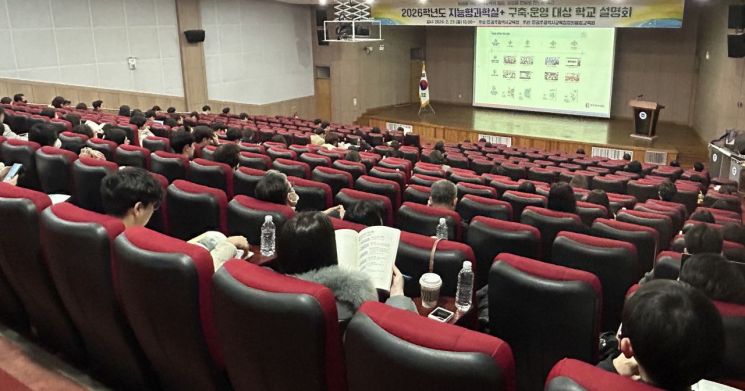
 On the 23rd, Gwangju Creative Convergence Education Institute provided guidance on project direction and operational guidelines to officials responsible for schools implementing the "2026 Academic Year Intelligent Science Lab+ Establishment and Operation" at the main auditorium of its headquarters. Provided by Gwangju Metropolitan Office of Education.
The Gwangju Institute for Creative Convergence Education under the Gwangju Metropolitan Office of Education (hereinafter Gwangju Institute for Creative Convergence Education) is expanding its future-oriented science classroom space, the "Intelligent Science Lab+."
According to the Gwangju Metropolitan Office of Education on February 24, the "Intelligent Science Lab+" is a future-oriented laboratory that creates a student-led science learning environment by utilizing advanced science and technology and digital inquiry tools within the 2022 revised science curriculum.
The Gwangju Institute for Creative Convergence Education established "Intelligent Science Labs" at seven schools last year, including Geumgu Elementary School, Usan Middle School, and Gwangju Girls' High School, and this year it will additionally install them at 103 schools, including Cheomdan Elementary School, Dongmyeong Middle School, and Gwangju High School.
However, rather than focusing on remodeling the space itself, the project will concentrate on equipping existing science labs with essential equipment so that digital science inquiry classes can be implemented.
This year, the project will proceed by creating "Intelligent Science Lab+" facilities at 68 schools in the first half of the year, including 32 schools supported by the Ministry of Education and 36 schools supported by the metropolitan office of education, and then adding 35 more schools in the second half of the year.
Subsequently, the plan is to establish "Intelligent Science Lab+" facilities in all schools by 2027.
Through the "Intelligent Science Lab+" project, inquiry-centered science education is expected to take place, in which students use advanced technology to pose their own questions, obtain data, and find answers.
On February 23, the Gwangju Institute for Creative Convergence Education held a briefing session at the main auditorium of its headquarters for staff in charge of schools participating in the "2026 academic year Intelligent Science Lab+ establishment and operation" and provided guidance on these matters.
In addition, Hwang Gyuhwa, a researcher at the Korea Foundation for the Advancement of Science and Creativity, delivered a special lecture on the theme "Intelligent Science Labs that Revitalize Inquiry in the Classroom," followed by presentations from teacher Jung Juri of Bonchon Elementary School and teacher Kim Namseong of Seolwol Girls' High School, who shared cases of establishing and operating Intelligent Science Lab+ facilities.
By presenting these establishment and operation cases, the session helped participants understand how to apply them in the field and suggested specific step-by-step directions for implementation.
Jin Young, director of the Gwangju Institute for Creative Convergence Education, said, "To ensure that future-oriented science learning environments are successfully established, we will continue to provide customized consulting and training for the teachers in charge."
© The Asia Business Daily(www.asiae.co.kr). All rights reserved.
![Clutching a Stolen Dior Bag, Saying "I Hate Being Poor but Real"... The Grotesque Con of a "Human Knockoff" [Slate]](https://cwcontent.asiae.co.kr/asiaresize/183/2026021902243444107_1771435474.jpg)
















