Easing Truck Parking Shortages and Illegal Parking Complaints
Expanding Community-Based Truck Parking Spaces
Joint Review of an Integrated, Self-Sustaining Cooperation Model
Big Mobility, a matching platform for truck parking lots, announced on the 24th that it has signed a memorandum of understanding (MOU) with Nice Infra to strengthen cooperation on truck parking infrastructure.
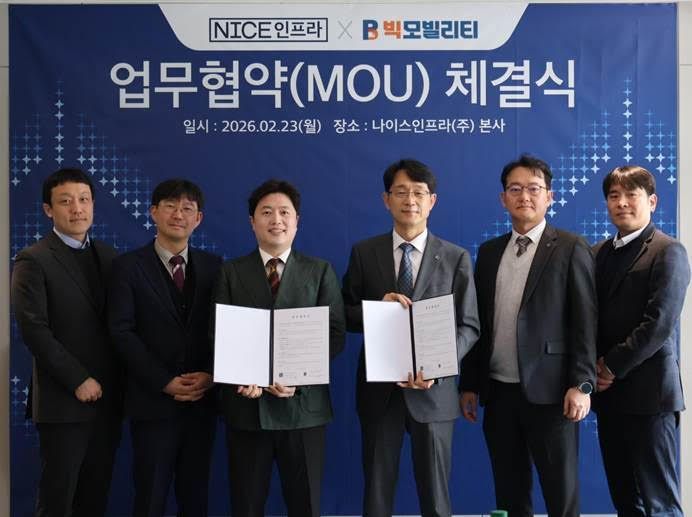 Third from the left, Seo Daegyu, CEO of Big Mobility, fourth, Paek Seungyeop, Executive Director of Nice Infrastructure. Big Mobility
Recently, in some areas, the shortage of truck parking spaces has often led to social problems such as illegal parking on roadsides and near residential areas, safety risks, and complaints related to noise and the environment. There are limits to addressing these issues through municipal crackdowns alone, so there is growing interest in securing alternative parking spaces and developing operational models.
This agreement was promoted to respond to such on-site regional needs, enhance the utilization of idle land and peripheral parking lots, and establish a cooperative framework to gradually expand truck-only parking spaces. The two companies plan to combine their respective strengths to contribute to the efficient operation of parking infrastructure and the mitigation of parking-related issues in local communities.
Following the signing of the agreement, the two companies will specify their initiatives through working-level consultations and will sequentially review business opportunities and expand the scope of application, starting with regions where cooperation is highly feasible. Under the initial agreement, they will first work together to identify and operate truck parking spaces in the Seoul metropolitan area and other major metropolitan regions. Nice Infra will leverage its network in the process of securing infrastructure, including site identification and contracting, while Big Mobility will use its expertise in connecting truck user demand and its operational know-how to improve operating efficiency and user convenience.
The expected positive outcomes of this collaboration include: mitigation of illegal truck parking and improved traffic safety; a reduction in complaints from local residents; and enhanced utilization of idle assets. In particular, for local governments, the partnership aligns with policy objectives such as easing parking shortages and reducing civil complaints, and is therefore expected to have strong potential for expansion as an effective public-private cooperation model.
A Nice Infra representative said, "Through this MOU, we will establish a cooperative framework that can both increase the utilization of idle assets and make a tangible contribution to improving the truck parking environment." A Big Mobility representative also said, "By combining on-site infrastructure development capabilities with operational technology, we will expand services that help resolve parking issues in local communities."
© The Asia Business Daily(www.asiae.co.kr). All rights reserved.

















