Three Consecutive Years of Energy Reduction...
Cost-Linked Pricing and Higher Unit Rates Add to the Burden
Busan Transportation Corporation reduced its power consumption in 2025 by 4.8% from the previous year, achieving a decrease for the third consecutive year, but its electricity bill actually increased.
The corporation stated that, as a result of implementing intensive energy-saving measures last year, it cut consumption by 15,773 MWh compared with a year earlier, bringing its total power usage down to 314,347 MWh. The associated cost-saving effect was calculated at approximately 3.5 billion won.
By segment, power consumption for electric trains came to 182,214 MWh, down 7,622 MWh from the previous year, while power usage at stations fell by 8,151 MWh to 132,133 MWh. The corporation has continued to reduce its power consumption for three consecutive years since 2023.
This performance is analyzed as the result of company-wide efforts to save energy, including the "Integrated Energy Savings for Carbon Neutrality" project, operation of a smart ventilation system, establishment of a peak power control system, and the introduction of new electric trains equipped with high-efficiency driving systems.
However, the corporation’s annual electricity bill for 2025 amounted to about 69.73 billion won, an increase of 1.95 billion won (2.9%) from the previous year. This was due to a continued rise in unit prices under the cost-linked electricity pricing system introduced in 2021. Most recently, the unit rate for industrial (Type B) electricity was raised by 10.2% on October 1, 2024, from 165.8 won per kWh to 182.7 won.
Urban rail operators also face structural limitations that make it difficult to flexibly adjust their power usage. Under the industrial (Type B) tariff system, differential rates are applied by season and time of day according to maximum demand (peak power). In urban rail, demand is concentrated during commuting hours and major events. The fact that a constant power supply is essential for safe operation is another burden.
In response, 15 rail operators nationwide, including Busan Transportation Corporation, formed a consultative body in 2024 and are jointly calling for improvements to the electricity tariff system. They argue that a "railway-only electricity tariff system" is needed to reflect the public nature and unique characteristics of rail operations.
President Lee Byungjin said, "Despite company-wide efforts to save energy, the financial burden is increasing due to higher electricity rates," adding, "It is necessary to establish a rational electricity tariff system that reflects the characteristics of urban railways, which provide transportation welfare services."
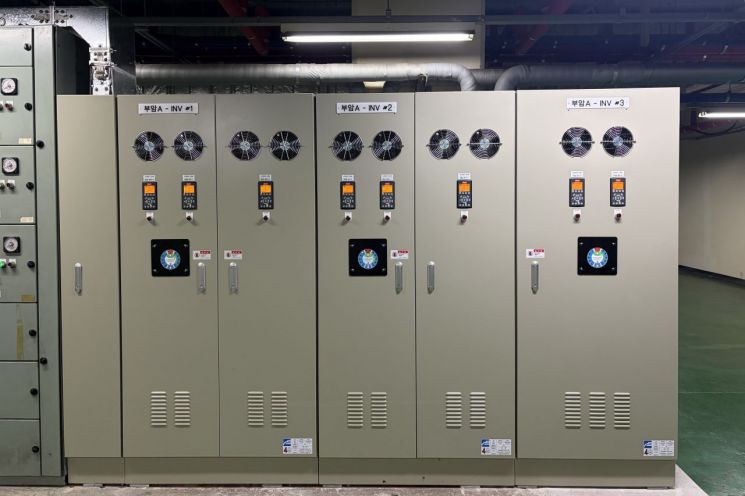 A high-efficiency inverter installed in the ventilation room of a Busan Metro station as part of the "Integrated Energy Saving for Carbon Neutrality" project.
© The Asia Business Daily(www.asiae.co.kr). All rights reserved.
![Clutching a Stolen Dior Bag, Saying "I Hate Being Poor but Real"... The Grotesque Con of a "Human Knockoff" [Slate]](https://cwcontent.asiae.co.kr/asiaresize/183/2026021902243444107_1771435474.jpg)
















