360-degree precision inspection even in high-temperature, toxic-gas environments
Signal strength boosted 13.7-fold...Enabling real-time monitoring
A new ultrasonic sensor technology has been developed to eliminate inspection blind spots in industrial sites that were previously inaccessible due to intense heat and toxic gases. Because it can precisely detect defects in all directions without attaching the sensor directly to the structure, attention is focusing on whether it could transform safety management systems at high-risk facilities such as nuclear power plants and large-scale plants.
The Korea Research Institute of Standards and Science (KRISS) announced on the 24th that it has developed an ultrasonic sensor that can detect 360-degree omnidirectional defects without directly attaching the sensor to the inspection target, by applying a waveguide. The technology is expected to significantly enhance industrial safety by enabling real-time, high-speed inspection of structures in extreme environments, such as high-temperature piping and hazardous chemical storage tanks.
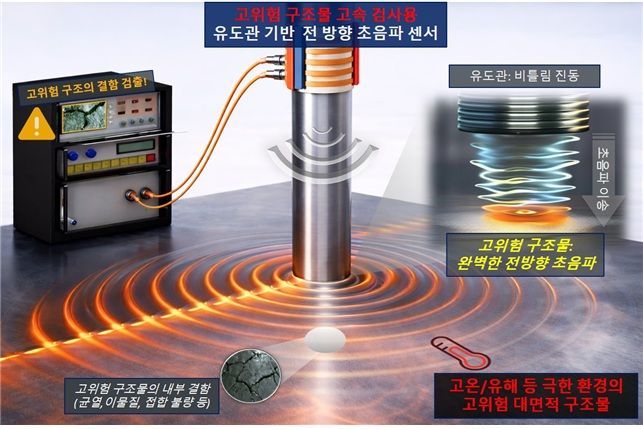 Schematic diagram of a guided-duct-based omnidirectional ultrasonic sensor developed by KRISS. Provided by the research team.
"Seeing without attaching"...Remote inspection with sensor-structure separation
Non-destructive testing is a core safety technology that detects internal defects using ultrasonic signals without damaging the structure. It is essential in high-risk industrial fields such as aerospace, nuclear power, and large-scale plants, where the potential for accidents is high.
The challenge lay in "installation." Conventional ultrasonic sensors had to be in close contact with the surface of the inspection target, so they were easily damaged in high-temperature or corrosive environments, and it was fundamentally impossible to attach sensors in areas where worker access was restricted. There were also limits to the method of connecting multiple sensors in segmented form to achieve 360-degree inspection. During the process of combining waves into a single signal, interference and distortion occurred, reducing precision.
The KRISS Non-destructive Evaluation Group resolved this structural limitation by introducing a waveguide as a medium. The sensor is installed at a safe location away from the structure, and ultrasound is transmitted through the waveguide. This way, the sensor is not directly exposed to extreme environments, while still delivering uniform waves to the inspection target.
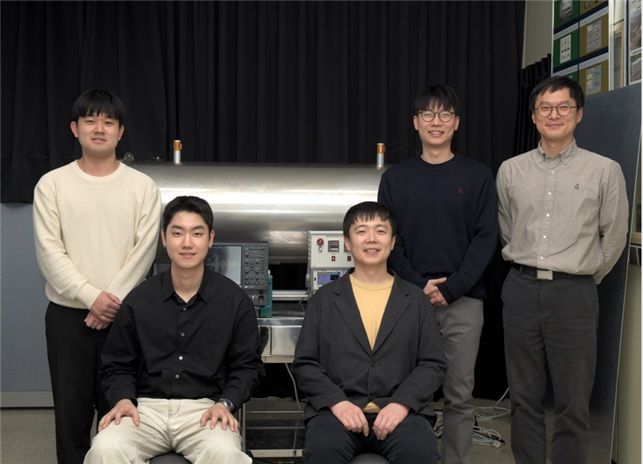 KRISS Non-destructive Testing Group. From left: Kim Seungil, UST research student (work-study); Jung Jooyoung, work-study research student; Seung Hongmin, Senior Researcher; Park Chanwook, Postdoctoral Researcher; Park Chunsu, Head of the Non-destructive Testing Group. Provided by KRISS
Omnidirectional uniform waves realized through torsional vibration
The core of the technology is generating torsional vibration inside a cylindrical waveguide and aligning it evenly for transmission. By uniformly radiating vibrations that twist like wringing a towel, the system produces consistent horizontal shear waves in all directions, even when the sensor is placed at a considerable distance.
Experiments showed that the developed sensor achieved approximately 95% directional uniformity. Signal strength improved by more than 13.7 times compared with the conventional segmented method. It can rapidly scan wide areas while still providing sufficient precision for detailed imaging.
The waveguide can be designed in various materials and geometries, and its end can be machined to match curved structures. This means it can be flexibly applied to diverse environments, including complex piping, curved tanks, and underwater structures.
"Precise inspection of underwater structures"...Expected immediate application to accident-prevention systems
Seung Hongmin, senior researcher at the KRISS Non-destructive Evaluation Group, said, "The sensor we developed demonstrates excellent signal performance even in liquid environments, enabling precise inspection of large structures submerged in water," adding, "By accurately inspecting blind spots that have so far been difficult to test, it can help prevent large-scale disaster accidents."
This technology is also expected to reduce costs, as it allows a single, relatively inexpensive waveguide-based sensor to inspect wide areas instead of installing multiple expensive sensors. When combined with real-time monitoring systems, it is also seen as having the potential to evolve into a continuous safety surveillance infrastructure for facilities in extreme environments.
Meanwhile, this research was carried out with support from the KRISS basic project titled "Development of digital safety measurement technology for innovation in the availability of intelligent facility monitoring," and was published in the international mechanical engineering journal "Mechanical Systems and Signal Processing (IF 8.9)" on December 1, 2025.
© The Asia Business Daily(www.asiae.co.kr). All rights reserved.


















