Executives Who Deleted Evidence of Subcontracting Act Violations
Supreme Court Overturns Appellate Court’s Prison Sentences and Remands Case
"Destruction of Evidence as Part of the Right to Defense Cannot Be Punished"
Even if evidence is destroyed to conceal a company’s legal violations, the Supreme Court has ruled that such destruction cannot be punished as destruction of evidence in “another person’s criminal case” if the officer or employee who gave the order could themselves be subject to criminal punishment. This is because, under the Criminal Act, the offense of destruction of evidence is established only when the evidence of a crime committed by “another person” is damaged.
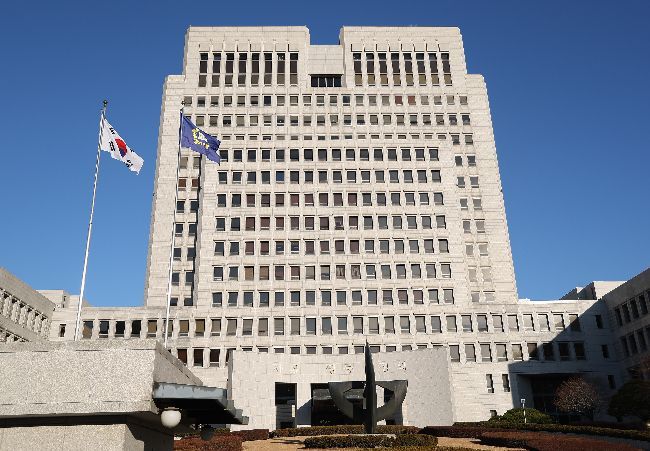
According to the legal community on the 24th, the Supreme Court (Presiding Justice Noh Kyungphil) reversed the lower court ruling that had found former HD Hyundai Heavy Industries executive A and former team leader B guilty of instigating destruction of evidence and destruction of evidence, and remanded the case to the appellate court.
A, who served as an executive in charge of the Offshore Plant Partner Support Team at Hyundai Heavy Industries, was indicted on charges of instructing subordinate employees between around July and October 2018 to delete materials related to the company’s violation of the Fair Transactions in Subcontracting Act, thereby destroying evidence. B, who was the team leader at the time, was brought to trial along with A on charges of conspiring with other employees to carry out acts of destruction of evidence, including deleting the related materials, in accordance with A’s instructions.
The key issue at trial was whether the materials they destroyed constituted evidence in the company’s (i.e., another person’s) criminal case, or whether they constituted evidence of the defendants’ “own” crimes. Under criminal law, destroying evidence to avoid one’s own criminal liability is regarded as an exercise of the right to defense and is therefore not punishable.
The court of first instance acquitted them, holding that it was difficult to view their conduct as destruction of another person’s evidence. However, the appellate court ruled that “the defendants destroyed evidence while knowing that the company’s violation of the Subcontracting Act could in the future become a criminal case,” and sentenced A to one year in prison, and B to eight months in prison, suspended for two years.
The Supreme Court overturned the appellate court’s guilty verdict. The Court held that the term “one’s own criminal case” also includes situations where, under a joint penal provision, an individual, as the person who carried out work on behalf of a corporation, can be directly subject to criminal punishment. In other words, in the event of a violation of the Subcontracting Act, not only the company but also A and B, who actually performed the work, could themselves be directly subject to criminal punishment.
The bench stated, “It is difficult to rule out the possibility that the defendants, in circumstances where they themselves could be directly punished as the actors, destroyed the related materials for their own benefit,” and found that “the materials they deleted are likely not evidence in another person’s criminal case, but evidence substantially related to the defendants’ own criminal case.”
The Court went on to point out that “the lower court erred in its understanding of the legal principles governing the establishment of the offense of destruction of evidence, by concluding that the act of deleting the evidence constituted destruction of evidence in another person’s criminal case without fully considering the defendants’ positions, the nature of their work, and the possibility of applying the joint penal provision.”
© The Asia Business Daily(www.asiae.co.kr). All rights reserved.
![Clutching a Stolen Dior Bag, Saying "I Hate Being Poor but Real"... The Grotesque Con of a "Human Knockoff" [Slate]](https://cwcontent.asiae.co.kr/asiaresize/183/2026021902243444107_1771435474.jpg)
















