AI Searches and Selects Beam Pattern Candidates
Field Verification in Commercial Networks Planned for Second Half of the Year
KT Corporation announced on the 23rd that it has successfully verified artificial intelligence (AI)-based beam pattern optimization technology in collaboration with global mobile network equipment company Nokia.
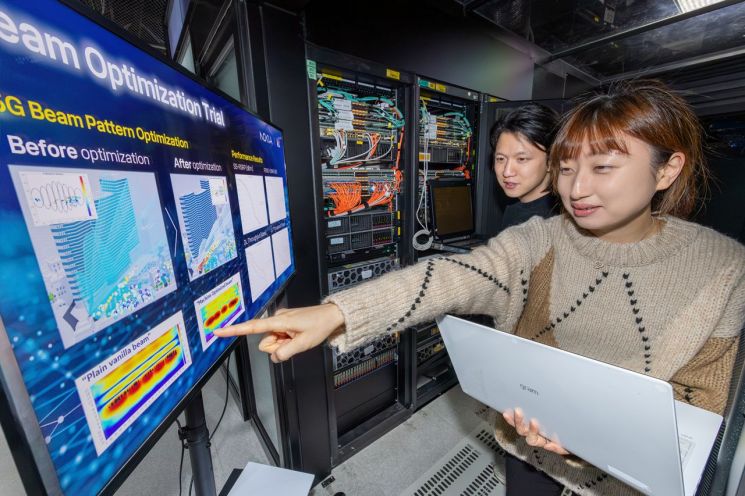 Korea Telecom employees are conducting validation tests of beam-pattern optimization technology. Provided by Korea Telecom
A beam pattern refers to the distribution of signals that determines in which direction, and with what width and strength, a base station antenna will transmit its beams (signals). The technology verified this time uses AI to actively reconfigure beam patterns by analyzing various network data such as traffic flow in real time. AI has been applied so that the unique characteristics of each area and environment can be precisely reflected in base station coverage optimization, and the project was carried out to secure improved wireless quality.
In the case of 5G base stations based on massive multiple-input multiple-output (mMIMO), which are widely used in commercial networks, multiple transmit and receive antennas are used to deliver different beams simultaneously to many users. This can greatly increase communication capacity and efficiency, but it also allows for tens of thousands of possible beam pattern combinations within a single cell, making it difficult to select the optimal one.
KT Corporation and Nokia made this possible through a reinforcement learning-based policy optimization algorithm for AI. Through periodic learning, the beam strategy can autonomously adjust itself in response to environmental changes such as time of day or specific events. As a result, they confirmed that, even under the same equipment conditions, it is possible to provide higher wireless signal quality, more stable coverage, and improved capacity handling performance.
KT Corporation expects this to play a meaningful role in improving wireless quality and enhancing network operation efficiency, in line with its strategy to advance the AI-based radio access network (AI-RAN). The two companies plan to cooperate in securing competitiveness in core AI-RAN technologies for the 6G era, including conducting field verification in commercial networks in the second half of this year.
Jongshik Lee, Head of KT Corporation’s Institute of Convergence Technology (Executive Vice President), said, "This verification is a meaningful achievement in confirming that AI can configure beam patterns in a more sophisticated way in wireless networks according to changing conditions," adding, "We will work closely with Nokia to further advance AI-RAN technology and expand its commercial deployment, doing our utmost to improve wireless quality in ways that customers can truly experience."
© The Asia Business Daily(www.asiae.co.kr). All rights reserved.
![Clutching a Stolen Dior Bag, Saying "I Hate Being Poor but Real"... The Grotesque Con of a "Human Knockoff" [Slate]](https://cwcontent.asiae.co.kr/asiaresize/183/2026021902243444107_1771435474.jpg)
















