Establishment of Counterterrorism and Counterintelligence Units in Seoul and Gyeonggi Nambu
Restructuring of National Security Investigation System Ahead of Espionage Law Amendment
The police are newly establishing an Anti-Terrorism and Counterintelligence Investigation Unit to strengthen national security and counterintelligence investigation capabilities. This is in preparation for an amendment to the Criminal Act that would expand the scope of the espionage offense from being limited to hostile states (North Korea) to covering "foreign countries, etc."
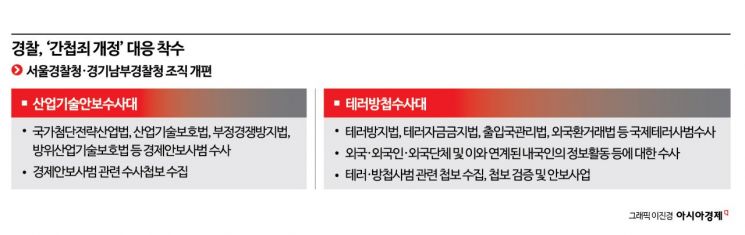
According to the police on the 23rd, the National Police Agency will create a new Anti-Terrorism and Counterintelligence Investigation Unit within the Seoul Metropolitan Police Agency and the Gyeonggi Nambu Provincial Police Agency as part of this week's organizational restructuring. Within the National Security Investigation Bureau, the "counterintelligence" function of the Industrial Technology Security Investigation Unit will be separated and reorganized into an independent unit. The recent selection of personnel has been completed among officers with investigation or security career tracks, and it has been confirmed that the heads of the new units have been designated at the superintendent and senior inspector ranks, respectively. The size of the units is being kept confidential for security reasons.
The new Anti-Terrorism and Counterintelligence Investigation Unit will be exclusively responsible for investigating international terrorism offenses under the Counter-Terrorism Act and the Foreign Exchange Transactions Act, as well as for "investigations into information activities by foreign countries, foreigners, foreign organizations, and Korean nationals connected to them." The existing Industrial Technology Security Investigation Unit will focus on collecting intelligence and conducting investigations into "economic security" crimes under the Act on Prevention of Divulgence and Protection of Industrial Technology and the Defense Industry Technology Protection Act. On February 2, the police revised the rules on organizational structure and division of duties to reflect these changes.
This reorganization is directly linked to the ongoing discussions on amending the espionage offense. A bill to amend the Criminal Act, which would expand the application of the espionage offense from hostile states to "foreign countries or organizations equivalent thereto," has been submitted to the plenary session of the National Assembly. Once the amendment is completed, a significant number of cases that have so far been investigated indirectly under statutes such as the Military Secret Protection Act and the Protection of Communications Secrets Act are expected to fall directly under the espionage offense. This is why the police’s counterintelligence investigation capabilities in connection with "foreign countries" have become increasingly important.
Under the current espionage offense, liability is limited to those who engage in or aid espionage for a hostile state, or those who leak military secrets to a hostile state. Although since the end of the Cold War the scope of security has expanded from state secrets to industrial secrets, the espionage offense has remained unchanged since it was enacted in September 1953. Unlike major countries that broadly define espionage suspicions to cover "foreign countries, etc.," Korea limits them to hostile states, which has made it impossible to investigate the leakage of national strategic technologies such as semiconductors under the espionage offense, which allows for heavier sentences.
For example, leaking or infringing on "national core technologies" under the Act on Prevention of Divulgence and Protection of Industrial Technology is punishable by imprisonment for at least three years and a fine of up to 6.5 billion won. However, the sentencing guidelines of the courts set a basic range of only 3 to 7 years, and even when aggravating factors are applied, the range is just 5 to 12 years. In the United States, a competing country in semiconductors, imprisonment can be imposed for up to 33 years and 9 months depending on the amount of damage.
In addition, during the "Chinese secret police station" incident in 2022, various countries arrested those involved on espionage charges, but in Korea, the police only applied charges such as violations of the Food Sanitation Act to the real owner of the Chinese restaurant identified as the local base. Despite serious suspicions of illegal information gathering and repression of dissidents, there was no legal basis for an investigation.
A police official explained, "As the realm of security expands to include industrial technology leaks and disasters, the scope of national security investigations is diversifying from traditional anti-communist investigations to economic security, public security, and terrorism," adding, "We are securing investigative personnel in anticipation that, once the espionage offense is amended, there will be many more applicable charges."
© The Asia Business Daily(www.asiae.co.kr). All rights reserved.
![Clutching a Stolen Dior Bag, Saying "I Hate Being Poor but Real"... The Grotesque Con of a "Human Knockoff" [Slate]](https://cwcontent.asiae.co.kr/asiaresize/183/2026021902243444107_1771435474.jpg)

















