U.S. Supreme Court Rules Trump’s Reciprocal Tariffs Illegal
Trump Signals Immediate Imposition of New 10% Global Tariff
Tariff Pressure Likely to Continue Under Trade Act Section 122, Trade Expansion Act Section 232, and Trade Act Section 301
Koo Yooncheol and Kim Jungkwan Convene Emergency Countermeasures Meeting
Blue House to Hold Joint Meeting of Relevant Ministries on the Afternoon of the 21st
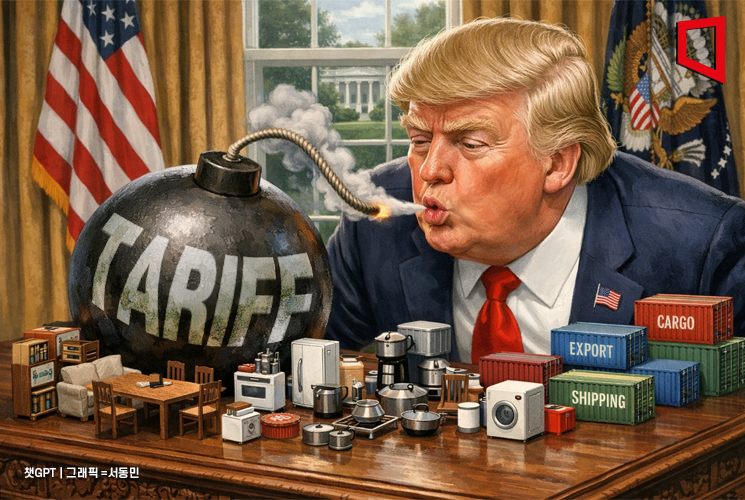
Immediately after the U.S. Supreme Court ruled that the Trump administration's reciprocal tariffs on each country were illegal, the Blue House and the relevant ministries moved quickly to discuss their response. Although the effect of the reciprocal tariffs imposed on major countries has been halted for now, uncertainty has grown because U.S. President Donald Trump has announced that he will immediately use alternative tools to impose a new 10% tariff on the entire world. In addition, in Korea's case, concerns are expected to deepen as the country is about to handle the 350 billion dollar "Special Act on Investment in the United States," which is linked to the U.S. reciprocal tariffs.
According to the Blue House on the 21st, Policy Chief Kim Yongbeom and National Security Office Director Wi Sunglak will hold a joint meeting of relevant ministries at 2 p.m. on this day to review the ramifications of the U.S. Supreme Court ruling and the direction of Korea's trade response toward the United States. At the meeting, they are expected to draw up response scenarios for each issue, focusing on the scope of tariffs invalidated by the ruling, the legal basis for the "alternative tariffs," their effective date and applicable items, and the impact on Korea's exports and investment.
Earlier, on the 20th (local time), the U.S. Supreme Court ruled by a 6-3 decision that reciprocal tariff measures based on the International Emergency Economic Powers Act (IEEPA) exceed presidential authority. Immediately after the ruling, President Trump signed an executive order terminating the IEEPA-based tariffs, while at the same time declaring that he would move to impose a 10% "global tariff," applicable for up to 150 days, based on Section 122 of the Trade Act of 1974.
While the U.S. Supreme Court decision has resolved uncertainty surrounding previously imposed "reciprocal tariffs," a series of analyses have pointed out that uncertainty has in fact increased because tariff measures that circumvent IEEPA are now more likely. As the IEEPA-based reciprocal tariffs have been legally blocked, the reciprocal tariffs imposed on Korea (15% as of this report) are in principle rendered null and void. However, the likelihood has grown that President Trump will continue his tariff pressure by invoking other statutes (Section 122 of the Trade Act, Section 232 of the Trade Expansion Act, and Section 301 of the Trade Act). Trade authorities will likely need to separately identify when the 10% global tariff actually takes effect, which items it will cover, and whether existing tariffs on automobiles, steel, and other items will remain in place, in order to prevent a new shock to exports to the United States and to use this as a basis for finding new negotiating leverage.
In response, the relevant ministries are moving swiftly. Vice Prime Minister and Minister of Economy and Finance Koo Yooncheol convened an emergency meeting in the morning and stated, "We will put the national interest first and closely discuss, together with the relevant ministries, the impact on each domestic industry and the corresponding response measures." The Ministry of Trade, Industry and Energy, under the chairmanship of Minister Kim Jungkwan, held an emergency countermeasures meeting attended by Trade Negotiations Deputy Minister Yeo Han-koo, directors and division heads of the relevant departments, and commercial attach?s from the Korean embassies in the United States and Japan to closely examine the impact of the ruling and the direction of the response. Minister Kim said, "Although this ruling has somewhat increased uncertainty regarding exports to the United States, the overall conditions for exports to the U.S. secured through the Korea-U.S. tariff agreement will be maintained in broad terms."
The National Assembly Keeps the 'Special Act Schedule'... Political Timelines Such as Judicial Reform Remain Variables
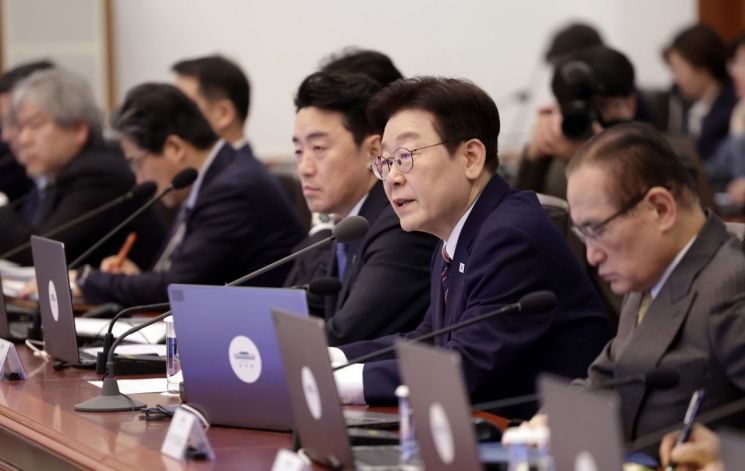
The general mood in the National Assembly is to proceed with the review of the "Special Act on Investment in the United States" as scheduled. The Special Committee on Investment in the United States is reported to be planning to hold a legislative public hearing on the 24th, coordinate key issues within its activity period (until March 9), and continue discussions with the goal of passing the bill at the plenary session on March 5. The ruling and opposition parties plan to use the public hearing to also confirm the government's position on what implications the latest U.S. Supreme Court ruling has for the Korea-U.S. trade environment and the necessity of the special act.
Kim Sanghoon, a lawmaker from the People Power Party and chair of the National Assembly's Special Committee on Investment in the United States, said, "It does not appear to constitute grounds for canceling Korea's investment in the United States." Jeong Taeho, the ruling party secretary of the committee, also judged that "the law is being created to implement the portion of investment promised between the two governments, so it has no direct relation to this ruling." However, the Progressive Reform Party stated, "The Trump administration must respect the judgment of the U.S. judiciary and immediately halt its baseless tariff pressure," adding, "We must thoroughly analyze the additional alternative measures Trump has announced and be fully prepared so that our companies do not fall victim to unilateralism that has lost its legitimacy." The Progressive Party argued, "The government and the National Assembly must immediately stop pursuing the Special Act on Investment in the United States."
The political schedules of the ruling and opposition parties surrounding the promotion of the bill are still considered variables. While the Democratic Party is seeking to pass judicial reform bills such as the crime of distortion of law, the People Power Party may use the handling of the Special Act on Investment in the United States as a card to block the Democratic Party's judicial reform bills. In fact, the special committee held its first plenary meeting on the 12th, but it fell into gridlock as the People Power Party protested the Democratic Party's move the previous day to pass the Supreme Court Justice Expansion Act and the Constitutional Complaint Act at the National Assembly's Legislation and Judiciary Committee. The National Assembly's Planning and Finance Committee is expected, during its work report session with the Ministry of Economy and Finance and other agencies on the 23rd, to focus its questioning on follow-up responses to the tariff ruling and on fiscal and risk management measures related to the special act.
© The Asia Business Daily(www.asiae.co.kr). All rights reserved.


















