Cross Installed Atop Central Spire, Making It the Tallest Church in the World
Construction Began in 1882...Completion Expected in the 2030s
Antoni Gaudi's unfinished masterpiece, the Sagrada Familia Cathedral in Spain, has reached another milestone. With a cross installed at the top of the central spire, the basilica has now reached a maximum height of 172.5 meters.
Citing reports from AP and other outlets, Yonhap News reported that on the 20th (local time), the upper cross structure was placed on the summit of the cathedral's central "Tower of Jesus Christ."
As a result, the Sagrada Familia Cathedral has become even taller than before, once again setting a new record as the tallest church in the world. Late last year, when part of the central tower was completed, it reached a height of 162.91 meters, surpassing Germany's Ulm Minster (161.53 meters) to become the tallest church in the world.
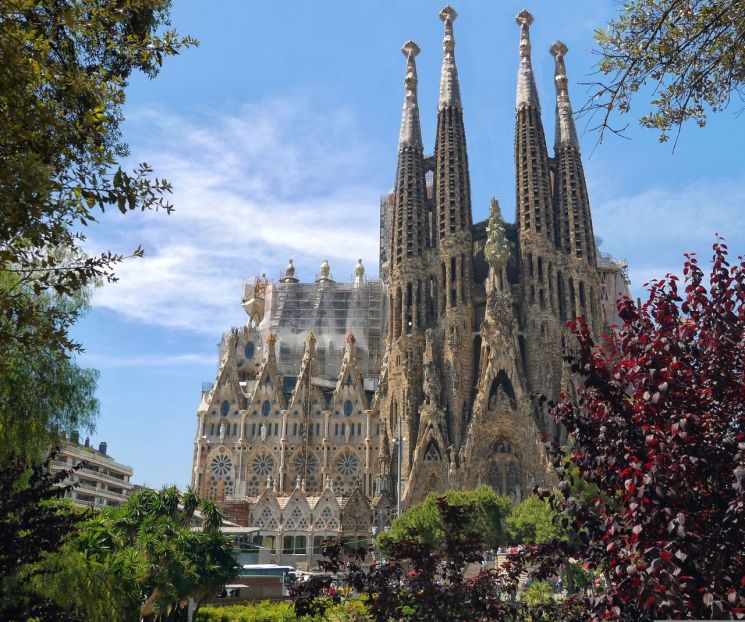
During his lifetime, Gaudi designed the cathedral to be lower than Montjuic Hill in Barcelona (173 meters). This reflected his belief that a man-made structure should not be taller than God's creation. Its current height still adheres to that principle.
Construction of the Sagrada Familia Cathedral began in 1882, and work is still ongoing 144 years later. When Gaudi died in 1926 at the age of 73, only one of the many planned spires had been completed. Since then, construction has been repeatedly delayed by the Spanish Civil War, financial difficulties, and the COVID-19 pandemic.
Parts of the interior and exterior of the Tower of Christ are still under construction, with cranes and scaffolding in place. The cathedral authorities are preparing a large-scale event in June this year to mark the 100th anniversary of Gaudi's death, and plan to remove the scaffolding around the tower by then.
Designated as a UNESCO World Heritage Site, the Sagrada Familia Cathedral has become a major global tourist attraction, accelerating the pace of construction. Entrance fees and donations from the millions of visitors who come each year are the main sources of funding. However, given the intricate exterior ornamentation and interior finishing work still required, many expect that full completion is likely to be pushed back to the mid-2030s.
Controversy also remains over how the project will be finished. To build the large staircase in front of the main entrance as originally planned, part of a nearby residential area would have to be demolished. The construction committee insists that Gaudi's original design must be preserved, but talks between the city authorities and local residents have yet to reach a conclusion.
© The Asia Business Daily(www.asiae.co.kr). All rights reserved.

















