All Tariffs Based on IEEPA Voided... "Tariff Authority Belongs to Congress"
Existing Tariffs on Steel, Aluminum, etc. to Remain
Global Trade Framework Braces for Repercussions
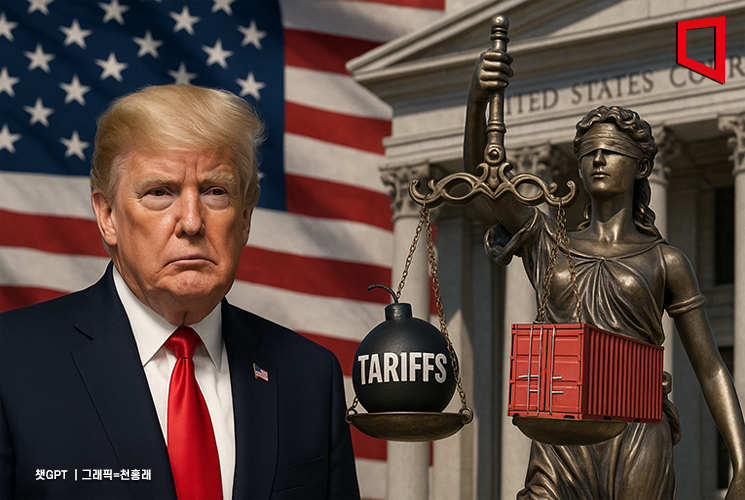
The U.S. Supreme Court has ruled that the broad tariffs imposed by U.S. President Donald Trump based on national emergency powers are unlawful. The decision puts a brake on a major constitutional issue over how far to recognize the president's trade authority. It is expected to have a considerable impact on the overall trade policy of a second Trump administration.
On the 20th (local time), the U.S. Supreme Court ruled that President Trump exceeded his legal authority when he imposed sweeping tariffs on imports from around the world based on the International Emergency Economic Powers Act (IEEPA), enacted in 1977, and declared the tariffs void. Of the nine justices, not only three liberal justices but also three conservative justices sided with the decision to invalidate the tariffs.
Chief Justice Roberts pointed out, "The president claims that he can unilaterally exercise a special authority that is not limited in amount, duration, or scope, but no statute has been identified in which Congress has specified that the text of the IEEPA can be applied to tariffs." He went on to rule, "The IEEPA does not grant the president the authority to impose tariffs."
The U.S. Constitution grants Congress the authority to set tariffs. The IEEPA allows the president to regulate exports and imports when there is an "unusual and extraordinary threat," but it does not contain any provision that explicitly permits tariffs. The fact that no president before Trump had ever imposed tariffs based on this law also served as a backdrop for this decision.
Previously, in February 2025, President Trump imposed a 25% tariff on Canada, China, and Mexico on the grounds that they had failed to sufficiently block the inflow of illegal drugs such as fentanyl into the United States. Then, on April 2, he declared "Liberation Day" and applied a flat basic 10% tariff on imports from nearly all countries.
However, small-business groups and 12 state governments led by Democratic governors filed lawsuits in opposition, arguing that the tariffs effectively amounted to a tax on U.S. consumers and that the president did not have the authority to impose them without congressional approval.
Not all of President Trump's tariffs will be nullified, though. Measures imposed under other statutes, such as tariffs on steel and aluminum, will remain in place. Accordingly, there is speculation that the administration may seek ways to reimpose tariffs by relying on alternative legal grounds.
Nevertheless, this ruling is expected to have a significant impact on the global trade order and on the structure of trade negotiations with major trading partners, including South Korea.
© The Asia Business Daily(www.asiae.co.kr). All rights reserved.

















