Easing of Floor Area Ratio Regulations When Compensating Tenants for Losses
Seoul City Seeks to Promote Housing Supply in Cooperation with the Central Government
The Seoul Metropolitan Government announced on February 22 that it has proposed to the central government the institutional improvements needed to promote small-scale housing maintenance projects.
Small-scale housing maintenance projects are projects aimed at improving the residential environment in low-rise residential areas where many aging multi-family and multi-household houses and semi-basement units are concentrated. Depending on the project size and eligibility requirements, they are classified into autonomous housing maintenance projects, street housing maintenance projects, small-scale reconstruction projects, and small-scale redevelopment projects.
Of Seoul's total residential area of 313 square kilometers, 131 square kilometers, or 41.8%, are low-rise residential areas, which were mainly formed through land readjustment projects in the 1960s to 1980s. These low-rise residential areas are now in urgent need of residential environment improvement due to aging, narrow roads, and small lot sizes. However, about 115 square kilometers of such low-rise residential areas, accounting for roughly 87%, do not meet the legal requirements for redevelopment, making it necessary to improve the residential environment through small-scale housing maintenance projects.
Compared with large-scale redevelopment projects, small-scale housing maintenance projects have simpler implementation procedures, and they allow housing maintenance to proceed more quickly in terms of resident conflict management and project duration.
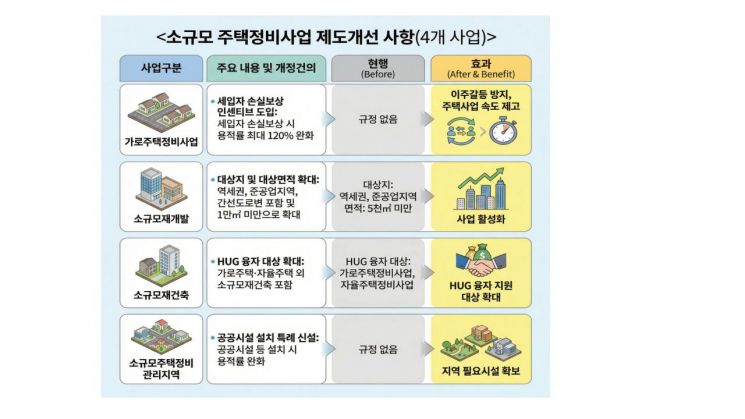
The latest proposal for improvement was made in three areas to promote small-scale housing maintenance projects: preventing project delays (tenant loss compensation incentives), measures to vitalize projects (expanding eligible project areas and providing loan support), and securing necessary facilities within the area (public contributions).
The city proposed to the central government that a new incentive be introduced in the street housing maintenance project process, under which easing of floor area ratio regulations (up to a maximum of 120%) would be granted when tenant loss compensation is provided.
In addition, to facilitate smooth project financing and improve business feasibility for small-scale reconstruction projects, the city requested that such projects be included as eligible projects for loans guaranteed by the Korea Housing and Urban Guarantee Corporation (HUG).
The city also proposed easing the eligibility requirements for small-scale redevelopment project sites, which had been limited to areas of less than 5,000 square meters located in station influence areas or quasi-industrial zones, so that they would instead cover areas of less than 10,000 square meters located in station influence areas, quasi-industrial zones, or along arterial roads.
Furthermore, the city requested that a legal basis be newly established to allow floor area ratio relaxations when installing public facilities and providing public contributions under the National Land Planning and Utilization Act, in order to enable the establishment of reasonable small-scale housing maintenance management plans.
The Seoul Metropolitan Government plans to continue consultations with the central government so that small-scale housing maintenance projects can be promoted and housing supply can proceed swiftly.
Lee Junhyoung, Director General for Regulatory Innovation Planning at the Seoul Metropolitan Government, said, "Improving the residential environment in aging low-rise residential areas is directly linked to citizens' daily lives and safety, and small-scale housing maintenance projects for this purpose are also important from the perspective of housing supply," adding, "The city will swiftly improve matters that can be addressed on its own, while continuing to consult with the central government on tasks that require cooperation such as amendments to laws and regulations, so that they can lead to institutional improvements."
© The Asia Business Daily(www.asiae.co.kr). All rights reserved.
!["The Woman Who Threw Herself into the Water Clutching a Stolen Dior Bag"...A Grotesque Success Story That Shakes the Korean Psyche [Slate]](https://cwcontent.asiae.co.kr/asiaresize/183/2026021902243444107_1771435474.jpg)
















