K-ICS at 198%... Year-End CSM at 13.2 Trillion Won
End of "Deviant Accounting"... Equity Capital Up 26 Trillion Won
"Targeting 130% Basic Capital and 180% K-ICS"
Samsung Life Insurance has exceeded 2 trillion won in net profit for the third consecutive year. With the termination of so-called "non-standard accounting," the value of its Samsung Electronics stake, which had been classified as belonging to participating insurance policyholders, was incorporated into its equity capital, increasing equity by more than 20 trillion won.
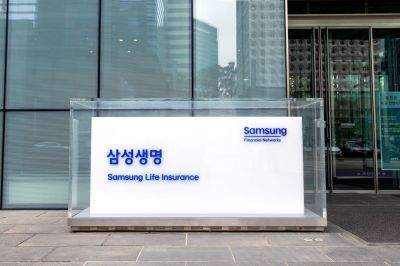
Samsung Life Insurance announced on the 20th that last year's net profit attributable to controlling shareholders on a consolidated basis came to 2.3028 trillion won, up 9.3% from the same period a year earlier. By generating new business focused on profitability and demonstrating solid profit growth, the company increased its net profit, surpassing 2 trillion won for the third consecutive year.
The Contractual Service Margin (CSM), a key profitability indicator, also maintained solid growth.
Insurance service profit came in at 975 billion won, driven by an expansion in CSM-related profit and a narrowing gap between actual and expected results. Investment profit reached 2.022 trillion won through stable asset management under the Asset-Liability Management (ALM) principle.
CSM at the end of last year stood at 13.2 trillion won. By securing stable new business, including expanded sales of high-margin health products, new business CSM totaled 3.0595 trillion won. In particular, health CSM accounted for three-quarters of that amount, at 2.301 trillion won.
A Samsung Life Insurance representative explained, "Strengthening the lineup of pure health-type products and enhancing non-price competitiveness expanded our dominance in the health insurance market, which in turn led to the establishment of a foundation for future profit."
The company also expanded its sales channels. The number of exclusive agents increased by more than 5,000 from a year earlier to around 43,000. The exclusive channel generated 85.4% of total new business CSM.
Assets under management at year-end stood at 247 trillion won. The Korea Insurance Capital Standard (K-ICS) ratio, a key solvency and financial soundness indicator, is expected to be 198%, maintaining one of the highest levels in the industry.
At its earnings conference call that day, Samsung Life Insurance presented its targets for shareholder returns, solvency indicators such as the K-ICS ratio, and profitability indicators including CSM for this year.
Regarding shareholder return policy, Chief Financial Officer (CFO) Lee Wansam said, "It is difficult to predict when gains from future sales of Samsung Electronics shares will occur, and the size of such sales is also highly volatile, so it is hard to specify a particular dividend payout ratio." He added, however, "If there is a large-scale disposal of related equity holdings or non-recurring gains that could affect dividends per share (DPS), which are at the core of our capital policy, we plan to make strategic decisions such as allocating them over an appropriate period and including them in the dividend pool."
On the CSM target, Channel Marketing Team Head Heo Jeongmu said, "We expect challenging external conditions to continue this year, including the introduction of commission regulations and the application of loss ratio and expense guidelines, but we have set securing new business CSM as our top priority," adding, "Last year, we recorded 3.1 trillion won, and this year our goal is to achieve at least 3.2 trillion won."
Regarding the K-ICS ratio target, Risk Management (RM) Team Head Lee Jiseon said, "Our core capital ratio was 157% as of the end of last year, and we will manage it at around 120% to 130%, which is above the regulatory recommendation of 80%," and added, "If we manage the core capital ratio at the 120% to 130% level, we expect the mid- to long-term K-ICS ratio to be maintained at around 180%."
Meanwhile, Samsung Life Insurance disclosed in its audit report that it has decided to classify the valuation gains on Samsung Electronics shares in the participating account, which had been managed as a separate liability item called "policyholder equity adjustment," as equity capital.
As of the end of last year, Samsung Life Insurance's equity capital on a consolidated basis was about 64.8 trillion won, an increase of 26.7 trillion won (70.1%) from 38.1 trillion won at the end of the previous year.
In the past, Samsung Life Insurance sold participating insurance products and used policyholder premiums to acquire an 8.51% stake in Samsung Electronics. Of this, the portion attributable to participating policyholders was separated and accumulated in a separate liability account called policyholder equity adjustment.
This time, with the termination of non-standard accounting and in accordance with guidance from the financial authorities, Samsung Life Insurance retrospectively restated its past financial statements and reclassified 7.7352 trillion won of policyholder equity adjustment as of early 2024 as equity capital.
In addition, among the valuation gains generated by last year's sharp rise in Samsung Electronics' share price, the portion attributable to participating insurance policyholders was reflected as equity rather than as a liability.
As a result, reported equity capital increased by 26.7 trillion won (70.1%) in just one year. As liabilities decreased and equity capital increased by more than 20 trillion won, the K-ICS ratio is also expected to rise going forward.
Samsung Life Insurance added a note in the audit report stating, "This accounting change has no impact whatsoever on the contractual rights of participating policyholders under the policy terms and conditions."
© The Asia Business Daily(www.asiae.co.kr). All rights reserved.

















