Ministry to Provide Tailored Intensive Care for Patients with Brain and Spinal Cord Injuries and Fractures
From March, "Customized Rehabilitation Fees" to Be Applied to Support Early Return to Society
'Recovery-phase rehabilitation medicine,' which reduces patients' disabilities and accelerates their return to daily life through intensive rehabilitation immediately after surgery or onset of illness, will be further strengthened.
The Ministry of Health and Welfare announced on the 20th that it has designated 71 hospitals nationwide as "third-term rehabilitation medical institutions." This designation will be valid for three years from next month until February 2029, and through patient-tailored intensive rehabilitation services, it will establish a rehabilitation care delivery system that connects the acute phase, recovery phase, maintenance phase, and community-based integrated care.
A total of 97 institutions applied for this third-term designation. The ministry explained that it evaluated whether they met the essential designation criteria through document reviews and on-site inspections, including the number of rehabilitation medicine specialists, the number of patients per nurse and per physical/occupational therapist, and facilities and equipment. Among the newly applying institutions, some were designated on the condition that they meet the standard of a "proportion of recovery-phase rehabilitation patients (40% or more)" within one year, taking into account local rehabilitation demand and regional balance.
From March, these rehabilitation medical institutions will be subject to pilot reimbursement schemes such as "customized rehabilitation fees," "intensive rehabilitation treatment fees" that bundle and reimburse similar existing rehabilitation services, "integrated care planning and management fees," and "home-visit rehabilitation." In particular, the "degressive inpatient fee system" will not be applied, so inpatient fees will not be reduced even if the length of stay is extended within the approved period by patient group (30 to 180 days). This will allow patients to receive sufficient intensive rehabilitation without the pressure of early discharge.
In addition, support will be provided so that patients discharged after intensive rehabilitation can continue to receive treatment or care in connection with community services, and for those who require home-based rehabilitation, home-visit rehabilitation will be provided.
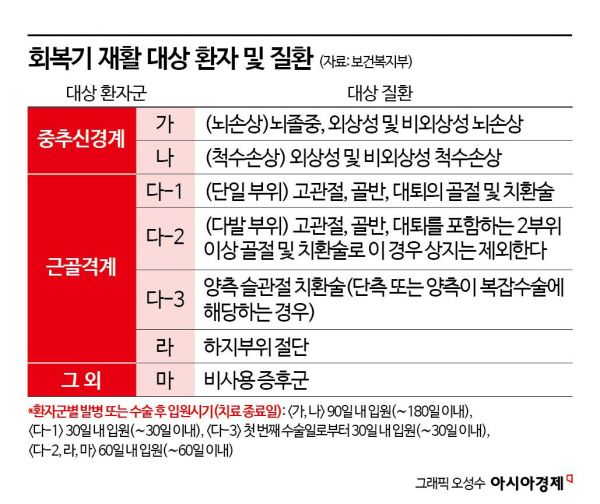
Patients who can be admitted to rehabilitation medical institutions and receive customized rehabilitation fees include those with central nervous system conditions (such as brain injury and spinal cord injury), musculoskeletal conditions (such as fractures and replacement surgery of the hip joint, pelvis, and femur), and disuse syndrome. In addition, patients with brain injury or spinal cord injury must be admitted to the relevant institution within 90 days of onset, and those with hip fractures and similar conditions must be admitted within 30 to 60 days.
The ministry plans to continuously improve the system by closely analyzing the outcomes and areas for improvement of the previous second-term project, including the rate of return to home and patient satisfaction. Kwak Soonheon, Director-General for Health Care Policy at the Ministry of Health and Welfare, said, "By designating rehabilitation medical institutions, we will support functional recovery and return to the community after acute treatment, reduce long-term and repeated hospitalizations, and strengthen a community-based rehabilitation care system that is patient-centered and ensures continuity between medical care and long-term care."
© The Asia Business Daily(www.asiae.co.kr). All rights reserved.

















