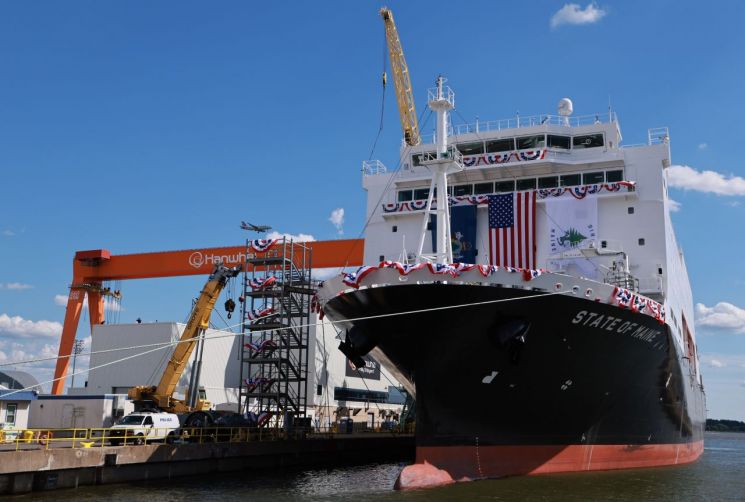
The Maritime Action Plan (MAP), a shipbuilding revival strategy recently announced by the Trump administration in the United States, has been criticized as likely to generate considerable costs without achieving its intended goals.
Colin Grabow, Deputy Director of the Herbert A. Stiefel Center for Trade Policy Studies at the CATO Institute, a U.S. libertarian think tank, assessed MAP’s goal of securing large commercial shipbuilding capacity in order to enable warship construction as “unrealistic.” The following is a summarized and organized version of the article Grabow posted on the institute’s website on the 19th.
The cost of building large commercial vessels at U.S. shipyards is about five times the global average price. As a result, very few ships are actually built in the United States. To overcome this competitiveness gap, there would need to be a sweeping transformation in costs, productivity, and industrial organization.
There are three main obstacles to overcome. First, securing sufficient manpower. Shipbuilding is labor-intensive and requires a stable, highly skilled workforce. However, the Philly Shipyard (acquired by Hanwha Ocean in December 2024) is known to have an annual turnover rate approaching 100%. Second, U.S. shipbuilding facilities are outdated. According to a June 2025 report by the U.S. Government Accountability Office (GAO), most of the infrastructure dates back to the World War II era. Industry officials have long assessed that U.S. shipyards lag their competitors by decades in terms of technology. These factors create a massive productivity gap that is difficult to close in the short term. In particular, the U.S. Navy’s shipyard modernization program that began in 2018 is structured as a 20-year project. Third, U.S. shipyards face high input costs for raw materials. U.S. steel prices, which are kept high by tariffs, pose a major problem for competitive shipbuilding.
To overcome these challenges, MAP proposes more subsidies, the introduction of new fees on foreign-built vessels, and rules that would require a certain share of U.S. imports to be carried on U.S.-built ships. This is not a novel approach at all. The United States has used subsidy policies in the past, and the results were poor.
The most ambitious federal program was the “construction differential subsidies” introduced in 1936. This system subsidized up to half of the cost of U.S.-built ships. Its purpose was explicitly clear: to cover up to 50% of domestic construction costs in order to eliminate the price gap between domestic and foreign shipbuilding. However, this measure failed to foster competitiveness, and storm clouds were already gathering over the industry even before the subsidies were withdrawn in 1981. The fact that annual production of 15 to 20 ships under the subsidy regime fell to mostly single digits for decades after the subsidies ended shows how dependent U.S. shipyards were on this funding.
Even if MAP’s industrial policy were somehow successful and significantly increased ship production, the benefits would still be unclear. The government argues that expanding commercial shipbuilding would spill over into naval shipbuilding, lowering costs and improving delivery schedules. However, this logic appears to be at odds with the realities of naval and commercial shipbuilding.
Commercial and naval shipbuilding share some common elements but differ greatly in important respects. One study pointed to major differences in materials, production complexity, regulation, and design philosophy. In 2006 congressional testimony, the commander of the Naval Sea Systems Command stated that “one could argue they are separate industries.”
The fact that major naval shipyards have largely abandoned commercial construction despite having an adequate domestic market supports this view. Bath Iron Works, which builds destroyers, has not built a commercial vessel since 1984. Another warship builder, Ingalls Shipbuilding, has not attempted commercial construction since a failed effort in 1999. Newport News Shipbuilding tried to fill its order book after the Cold War by taking commercial tanker contracts in the 1990s, but ended up recording losses of more than 320 million dollars.
Meanwhile, Fincantieri Marine Group builds surface combatants at its Marinette shipyard in Wisconsin and constructs commercial vessels at a separate shipyard in Sturgeon Bay.
This “bifurcation of shipbuilding” is not unique to the United States. Ronald O’Rourke, an analyst at the Congressional Research Service (CRS), notes that Asian shipyards that build both naval and commercial ships seek to separate their workforces by ship type. Mitsubishi Heavy Industries in Japan is known to separate naval and commercial shipbuilding physically and organizationally, much like an “air gap.”
Furthermore, a 2024 analysis by the RAND Corporation suggested that the two types of shipbuilding in China are likely to proceed increasingly independently, with shipyards focusing on either naval or commercial shipbuilding, but not both. Notably, Samsung Heavy Industries in Korea is avoiding the construction of naval combatants.
Of course, there are some overlaps between commercial and naval shipbuilding, and one can imagine scenarios in which expanding commercial production spreads certain fixed and overhead costs over more ships, thereby improving efficiency. But consider the underlying logic. Using subsidies to promote commercial shipbuilding means spending a large amount of money upfront in the hope of recouping it through new efficiencies later, which is a highly uncertain proposition.
These concerns are grounded in past experience. A 1975 GAO report cited Navy testimony to Congress the previous year stating that subsidized commercial shipbuilding had contributed to delays and cost overruns in naval ship deliveries by exacerbating shortages of skilled labor. In other words, subsidized construction of large commercial vessels can actually weaken warship construction. A similar logic applies within commercial shipbuilding itself. As labor and investment are drawn toward large shipyards, smaller shipyards that may be better positioned to build comparative advantage in the international market could be disadvantaged. It is far from clear that broadly increasing commercial production, or adding commercial work to naval shipyards that are already failing to deliver combatants on time, would solve any of the problems those naval shipyards face.
Even if MAP contains the wrong solutions, the problems of naval shipbuilding and an aging, uncompetitive commercial shipbuilding capacity are real. What, then, would more credible reform measures look like? I have proposed several policy options.
First, ensure continuity of production. U.S. shipyards frequently cite the government’s failure to provide a consistent “demand signal” as a core source of difficulty. This complaint is not without merit. When visibility into future demand is low, planning and investment to meet warship construction needs become more difficult. Rather than a “boom-and-bust” cycle, the United States should aim for more stable and predictable production.
Japan can serve as one model. According to Ronald O’Rourke of the Congressional Research Service, Japan builds one submarine every year, regardless of the security environment. If more submarines are needed, it can extend the service life of existing vessels to increase force levels. Conversely, if necessary, it can reduce the fleet by retiring older ships. In either case, this approach stabilizes demand, improves production efficiency, and preserves technology, equipment, and skills.
Second, make use of allied shipyards. The United States counts some of the world’s most capable shipbuilders among its core allies, but laws restricting the overseas construction and repair of warships make it difficult to leverage this strength. As more experts have argued, if these laws were revised, it would become possible to build large modules or even entire ships at skilled allied shipyards.
Domestic construction has value, but at some point the benefits of using allied shipyards-where construction times are much shorter and costs significantly lower-outweigh that value. In many programs, including non-combatant vessels such as fleet oilers and icebreakers, where delays and cost overruns are severe, the national security balance may already tilt in favor of allied construction.
Third, reform or repeal the coastwise laws. There is long-standing, clear evidence that U.S. coastwise laws-often referred to collectively as the Jones Act, which restricts domestic coastal shipping to vessels that are U.S.-owned, U.S.-flagged, U.S.-built, and U.S.-crewed-impose substantial economic burdens on strategic industries such as steel and energy. Yet these laws also fail more directly on national security grounds. Forcing Americans to buy new ships at exorbitant prices has not helped to develop a large, modern fleet or a robust shipbuilding industry.
At a minimum, the law should be reformed to allow the use of ships built in allied countries. Dramatically lowering capital costs would encourage the development of a larger and more modern fleet, along with associated economic and national security benefits. In addition, increased coastal shipping could expand employment opportunities for U.S. shipyards in repair and maintenance.
A more ambitious approach would be to repeal the law altogether and meet national security needs through targeted subsidies that promote the employment of U.S. ships and mariners.
© The Asia Business Daily(www.asiae.co.kr). All rights reserved.

















