A Look at TCL's Earnings Report from Last Year
Rising Market Share on the Back of Mid- to Low-Priced LCD Sales
Expanding into Global and Mid- to High-End TV Lineups
Samsung and LG Pursue a Two-Track Strategy of Premium and Mass-Market Products
Chinese home appliance maker TCL is rapidly expanding its presence in the global TV market. While increasing its share with a focus on low-priced LCD (liquid crystal display) TVs, it has recently been strengthening its mid- to high-end lineups in an attempt to break into the premium segment. In the midst of this, Korean manufacturers such as Samsung Electronics and LG Electronics are concentrating on defending profitability amid intensifying competition from Chinese players.
According to TCL's interim results report for last year released on the 20th, the company’s total revenue for the first half of the year increased by 20.4%, from 45.494 billion Hong Kong dollars to 54.777 billion Hong Kong dollars. Gross profit rose by 16%, and net profit jumped by 67.8%. The improvement in earnings is analyzed to have been driven by growth in TV sales and shipments. During the same period, global TV shipments reached 13.46 million units, up 7.6% year-on-year, while TV revenue expanded by 9.4%.
This growth is underpinned by an aggressive volume expansion strategy. TCL has been boosting its market share by increasing sales centered on mid- to low-priced LCD TVs. According to Counterpoint Research’s Global Monthly TV Tracker released the previous day, TCL captured the No. 1 position in the global TV market in December last year with a 16% share based on shipment volume. It was the first time TCL surpassed the monthly top ranking that Samsung Electronics had maintained for a long period.
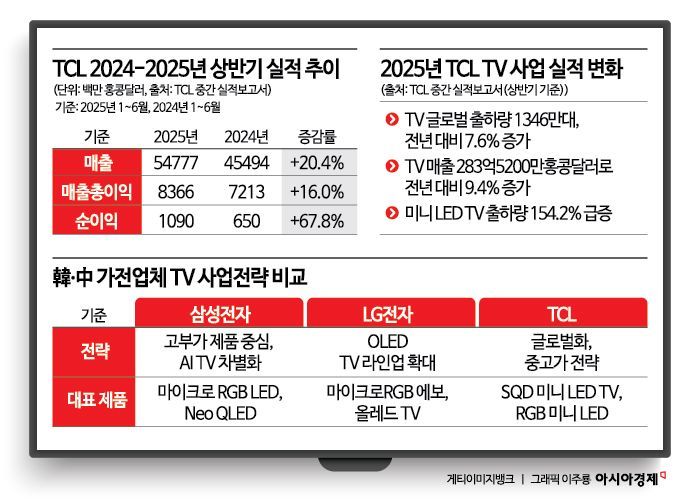
However, TCL’s strategy is not limited to low-price offensives. Recently, TCL has been pushing into the premium market by frontloading mid- to high-end products such as QLED (quantum dot light-emitting diode) and mini LED TVs. In the first half, shipments of QLED TVs and mini LED TVs increased by 73.7% and 176%, respectively. The company’s strategy is to pursue qualitative growth by improving its product mix, focusing more on strengthening mid- to high-end lineups than on simply increasing volume. In parallel, it is accelerating the expansion of its global brand by increasing sales of mid- to low-priced products based on overseas production hubs in Vietnam, Mexico, Brazil, and other countries.
These moves by Chinese manufacturers are becoming a burden for Korean companies. With global TV demand stagnating and price competition intensifying, profitability pressures are mounting. In an environment where it is difficult to expand the overall market size, competition for market share can directly translate into declining profits.
In response, Samsung Electronics and LG Electronics have set their strategic direction to prioritize profitability over market share. Their plan is to protect the average selling price by increasing the proportion of premium products, while at the same time maintaining entry-level lineups to preserve their market base.
Domestic manufacturers aim to defend profitability with a “two-track” strategy that combines high value-added premium lineups with mass-market products such as ultra-high-definition (UHD) and small-sized LED TVs. Following the launch in August last year of its 115-inch Micro RGB (red, green, blue) LED (light-emitting diode) TV, Samsung Electronics has expanded the lineup to 55-, 65-, 75-, 85-, and 100-inch models. At the same time, it is broadening high value-added lineups such as Neo QLED and OLED, while still maintaining its LCD-based product range. LG Electronics also plans to roll out new lineups, including unveiling its LCD-based premium TV, the “Micro RGB Evo.” In addition, it plans to launch within this year a mass-market special edition (SE) of its premium OLED TV with a lower price point. The idea is to maintain competitiveness in OLED technology while lowering the entry barrier to broaden its customer base.
Beyond hardware competition, expansion of software and ecosystems is also a key pillar of their defense strategy. Leveraging artificial intelligence (AI) capabilities that Chinese manufacturers have yet to catch up with, they are seeking differentiation in areas such as AI home, operating systems (OS), and security. Samsung Electronics this year introduced the “Vision AI Companion,” which enhances AI features across its entire TV lineup, and announced that it will support upgrades of its proprietary TV OS, “Tizen OS,” for seven years. LG Electronics has also built a platform ecosystem by installing its webOS on more than 70 million of its smart TVs.
© The Asia Business Daily(www.asiae.co.kr). All rights reserved.


















