First revival of "price re-determination" since 2006
Forcing companies to scrap collusive prices and cut them to market levels
Surcharges also set to hit record levels...Arithmetically approaching 1 trillion won
The Korea Fair Trade Commission has pulled out its strongest card in 20 years, issuing a so-called "price re-determination order" against flour milling companies that have dominated the domestic flour market and engaged in collusion for six years. The measure forces companies to scrap prices that were inflated through collusion and recalculate them in line with market levels. Together with a potential "fine bomb" that could approach the 1 trillion won range, a punitive sanction that effectively strips companies of their right to set prices is becoming a reality.
"We must correct distortions in everyday consumer prices"...First 'forced price cut' in 20 years foreshadowed
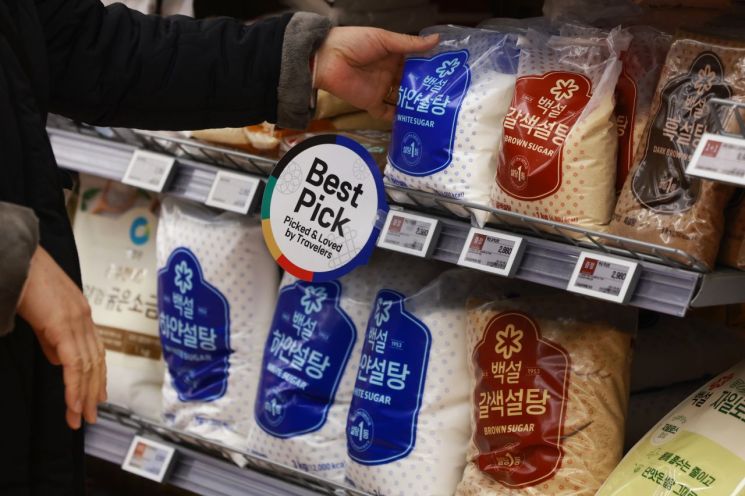
On the 20th, the Korea Fair Trade Commission announced that it had sent an examiner's report the previous day to each of the seven flour milling companies involved in the flour price-fixing case: Daehan Flour Mills, Daesun Flour Mills, Sajo Dongawon, Samyang, Samhwa Flour Mills, CJ CheilJedang, and Hantop. The examiner's report of the Korea Fair Trade Commission is akin to a prosecutorial indictment that sets out the details of the legal violations, meaning that the commission has embarked on full-fledged sanction procedures.
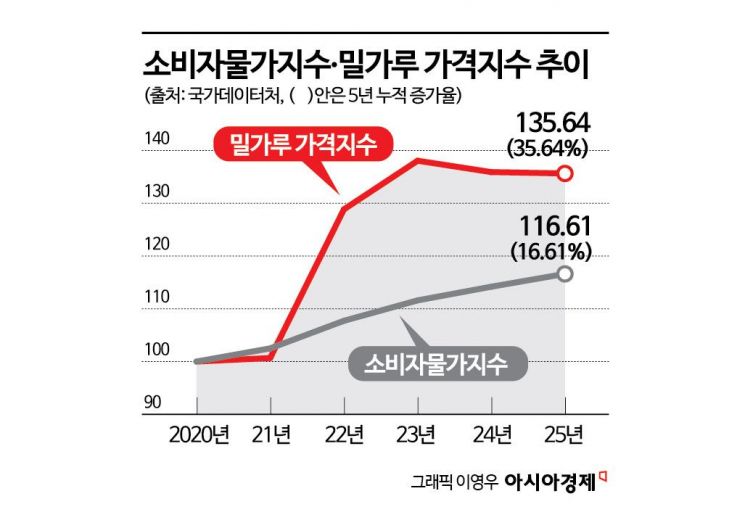
According to the examiner's report, the seven milling companies colluded on prices and quantities over a six-year period from November 2019 to October last year, abusing their combined 88% share of the domestic B2B (business-to-business) flour market. The sales affected by this collusion amounted to 5.8 trillion won. Prosecutors, who previously indicted these companies, stated that flour prices surged by up to 42.4% before and after the collusion, directly hitting the prices of staple foods such as instant noodles and bread.
The examiner at the Korea Fair Trade Commission concluded that these actions violated the Monopoly Regulation and Fair Trade Act and proposed a corrective order, a price re-determination order, and the imposition of fines. If the price re-determination order is actually invoked, it will be the first such case in 20 years since the 2006 flour industry collusion case. At that time, eight companies were found to have colluded on quantities and prices over about six years, and they were hit with a total of 43.417 billion won in fines along with a price re-determination order. The views expressed in the examiner's report are the examiner's proposed measures at the investigation stage and will be finalized after deliberation by the commission.
Yoo Sungwook, Director General for Investigation Management at the Korea Fair Trade Commission, explained, "The inclusion of the price re-determination order reflects our judgment that it is actively necessary for items that are closely related to people's livelihoods." In light of the precedent from 2006, when flour prices fell by around 5% following the price re-determination order, if such an order is included in the final decision, its impact on the market is expected to be considerable.
The size of the fines is also likely to be the largest ever. Applying the maximum 20% of sales, which is the benchmark for fines related to collusion, the fines could arithmetically reach up to 1.16 trillion won. This would overwhelmingly shatter the previous record of 668.9 billion won for liquefied petroleum gas (LPG) collusion in 2010 and the recent 408.3 billion won imposed for sugar price-fixing.
"The public's right to know comes first"...Unusual mid-investigation announcement following president's stern warning
This investigation proceeded with unusual speed and intensity. Whereas cartel investigations typically take about a year, the Korea Fair Trade Commission formed a dedicated task force of five members, including the director in charge, and completed the investigation and sent out the examiner's report in just four months. It is also unusual for the commission to disclose details of the investigation before its final decision. Regarding this, Director General Yoo explained that it was "a decision to respect the public's right to know and to enhance transparency in case handling." Because the issue is directly linked to everyday consumer prices, the commission intends to communicate actively from the examiner's report stage to raise awareness of the seriousness of collusion.
On the 19th, the Korea Fair Trade Commission sent out the examiner's report on the same day President Lee Jaemyung, at a meeting with his senior secretaries, defined colluding companies as a "cancerous presence" and ordered officials to "consider measures for their permanent expulsion." This is seen as showing that the president's strong commitment to stabilizing prices and the commission's strict enforcement stance are aligned. Meanwhile, the seven milling companies will be able to exercise their right of defense, including submitting written opinions, within eight weeks from the date they receive the examiner's report. As soon as this process is completed, the Korea Fair Trade Commission plans to convene a plenary session as quickly as possible to determine the final level of sanctions.
The Korea Fair Trade Commission stated, "Cartels that harm people's livelihoods will be sternly punished without exception," adding, "Through an all-out, pan-government response, we will achieve price stabilization outcomes that the public can truly feel."
© The Asia Business Daily(www.asiae.co.kr). All rights reserved.
![Clutching a Stolen Dior Bag, Saying "I Hate Being Poor but Real"... The Grotesque Con of a "Human Knockoff" [Slate]](https://cwcontent.asiae.co.kr/asiaresize/183/2026021902243444107_1771435474.jpg)


















