No. 1 NVIDIA (US), No. 2 Apple, No. 3 Alphabet
Among chipmakers, behind only NVIDIA, TSMC, and Broadcom
Higher earnings forecasts point to further gains in market cap ranking
On the 20th, KOSPI breaks through 5,700 in a "rotation market"
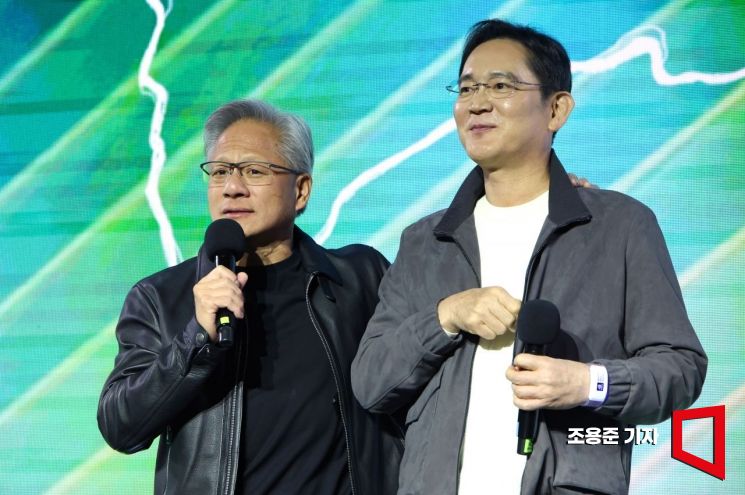 Lee Jaeyong, chairman of Samsung Electronics (right), is greeting Jensen Huang, CEO of Nvidia, at the GeForce Gamer Festival held at COEX Plaza in Seoul on Oct. 30 last year. 2025.10.30 Photo by Cho Yongjun
Powered by a super-boom in memory semiconductors and a recovery in technological competitiveness, Samsung Electronics has become the 14th-largest company in the world by market capitalization. As securities firms continue to raise their earnings and share-price forecasts for Samsung Electronics, there is a growing possibility that its ranking will climb further. Buoyed by the rise in Samsung Electronics' share price, the Kospi has also been hitting new all-time highs day after day.
Samsung Electronics climbs to 14th in global market cap rankings on share-price rally
According to the Korea Exchange and CompaniesMarketCap on the 20th, Samsung Electronics' market capitalization, including preferred shares, stood at 1,232 trillion won as of the previous trading day. On this day as well, Samsung Electronics opened at 189,800 won, up 0.48% from the previous session, and at one point in the morning its share price rose to 191,200 won. The Kospi opened at 5,696.89, up 0.35%, and for the first time in history broke through the 5,700-point level, reaching 5,724.51 as of 9:27 a.m.
Earlier this month, Samsung Electronics became the first single stock in Korea to reach a market capitalization of 1,000 trillion won, and it has now risen to 14th place in market-cap rankings among all listed companies worldwide. Nvidia of the United States ranks first with a market cap of 6,615 trillion won, followed by Apple in second place with 5,616 trillion won and Alphabet, Google's parent company, in third with 5,314 trillion won. Among Asian companies, Taiwan's TSMC is the only firm ahead of Samsung Electronics in the upper tier, ranking sixth with a market cap of 2,715 trillion won.
U.S. big tech companies such as Meta (8th), Broadcom (9th), and Tesla (10th) are ahead of Samsung Electronics in terms of market capitalization, while Eli Lilly, known for its obesity drugs, holds 13th place. Within the top 100 companies, SK Hynix, with a market cap of 651 trillion won, ranks 33rd and is the only Korean company other than Samsung Electronics to make the list. Among pure semiconductor companies, Samsung Electronics ranks fourth after Nvidia, TSMC, and Broadcom, while SK Hynix is seventh.
Just a year ago, Samsung Electronics' market-cap ranking hovered around the 30th place globally. However, as its share price has nearly tripled over the past year, its market-cap ranking has also surged vertically. The weight of Samsung Electronics as a single stock in the domestic stock market has increased as well. As of the previous day, Samsung Electronics accounted for about 26% of the Kospi's total market capitalization, up sharply from 15.7% at the end of the first half of last year.
The driving force behind the rebound in Samsung Electronics' share price is the explosion in demand for memory semiconductors stemming from the artificial intelligence (AI) revolution. The rapid increase in demand for high-bandwidth memory (HBM) due to AI data center expansion, combined with rising prices for general-purpose DRAM, has significantly improved Samsung Electronics' earnings and sent its share price soaring, according to analysts. The fact that the company has enhanced its technological competitiveness in HBM, a field in which it had been viewed as lagging behind competitors, and is rapidly regaining market leadership by, among other things, becoming the first in the world to officially ship sixth-generation products (HBM4), has also helped bolster investor sentiment.
Kim Younggeon, an analyst at Mirae Asset Securities, said, "Samsung Electronics' HBM4 passed customer quality tests without any redesign issues," adding, "It has secured a competitive edge in HBM4 and also has superior supply capacity, so the business environment is gradually becoming more favorable."
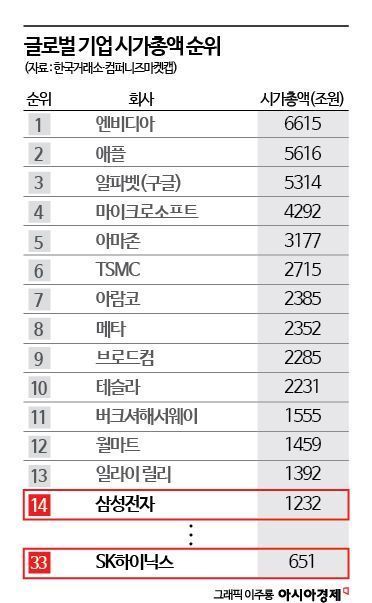
Upgraded earnings forecasts point to further gains in market-cap ranking
The securities industry expects Samsung Electronics to become the biggest beneficiary of the memory semiconductor supply shortage, as it increases the proportion of product supply to major customers such as Nvidia. Accordingly, analysts project that Samsung Electronics' earnings will exceed previous expectations, and its share-price targets are being raised day after day. The consensus estimate for Samsung Electronics' operating profit this year by domestic securities firms, compiled by FnGuide, stands at 167 trillion won, four times higher than the 42 trillion won projected at the end of last year, with this jump occurring in just two months.
Daol Investment & Securities, which has presented the highest target, raised its estimate for Samsung Electronics' operating profit this year from 177 trillion won to 209 trillion won on the 10th, and simultaneously lifted its fair-value target price to 270,000 won. This implies that the current share price, around 190,000 won, could rise by roughly 42%. If the share price does climb to 270,000 won as expected, the company's market capitalization would exceed 2,000 trillion won, and, in simple terms, its global market-cap ranking could rise to as high as 11th.
Ko Youngmin, an analyst at Daol Investment & Securities, explained, "Judging from current trends in memory semiconductor price negotiations, the average selling price of memory semiconductors in the second quarter could rise by between the mid-to-high 20% range and up to 30% compared with the previous quarter," adding, "This is a situation in which earnings estimates for Samsung Electronics need to be revised upward."
KB Securities also raised its target price for Samsung Electronics to 240,000 won on the 5th, analyzing that as of February the intensity of the memory semiconductor supply shortage has deepened further compared with the fourth quarter of last year.
Kim Dongwon, head of research at KB Securities, stressed, "Among the world's top 10 companies by operating profit this year, Samsung Electronics' operating profit (170 trillion won) will account for about 9%, while its current share of global market capitalization is only about 3%, which means there is substantial room for the company's corporate value to take a step up."
© The Asia Business Daily(www.asiae.co.kr). All rights reserved.