U.S. and Chinese fighter jets faced off in the skies near the Korean Peninsula. The incident occurred while U.S. Forces Korea (USFK) was conducting a large-scale air exercise over the West Sea, an unusual development.
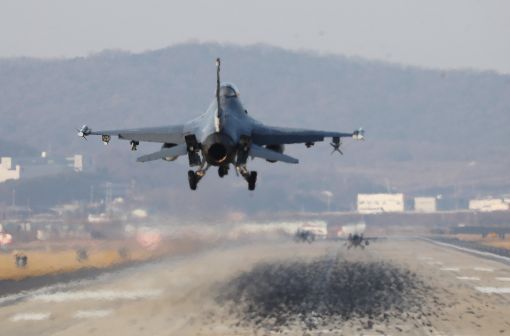 An F-16 fighter jet landing at Osan Air Base of the United States Air Force in Pyeongtaek, Gyeonggi Province.
According to military sources on the 20th, more than 10 F-16 fighter jets of U.S. Forces Korea took off from Osan Air Base in Pyeongtaek, Gyeonggi Province, on the 18th and maneuvered as far as the airspace over international waters in the West Sea. The USFK F-16s are said to have flown into the area between the Korea Air Defense Identification Zone (KADIZ) and the China Air Defense Identification Zone (CADIZ), which is not overlapped by either side’s zone. An air defense identification zone is a line arbitrarily established to enable early identification of aerial threats and is different from sovereign airspace under international law.
While conducting the large-scale air exercise over the West Sea, the USFK fighter jets approached close to CADIZ. In a tit-for-tat response, China scrambled its own fighter jets, heightening tensions. However, both the U.S. and Chinese fighter jets reportedly did not enter each other’s air defense identification zones.
Before the exercise, U.S. Forces Korea notified the South Korean military of the fact that the training would take place, but is said not to have explained the specific purpose of the flight. In the case of USFK-only exercises in which the Republic of Korea Air Force does not participate, there are instances where the training plans or objectives are not shared.
Some observers view it as unusual that the USFK Air Force assets conducted an independent exercise and interpret it as having the character of a move to keep China in check. U.S. Forces Korea has consistently emphasized its strategic flexibility, arguing that its role should extend beyond deterring the North Korean threat to also include countering China.
The Ministry of National Defense, for its part, stated regarding this matter, "We cannot confirm details related to the operation of U.S. Forces Korea assets or military operations," adding, "U.S. Forces Korea, together with our military, is maintaining a strong combined defense posture."
© The Asia Business Daily(www.asiae.co.kr). All rights reserved.
















