The antibody-drug conjugate (ADC) market, often described as a “guided missile” that precisely targets only cancer cells, is undergoing explosive expansion, driven by the successive launches of next-generation new drugs and the broadening of indications. Amid the offensive by big pharma and Chinese companies, Korean companies’ proprietary platforms are also coming into the spotlight.
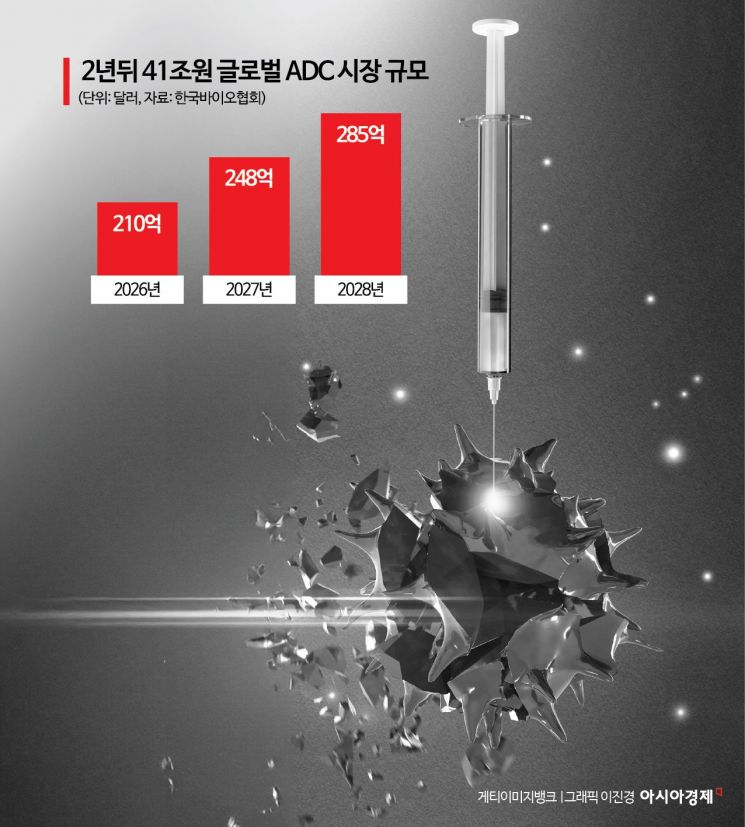
According to data from the Korea Biotechnology Industry Organization on the 20th, the global ADC market is expected to reach 21 billion dollars (about 30 trillion won) this year, then 24.8 billion dollars (about 35 trillion won) in 2027, and 28.5 billion dollars (about 41 trillion won) in 2028, continuing a steep upward trajectory every year.
As the patent expiration dates of existing core blockbuster anticancer drugs approach, big pharma companies are pouring in massive capital on the order of trillions of won to defend these products and secure new cash cows, aggressively pursuing mergers and acquisitions (M&A) of promising companies and acquiring pipeline technologies. In this intensifying global power struggle, the most threatening factor is, without question, the rapid rise of China. Backed by strong capital and flexible regulations, Chinese pharmaceutical companies are achieving overwhelming clinical development speed and have already become the country with the largest number of global ADC pipelines worldwide, further intensifying the competition for market leadership.
Korean biotech companies have likewise entered an unprecedented speed race for survival and global expansion. Recently, Chong Kun Dang obtained clinical trial approval for its first ADC new drug candidate, “CKD-703,” officially joining the new drug development race, while ABL Bio has also achieved visible progress by submitting an investigational new drug (IND) application to the U.S. Food and Drug Administration (FDA) for its bispecific antibody-based ADC new drug candidate “ABL209.”
Ligand Chemical Bioscience, regarded as a leading ADC company in Korea, is about to complete phase 1 clinical trials of “LCB84,” a TROP2-targeting ADC out-licensed to Janssen, and is moving toward entering phase 2 clinical trials in the second half of the year. As its own clinical programs expand and research and development (R&D) expenses surge, the company’s key task is to generate additional business development (BD) outcomes by securing further licensing deals for multiple late-stage pipelines within the year to offset these costs.
Aimed Bio, an emerging powerhouse, is clearly differentiating itself from existing players by combining its extensive patient-derived data with artificial intelligence (AI)-based precision targeting technology and focusing on intractable diseases with high unmet needs, such as brain tumors.
An industry insider in the biotech sector said, “Recently, some big pharma companies, including Pfizer, have faced serious difficulties in their ADC pipelines that were under ambitious development, with clinical trials running into trouble or even being terminated altogether due to unexpected toxicity and other safety issues,” adding, “This is a market where the value of proprietary platform technologies that can control side effects and dramatically improve the precision of drug efficacy is being evaluated more highly than ever, so there are still open opportunities for Korean biotech companies.”
© The Asia Business Daily(www.asiae.co.kr). All rights reserved.

















