Roundtable Meeting Held on Regulatory Innovation for R&D
The government has discussed regulatory innovation measures for research and development (R&D) that move away from uniform limits on the number of projects and instead allow researchers to independently select and focus on their projects.
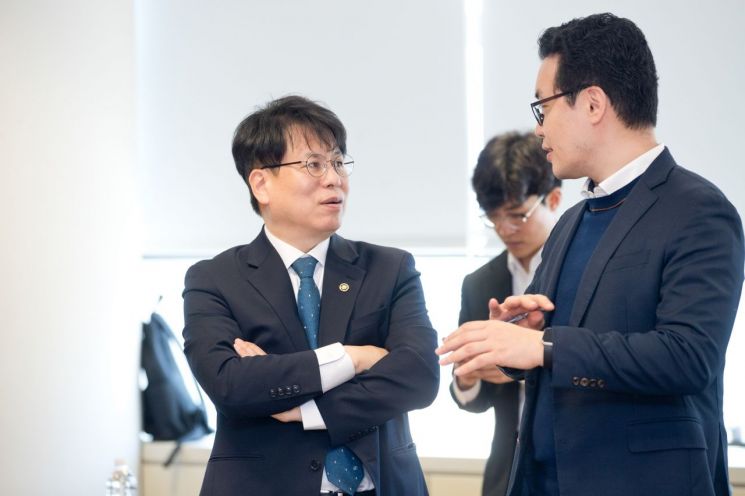 Park Ingyu, head of the Science and Technology Innovation Headquarters at the Ministry of Science and ICT, is speaking with Kim Dokyung, director of the Research System Innovation Division, ahead of the "Field Meeting for R&D Regulatory Innovation" held on the afternoon of the 19th in the conference room of the National Science and Technology Advisory Council at the Gwanghwamun Kyobo Building in Jongno-gu, Seoul. Ministry of Science and ICT.
On the 19th, at the conference hall of the National Science and Technology Advisory Council in Jongno-gu, Seoul, Park Ingyu, head of the Science and Technology Innovation Headquarters, held the "Roundtable Meeting for R&D Regulatory Innovation at Research Sites" and had in-depth discussions with representatives from industry, academia, research institutes, and research management agencies on concrete measures to support research implementation.
Participants at the meeting voiced the need to move away from the so-called "3 Principal Investigators and 5 Co-Investigators (3-Cheok 5-Gong)" rule, which limits researchers to winning up to three projects as a principal investigator and up to five projects as a co-investigator. This representative project-number restriction system, introduced in 2004, limits the number of national R&D projects a participating researcher can conduct simultaneously. It was intended to prevent researchers from taking on an excessive number of projects, which could lower research quality, and to avoid concentrating budgets on a small number of researchers. However, as various exceptions have emerged and confusion has grown, criticism has intensified that the system uniformly restricts individual capabilities.
The "Roundtable Meeting on Major R&D Policies for 2026 in the Chungcheong Region," held on January 16 at the Korea Basic Science Institute in Yuseong-gu, Daejeon, also raised the "3-Cheok 5-Gong" issue, where Lee Juhan, Presidential Secretary for Science and Technology Research, stated that easing the rule was under discussion.
At that time, Park also commented via social media (SNS) that "applying the 3-Cheok 5-Gong rule uniformly to all researchers is not efficient from the perspective of the nation's overall research capacity." He then pointed out that Full Time Equivalent (FTE), which reflects the share of a researcher’s participation, is being used in advanced science and technology countries. Park said, "Many exceptions to the 3-Cheok 5-Gong rule have already been created, and the FTE concept has been partially introduced, which is causing confusion," adding, "It is time to discuss whether to maintain the 3-Cheok 5-Gong system, or to standardize on FTE and leave the number of projects to the autonomous design of researchers."
Meanwhile, the roundtable also reviewed the current status of establishing interoperability between the research support system being promoted to reduce research administration burdens and the individual institutional systems.
Park said, "The core of R&D innovation is to enable researchers to escape unnecessary administrative regulations and devote themselves solely to creative research," adding, "Institutional flexibility that guarantees the autonomy of research, together with linkage among administrative systems that support it, will become the driving force for transforming the research field."
© The Asia Business Daily(www.asiae.co.kr). All rights reserved.

















