Secondary Share Sale and Return Guarantee Agreement Triggered by Offering Price
Bain Capital, MBK and Others That Joined 2021 Capital Increase
Financial Investors Set to Recover 358.7 Billion Won
The final offering price of K Bank, which is about to list on the KOSPI, has been set at 8,300 won. As a result, the secondary share sale linked to the offering price and the return guarantee agreement that the largest shareholder signed with the financial investors (FIs) will be triggered. It turns out that the FIs that participated in K Bank’s paid-in capital increase in 2021 will be able to secure the recovery of about half of their investment.
According to the investment banking (IB) industry on the 20th, when K Bank carried out a paid-in capital increase of 1.25 trillion won in 2021, Bain Capital, MBK Partners, Saemaeul Geumgo, JS Private Equity, Shinhan Asset Management, and Com2uS, which together invested 725 billion won, will recover about 358.7 billion won on March 5, the day K Bank is listed.
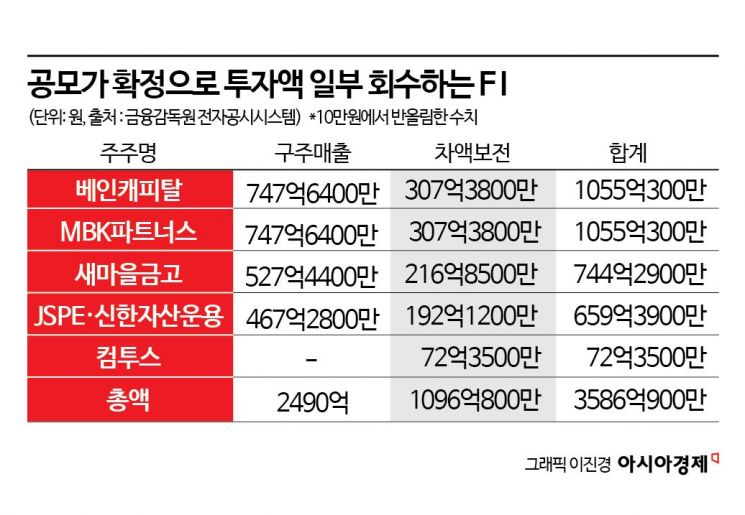
The compensation for the price difference will be allocated in accordance with the return guarantee agreement that BC Card, K Bank’s largest shareholder, promised to the FIs. In November last year, BC Card signed a shareholders’ agreement with the FIs. It promised that if the final offering price fell short of the eligible offering price calculated by applying an internal rate of return (IRR) of 8% agreed at the time of the 2021 fundraising, it would compensate, up to a cap of 110 billion won, the difference between the eligible offering price and the final offering price. The eligible offering price is about 9,299 won, calculated by applying an annual IRR of 8% from July 10, 2021, the investment date, to March 5 next month, the scheduled listing date. As the final offering price has been set at 8,300 won, BC Card must compensate about 109.6 billion won, calculated by multiplying 999 won per share by the 109,718,464 shares held by the FIs. Accordingly, BC Card must pay approximately 30.738 billion won each to Bain Capital and MBK Partners, 21.685 billion won to Saemaeul Geumgo, 19.212 billion won to Shinhan Asset Management and JS Private Equity, and 7.235 billion won to Com2uS.
The price-difference compensation agreement can be beneficial to both BC Card and the FIs. Under the agreement, if K Bank failed to list by July this year, the FIs would be able to exercise drag-along rights or a put option. A drag-along right is the right of minority shareholders to require a shareholder holding a majority stake to sell their shares together, and is used to diversify uncertainty over investment recovery. For example, when BC Card, K Bank’s largest shareholder (33.72% stake), sells its stake in K Bank to a third party, the FIs would have the right to sell their stakes together.
However, under the current Internet-only Bank Act, the shareholding of a non-financial controlling shareholder is capped at 34%. The K Bank stake held by BC Card, whose controlling shareholder KT is a non-financial entity, is already close to that limit. If the FIs exercise drag-along rights, any buyer that acquires shares in excess of the 34% limit would effectively have to be a financial company, making it difficult to find a purchaser. Even if they exercise the put option, BC Card cannot hold shares beyond the ownership limit, so the option cannot in practice be exercised.
Instead of invoking these provisions, which have become effectively useless, the FIs have gained an opportunity to exit their investment through this initial public offering (IPO) via secondary share sales and price-difference compensation. In addition, they can secure immediate cash through the compensation and may earn additional profits if the share price rises after listing. The FIs will still hold about 79.72 million shares after the offering, including shares subject to lock-up restrictions. For BC Card, using up to 110 billion won allows it to quell the dissatisfaction of FIs that need to recover a certain amount of their investment.
© The Asia Business Daily(www.asiae.co.kr). All rights reserved.
![Clutching a Stolen Dior Bag, Saying "I Hate Being Poor but Real"... The Grotesque Con of a "Human Knockoff" [Slate]](https://cwcontent.asiae.co.kr/asiaresize/183/2026021902243444107_1771435474.jpg)
















