FSC to Announce Household Debt Management Plan Next Week
Bank Household Loan Growth to Be Kept at or Below 1.8%
Separate Aggregate Target to Be Imposed on Mortgage Loans
Focus on Whether Mortgage RWA Will Be Raised and DSR Extended to Jeonse Loan
Financial authorities will further tighten lending regulations in the household debt management plan to be announced next week, including the introduction of an aggregate cap system for mortgage loans. The plan is to keep the growth rate of household loans in the banking sector below last year's level, while also setting a separate growth ceiling specifically for mortgage loans in order to preemptively block any additional overheating in the real estate market.
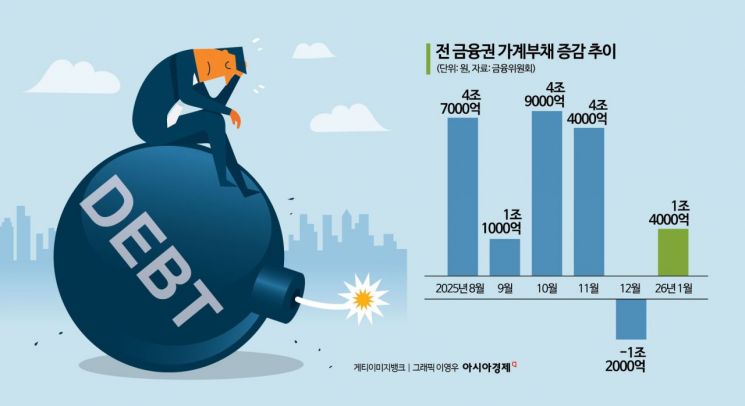
According to financial authorities on the 19th, the Financial Services Commission plans to include in the new household debt measures a scheme to manage the growth rate of household loans in the banking sector at a level lower than last year's 1.8%, while imposing a separate aggregate target for mortgage loans.
Since the introduction of aggregate household loan regulation, the government has presented annual household loan growth targets for the financial sector every year. Starting this year, it intends to further strengthen management by separating mortgage loans as an independently managed category. In addition to the aggregate control of total household loans, a dual management framework will be introduced that binds mortgage loans separately. This is interpreted as reflecting the judgment that, unless the growth of mortgage loans is preemptively suppressed, it could expand again.
Financial Services Commission Chairman Lee Eog-weon has also previously hinted at this policy direction. At a press briefing last month, Chairman Lee said, "Until now we have only looked at the aggregate target for household loans, but going forward we will consider ways to monitor mortgage loans together," adding, "We will review setting a separate management target for mortgage loans."
If an aggregate cap on mortgage loans becomes a reality, banks are expected to find it difficult to extend such loans as aggressively as before. Previously, within the overall growth limit for household loans, banks expanded mortgage lending, which is relatively easy to originate. However, once a separate aggregate cap is set, a hard ceiling will be placed on the volume of mortgage loans themselves, structurally constraining the supply capacity.
The market is also watching whether a plan to raise the risk weight (RWA) on mortgage loans will be included in these measures. At a National Assembly Political Affairs Committee work report on the 5th, Chairman Lee stated that he would review a plan to increase the mortgage loan RWA from the current 20% to 25%. If the RWA is raised, banks must set aside more capital in proportion to risk, which will ultimately reduce their lending capacity and could further tighten interest rates and screening standards.
Another key issue is whether to expand the scope of application of the debt service ratio (DSR) to jeonse loans. Currently, the DSR regulation is applied only to the interest payments on jeonse loans taken out by single-home owners in the Seoul metropolitan area and other regulated areas. The question is whether this will be extended to jeonse loans for tenants with no home ownership. However, if implemented, the regulation could affect jeonse funds that are strongly characterized by end-user demand, and considerable controversy is expected.
An official at the Financial Services Commission explained, "No decision has yet been made on whether to raise the mortgage loan RWA or to expand the scope of DSR application to jeonse loans."
Financial authorities are also wary that tighter regulations focused on banks could lead to a balloon effect, shifting demand to the so-called second-tier financial sector such as mutual finance institutions. According to the Financial Services Commission, total household loans in the entire financial sector in January increased by 1.4 trillion won from the previous month. While loans in the banking sector decreased by 1 trillion won, those in the second-tier financial sector increased by 2.4 trillion won, three times the increase recorded in December last year (800 billion won). In response, the Financial Supervisory Service convened mutual finance institutions earlier this month and urged them to refrain from aggressively marketing household loans, and Saemaul Geumgo has taken action by suspending household loan origination through loan brokers starting today.
At the same time, while maintaining its stance of curbing household loans, the financial authorities plan to put in place supplementary measures to prevent access to funds by vulnerable borrowers, such as those with mid- to low-credit scores, from being excessively constrained. They are reviewing a plan to exempt not only policy finance products but also private mid-interest-rate loans from aggregate regulation, and are discussing methods such as excluding all or a certain proportion of such products when calculating banks' household loan management performance.
Last year, financial authorities excluded policy finance products for low-income households, such as Sae-Hope Stepping Stone Loans, Saitdol Loans, and Didimdol and Bogeumjari-type loans, from the scope of household loan performance management for banks. This year, they intend to go one step further by expanding the exemption to include private mid-interest-rate loans as well, thereby continuing a selective regulatory approach that both reins in household debt and protects vulnerable groups from the perspective of inclusive finance.

An official at the financial authorities said, "In this year's household debt management plan, we will further strengthen safeguards to ensure that loans to mid- and low-credit borrowers are not squeezed," adding, "The detailed measures will be finalized in the plan to be announced at the end of this month."
© The Asia Business Daily(www.asiae.co.kr). All rights reserved.


















