ByteDance launches AI model that generates movie-quality videos
Robots performing 360-degree aerial spins unveiled during China's Spring Festival
DeepSeek poised to trigger a "second DeepSeek shock"
"Gap with the United States is narrowing"
From video to robots, China's artificial intelligence (AI) is shaking the world. There are even forecasts that China's "low-cost, high-efficiency" AI models, which can generate Hollywood-quality footage with just simple text prompts, could trigger a second "DeepSeek shock."
 Irish film director Ruairi Robinson posted a 15-second video on the social networking service X (formerly Twitter) on the 11th (local time) showing actors Brad Pitt and Tom Cruise fighting. The video was created using Sidaenseu 2.0, an AI video-generation model from ByteDance, the Chinese parent company of TikTok. Screenshot from X.
As of the 19th, the AI industry is still reeling from the impact of Sidaenseu 2.0, an AI video-generation model released on the 10th by ByteDance, the Chinese parent company of TikTok. ByteDance rolled out the new model just about two months after unveiling Sidaenseu 1.5 in December last year. Once users input an image and a text description and set the desired aspect ratio, video length, and resolution, the model can generate movie-quality footage. On the 11th (local time), Irish film director Ruairi Robinson posted a 15-second video on the social networking service X (formerly Twitter) showing actors Brad Pitt and Tom Cruise engaging in an intense fight on the rooftop of an abandoned building. Robinson said, "I only entered two lines of prompts into Sidaenseu 2.0."
As high-quality video production no longer requires human labor, concerns are mounting that the film ecosystem itself could be shaken. Renowned Chinese film director Jia Zhangke said, "I myself am planning to make a short film with Sidaenseu 2.0," adding, "To shoot a movie, you may only need one director." The U.S. film industry has pushed back, arguing that ByteDance's AI video-generation model infringes copyrights. The Motion Picture Association (MPA) said in a statement, "Sidaenseu 2.0 has used U.S. copyrighted works on a massive, unauthorized scale," warning that "ByteDance must immediately cease its copyright-infringing activities."
Robots that once waddled are doing backflips in just one year... Chinese robot manufacturing expected to grow 10% annually
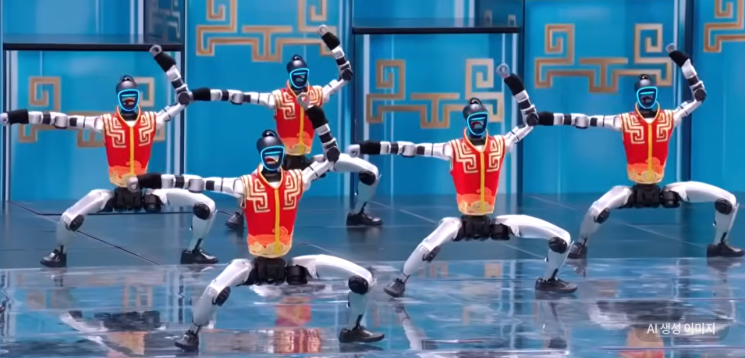 On the 16th, on China Central Television (CCTV)'s Spring Festival Gala Chunwan, the robot G1 from Chinese robotics company Unitree is performing martial arts moves. YouTube capture
The sophisticated Chinese robots unveiled during this year's Spring Festival (Chunjie, the Chinese Lunar New Year) have fired the starting gun for a global robot war. On the 16th, humanoid robots made by Chinese companies appeared one after another on China Central Television (CCTV)'s Spring Festival Gala program Chunwan. In particular, more than 10 units of G1, a robot from robotics specialist Unitree, performed complex martial arts moves, such as wielding swords and nunchucks and executing 360-degree spins in midair.
Just a year ago, Unitree's robots could do little more than wobble around and wave cheering props. This is why many say China's robot technology has made remarkable strides in just one year. Wang Xingxing, Chief Executive Officer (CEO) of Unitree, said, "This is the first time we have unveiled our group control technology that can simultaneously execute precise large-scale transitions and martial arts movements," explaining that "this is technology that will allow robots to be deployed in various fields such as logistics and manufacturing, and to efficiently position individual robots."
China's robot market is growing rapidly. According to the International Federation of Robotics (IFR), as of 2024, China accounts for 54% of global industrial robot installations. Moreover, domestic demand is so strong that more Chinese-made robots are sold in the domestic market than overseas. The IFR forecasts that China's robot manufacturing industry will grow at an average annual rate of 10% through 2028.
DeepSeek V4 expected to include "Engram" technology that cuts AI computing costs

Chinese AI startup DeepSeek is signaling yet another shock to the world, following ByteDance and Unitree. Last month, DeepSeek published a paper titled "Manifold-Constrained Hyper-Connections (mHC)" on arXiv, an online repository for preprints in science. The paper discusses a technology called "Engram," which reduces the computation cost of large-scale AI models and instead focuses them on higher-dimensional reasoning. There are growing expectations that Engram will be included in DeepSeek V4, the company's upcoming low-cost, high-efficiency large language model (LLM).
If DeepSeek V4 delivers a marked improvement in performance, it is expected to affect the GPU (graphics processing unit) ecosystem currently centered on the United States. Already last year, DeepSeek sparked what came to be known as the "DeepSeek shock" by developing an LLM at one-tenth of the cost incurred by U.S. Big Tech companies. The Financial Times (FT), a British business daily, said last month, "China will win the AI race," adding, "China's leading LLMs have rapidly narrowed the performance gap with those of U.S. Big Tech. Private-sector AI investment is larger in the United States than in China, but when you add Chinese government support, the difference is not that great."
© The Asia Business Daily(www.asiae.co.kr). All rights reserved.



















