US Races to Attract Investment Ahead of Midterms and Tariff Ruling
Speeds Up Deals to Prevent Agreements from Being Overturned
Japan Faces Sanctions Amid Deepening China-Japan Tensions
Sees a Chance to Advance Supply Chain De-risking fr
Observers in and around the Japanese government analyze that the reason the United States has recently been pressuring Japan to hurry a US$550 billion (KRW 797 trillion) investment project into the U.S. is the midterm elections. This is because all of the key business areas in the U.S.-bound investment package announced by President Trump are regarded as the most hotly contested battlegrounds in the upcoming U.S. midterms. The view is that Washington’s desire to highlight its success in attracting investment ahead of the elections is intersecting with Tokyo’s strategic calculation that it must diversify its mineral supply chains amid China-Japan tensions.
On the 19th, the Nihon Keizai Shimbun (Nikkei) reported regarding the timing of the project announcement that "Japan had intended to proceed cautiously, whereas the U.S. side gave up its year-end and New Year holidays to accelerate discussions and rushed the first announcement." Citing a Japanese government official, it added, "This matter is naturally a setup with the (U.S.) midterm elections in mind."
Earlier, on the 17th (local time), U.S. President Donald Trump wrote on his social media platform Truth Social, "Japan is now moving forward with the first set of investments under its official and financial commitment to invest US$550 billion in the United States," adding, "Today I am pleased to announce three tremendous projects in strategic areas: oil and gas in the great state of Texas, power generation in Ohio, and critical minerals in Georgia."
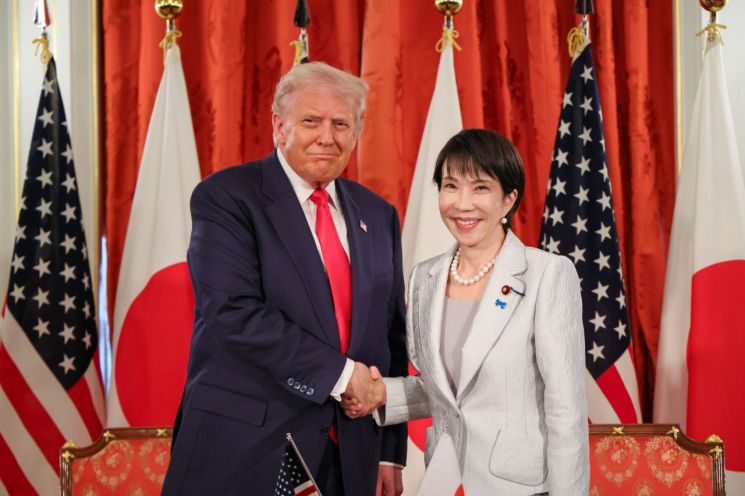 At the U.S.-Japan summit held in Japan on October 28 of last year, U.S. President Donald Trump and Japanese Prime Minister Sanae Takaichi are shaking hands. Prime Minister's Official Residence.
All three regions in the United States where Japan’s investment projects are to be carried out are considered battlegrounds in the November midterm elections. Ohio in the Midwest, where US$33.3 billion (KRW 48 trillion) will be invested to build a natural gas power plant, is a representative swing state that both Republicans and Democrats are courting heavily. It is the home state of Vice President J.D. Vance, but in recent gubernatorial election polls, Democratic support surged and even overtook that of the Republicans.
Georgia, where an industrial diamond production facility will be built, has traditionally been a Republican stronghold. However, the Democratic Party won there in the 2020 presidential election. U.S. polling organization the Cook Political Report has identified this state as one of the most fiercely contested battlegrounds in the midterms.
Texas, where an oil export facility will be constructed, is also a core Republican base, but in a Senate by-election last month, a Democratic candidate pulled off an upset by recapturing a seat for the first time in decades.
The fact that President Trump’s tariff policy is about to face a ruling by the U.S. Supreme Court is also cited as a factor that sped up the discussions. The idea is to launch the projects quickly before any court decision can overturn the agreements. Nikkei analyzed, "If the tariff policy is ruled unconstitutional, the agreements that were extracted from various countries by using high tariffs as a bargaining chip could be shaken," adding that this is "intended to sustain investment into the United States regardless of the ruling."
For Japan, where supply chain uncertainty has grown due to worsening China-Japan relations, this is also seen as a reasonable choice. The fact that the Japanese government has ranked the synthetic diamond project as its top priority among the three initiatives illustrates this. China last month implemented tough sanctions by completely banning exports of rare earths to Japan, and as the world’s largest producer of synthetic diamonds, it is also being mentioned as possibly wielding export controls in that field. Therefore, there is analysis that this investment in the United States could become a breakthrough for pursuing de-China-ization of supply chains. Nikkei stated, "The Takaichi administration is seeking to make the diversification of critical mineral supply chains a core element of its foreign policy," describing this as "a part where the administration’s intentions are clearly revealed."
In addition, South Korea’s situation is also said to have influenced Japan’s rapid decision-making. President Trump stated last month that South Korea was not following through on its investment commitments and signaled tariff hikes. According to Nikkei, a Japanese Foreign Ministry official stressed at the time, while comparing the responses of South Korea and Japan, that "Japan can present its first investment project in the first half of 2026." In order to avoid a sudden tariff hike, Japan instead adopted the stance of moving ahead with the promised investments.
Meanwhile, China strongly criticized the investment as a "political pledge of allegiance." Through an interview the previous day with Shang Haoyu, senior research fellow at the Asia-Pacific Institute of the China Institute of International Studies, the Chinese state-run Global Times argued that it was "a finely calibrated piece of political timing," and pointed out that "the Japanese economy will become more vulnerable to U.S. policies and economic fluctuations and will, in the long term, lose its economic autonomy."
© The Asia Business Daily(www.asiae.co.kr). All rights reserved.
![Clutching a Stolen Dior Bag, Saying "I Hate Being Poor but Real"... The Grotesque Con of a "Human Knockoff" [Slate]](https://cwcontent.asiae.co.kr/asiaresize/183/2026021902243444107_1771435474.jpg)
















