Approval granted for three-dose regimen of existing 2.4 mg
20% weight loss over 72 weeks...significant narrowing of the gap
U.S. FDA review decision expected soon
The competition over weight-loss efficacy in the obesity drug market has flared up again. Novo Nordisk, which has been considered to be lagging behind Eli Lilly's Mounjaro and Zepbound in terms of weight-loss effect, is now fully pushing a high-dose strategy for Wegovy. As European regulators have allowed administration of a high dose equivalent to three times the existing dose, competition is expected to intensify further going forward.
According to the biopharmaceutical industry on the 19th, Novo Nordisk received approval on the 17th (local time) from the European Commission of the European Union (EU) for prescriptions of 7.2 mg of the obesity drug Wegovy (semaglutide). The indication is for adult patients with obesity. Following approval in the United Kingdom, the scope of use has now been expanded to the whole of Europe.
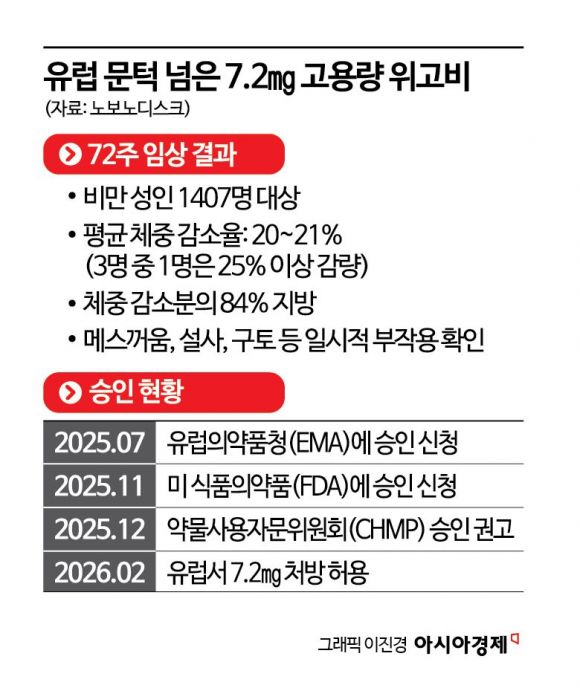
The Committee for Medicinal Products for Human Use (CHMP) of the European Medicines Agency (EMA) recommended approval of the high 7.2 mg dose of Wegovy in December last year. With this latest approval, physicians in the EU can now prescribe a total of 7.2 mg by administering the existing 2.4 mg weekly dose three times in succession. A separate approval process is under way for a single 7.2 mg injection pen, and Novo is aiming to launch it within this year.
In the 72-week STEP UP clinical trial submitted by Novo, the average weight-loss rate in the 7.2 mg treatment arm was reported to be around 20%. Notably, one-third of the participants in the treatment group achieved weight loss of 25% or more. This is an improvement over the 15% to 17% range previously confirmed with the 2.4 mg dose of Wegovy. Compared with the 21% weight-loss rate over 72 weeks for the already marketed 15 mg dose of Lilly's Mounjaro (tirzepatide), the gap has narrowed significantly.
Wegovy, which pioneered the market for glucagon-like peptide-1 (GLP-1) class obesity treatments, recently ceded its leading position to Mounjaro. Unlike semaglutide, which acts only on GLP-1 receptors, tirzepatide simultaneously stimulates GLP-1 and gastric inhibitory polypeptide (GIP) receptors, yielding greater weight-loss effects in clinical trials. With this EU approval making high-dose Wegovy prescriptions possible, some analysts say it has partially offset the perception that Wegovy is less effective than Mounjaro.
In November last year, Novo applied to the U.S. Food and Drug Administration (FDA) for approval of the 7.2 mg Wegovy product. The review is under way using a priority review voucher that significantly shortens the review period, and some expect approval could come as early as this month. However, there are considerable medium- to long-term variables. The approaching expiry of semaglutide-related patents in some countries is cited as a key risk factor. Chinese biopharmaceutical companies are accelerating development of generics in line with patent expirations, and both Novo Nordisk and Lilly are moving to defend their market shares through price cuts.
In response, Novo is also accelerating diversification of formulations. In the United States last month, it launched an oral, once-daily version of Wegovy, focusing on lowering the entry barrier associated with injection-based treatment. Lilly, for its part, is pushing to enter the oral market after obtaining meaningful results in Phase 3 clinical trials for orforglipron, its oral GLP-1 class candidate. As competition over high-dose products and oral formulations intensifies simultaneously, the battle for dominance in the obesity drug market is expected to grow even fiercer.
© The Asia Business Daily(www.asiae.co.kr). All rights reserved.
![Clutching a Stolen Dior Bag, Saying "I Hate Being Poor but Real"... The Grotesque Con of a "Human Knockoff" [Slate]](https://cwcontent.asiae.co.kr/asiaresize/183/2026021902243444107_1771435474.jpg)











