Dollar-yen rate returns to the 154 range
Impact of potential shifts in U.S. rate policy
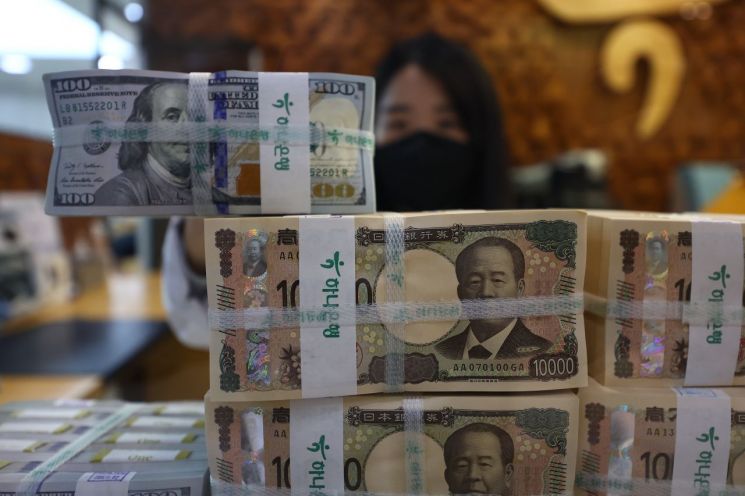 An employee organizing Japanese yen and US dollars at the Hana Bank Counterfeit Response Center in Jung-gu, Seoul. The photo is unrelated to this article. Yonhap News
As optimism over interest rate cuts has faded due to robust US economic indicators, the Japanese yen has posted its steepest monthly drop so far this month. With US Treasury yields climbing and upward pressure on the US dollar strengthening, the yen’s decline has stood out among major currencies.
Bloomberg reported that in New York afternoon trading on the 18th (local time), the dollar-yen exchange rate rose 1% from the previous session to 154.87 yen. This means the value of the yen fell by the same magnitude. Among the G10 currencies, it was the second-worst performer after the New Zealand dollar. In contrast, the Bloomberg Dollar Spot Index rose 0.5%, and the yield on the 10-year US Treasury note climbed 2 basis points (1bp = 0.01 percentage point) to 4.08%.
The yen’s strengthening trend that had continued since the start of the year now appears to have lost momentum. Last month, there was speculation that the Japanese authorities, with US assistance, would directly intervene in the foreign exchange market to defend the yen. Such expectations drove a sharp surge in the yen on January 24 in the New York FX market, following reports that the Federal Reserve (Fed) had conducted a rate check.
Bloomberg also assessed that the release of the minutes from the Fed’s Federal Open Market Committee (FOMC) meeting held on January 27-28 put additional downward pressure on the yen. The Fed stated that the New York trading desk had checked the level of the dollar-yen exchange rate at the request of the US Treasury.
According to the FOMC minutes, the Fed, acting on a request from the US Treasury, contacted financial institutions to inquire about yen exchange rates. The minutes noted, “In the few days before the meeting, the desk requested reference quotes for the dollar-yen exchange rate, an action known as a ‘rate check,’ and after reports of this request emerged, the value of the dollar fell noticeably,” adding that “the desk officer indicated that the Federal Reserve Bank of New York requested these quotes on behalf of the US Treasury.”
Shaun Osborne, chief foreign exchange strategist at Scotiabank, said, “The rebound in US Treasury yields is weighing on the yen,” and analyzed that “near-term risks are concentrated on the outlook for oil prices, as investors keep a close eye on overall market sentiment and the situation in the Middle East.”
© The Asia Business Daily(www.asiae.co.kr). All rights reserved.

















