Ministry of Land, Infrastructure and Transport Releases Last Year’s Air Traffic Volume Figures
The Ministry of Land, Infrastructure and Transport announced on the 19th that last year’s air traffic volume in Korea totaled 1,013,830 flights. This is a 6.8% increase from a year earlier and marks the first time the annual figure has exceeded 1 million flights.
Air traffic volume is an indicator of how much Korea’s airspace has been used. It is compiled based on flight plans submitted to the ministry by all domestic and international aircraft operators, including both transport and non-transport aircraft. On a daily basis, an average of 2,778 flights passed through Korean airspace, which is about 20% higher than the pre-COVID-19 level in 2019 (approximately 840,000 flights).
The increase in air traffic volume was driven by higher international traffic. International flights averaged 2,160 per day, up 9.4% from a year earlier. Short- and medium-haul international routes saw strong growth in demand, with routes to Southeast Asia and southern China accounting for 52% of all international flights. International overflights passing through Korean airspace rose 21.0% over the same period. According to the ministry, this further underscores Korea’s growing strategic importance as a key air hub in Northeast Asia.
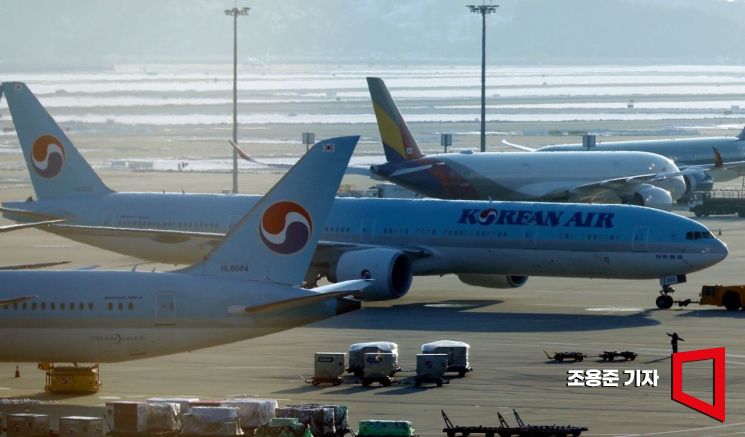 Passenger aircraft from Korean Air and Asiana Airlines are waiting on the runway and apron at Incheon International Airport in Yeongjongdo, Incheon. Reporter Jo Yongjun
In contrast, domestic flights averaged 617 per day, down 1.6% year-on-year. By airport, traffic increased at Incheon, Gimhae, Cheongju, Daegu, Gwangju, and Yeosu, while it decreased at Jeju, Gimpo, Muan, and Yangyang. Incheon International Airport handled the largest volume of air traffic, with a daily average of 1,193 flights, followed by Jeju International Airport (487 flights) and Gimpo International Airport (390 flights).
Yoo Kyungsoo, Director General for Aviation Safety Policy at the Ministry of Land, Infrastructure and Transport, said, “In a global environment where air travel demand is on a sustained medium- to long-term growth trajectory, a stable increase in air traffic will serve as a foundation for invigorating logistics, tourism, trade, and other industries, as well as the national economy,” adding, “We will do our utmost in air traffic management so that people can use the skies safely and efficiently.”
© The Asia Business Daily(www.asiae.co.kr). All rights reserved.

![Clutching a Stolen Dior Bag, Saying "I Hate Being Poor but Real"... The Grotesque Con of a "Human Knockoff" [Slate]](https://cwcontent.asiae.co.kr/asiaresize/183/2026021902243444107_1771435474.jpg)















