From 'scarcity' to 'experience consumption'
'Meme consumption' amplified by social media
The 2.99 dollar (about 5,000 won) canvas tote bag from the major U.S. grocery chain Trader Joe's is once again selling out in waves. It is just a simple shopping bag, but lines form before stores even open, and it sells out immediately after sales begin, a pattern that keeps repeating. On online resale platforms, it is traded for hundreds of dollars, and some even say it is "harder to get than a Chanel bag."
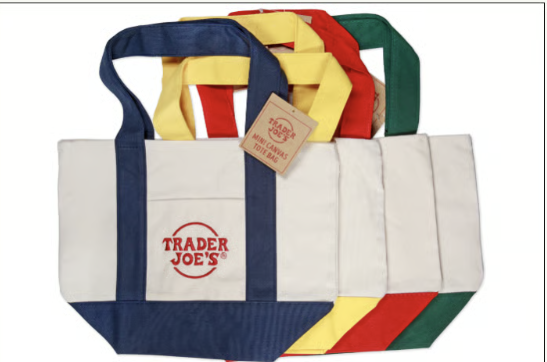
Beyond 'scarcity' to 'experience consumption'
Until recently, the key word explaining its popularity was clearly "scarcity." Analysts say that a structure in which it is released in limited quantities only at some offline stores in the United States, without any online sales, has created a sense of shortage. The U.S. business magazine Forbes also pointed out that "the fact that it is not easily attainable has stimulated the desires of younger generations."
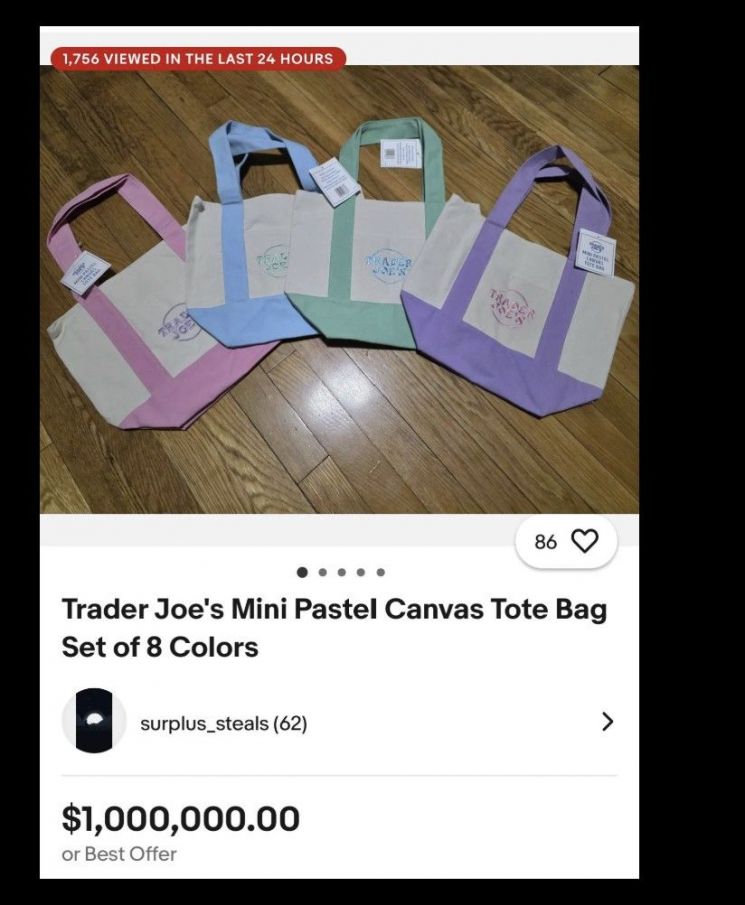 A listing for an eight-piece set of Trader Joe's tote bags posted on eBay, a U.S. secondhand marketplace. Some sellers listed the bags for $1,000,000 (about 1.4 billion won, roughly 170 million won apiece), drawing attention.
Recently, however, some analysts say there is another factor at play. The bag is being consumed not just as a product, but as a "token of experience." Like a souvenir that can only be bought at a particular travel destination, the Trader Joe's bag has become an object symbolizing the experience of visiting the United States. In particular, among Korean travelers, it serves as a kind of cultural proof that "I have actually been to an American supermarket."
'Meme consumption' amplified by social media
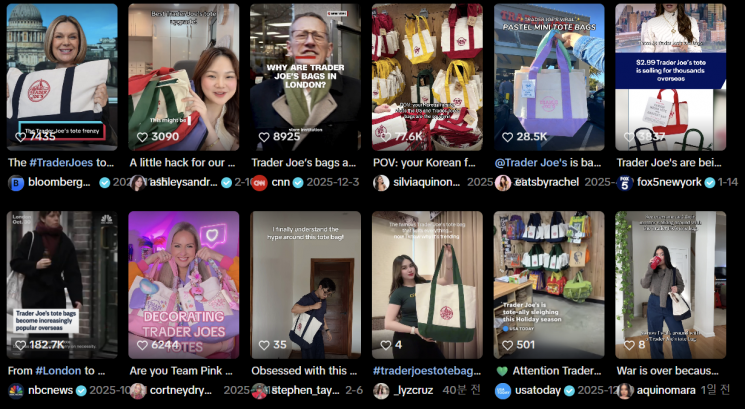
The way social media spreads content has also acted as a catalyst for its popularity. As "shopping haul" videos have become a trend on TikTok and Instagram, the tote bag has been repeatedly featured as a background prop in grocery-shopping content. Naturally, the brand logo becomes imprinted in viewers' minds, and a pattern emerges in which people keep asking, "Where did you buy that bag?" It is a form of voluntary viral marketing that is more powerful than advertising.
Another notable factor is its connection with "resale culture." Some consumers purchase the bag with resale in mind rather than actual use. In a situation where supply is limited, every time a new color is released, prices surge, and this pattern keeps repeating, leading some to perceive the bag as a kind of "micro investment product."
"It's cooler because it's not expensive"
Ironically, its low price has strengthened its symbolic meaning. That is because it conveys a message that the owner pursues rational spending rather than flaunting luxury goods. Some observers say this reflects a revival of the phenomenon in which everyday brands represent a lifestyle, much like Levi's or McDonald's, which were once regarded as American cultural icons.
Recently, rumors of the launch of a new seasonal design have been circulating, heightening expectations. There has been no official announcement, but given that in the past even rumors of new products alone were enough to spark people lining up before opening, some predict that a similar craze could unfold again this time.
The phenomenon of a shopping bag costing less than 5,000 won crossing borders and being consumed as a "cultural code" is gaining attention. Many analysts see it not as a simple fad, but as a symbolic case that reveals changes in both branding and patterns of consumption.
© The Asia Business Daily(www.asiae.co.kr). All rights reserved.
![A Woman with 50 Million Won Debt Clutches a Stolen Dior Bag and Jumps... A Monster Is Born [Slate]](https://cwcontent.asiae.co.kr/asiaresize/183/2026021902243444107_1771435474.jpg)


















