A Landslide Victory with 354 out of 464 Lower House Votes
Runoff Required in the House of Councillors
Sanae Takaichi, president of the ruling Liberal Democratic Party (LDP) and Japan's first female prime minister, has been re-elected as prime minister after winning the prime minister-designation vote in the House of Councillors following her victory in the House of Representatives.
According to NHK and other outlets on the 18th, Prime Minister Takaichi secured a second term by winning 354 out of 464 votes in the prime minister-designation vote in the House of Representatives held that day. All 316 LDP members and 36 members of the coalition partner Japan Innovation Party are believed to have cast their ballots for Prime Minister Takaichi. Ogawa Junya, leader of the largest opposition party in the lower house, the Centrist Reform Coalition, received 50 votes.
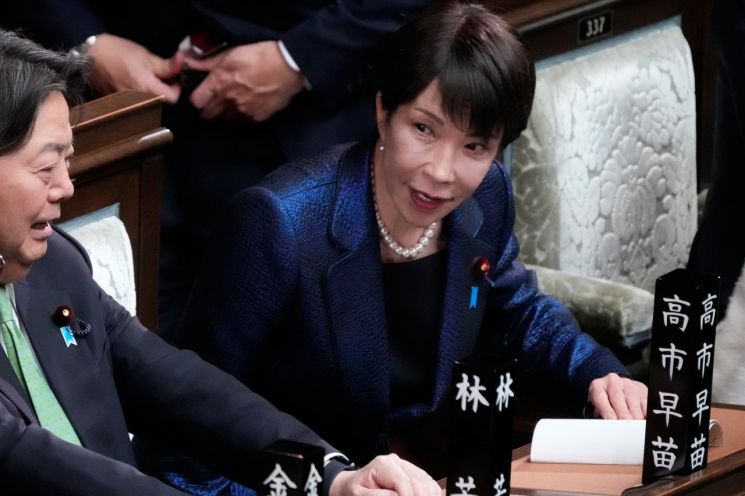
Because the result of the House of Representatives vote takes precedence if the House of Councillors and House of Representatives make different choices in the prime minister-designation process, Takaichi's re-election as prime minister had already been assured by the lower-house vote.
In the House of Councillors (upper house), where opposition parties outnumber the ruling bloc, no candidate won a majority in the first round of voting held after the House of Representatives vote. Prime Minister Takaichi received 123 votes, just one short of an outright majority, while Ogawa came in second with 58 votes.
In the runoff vote in the House of Councillors between Prime Minister Takaichi and Ogawa, Takaichi won by a narrow margin, taking 125 votes, just over half of the total. Ogawa received 65 votes.
Prime Minister Takaichi, who took office as Japan's 104th prime minister in late October last year, made a high-stakes move to strengthen her power base by dissolving the House of Representatives (lower house) early on January 23. In the general election held on the 8th, the LDP scored a landslide victory, winning more than two-thirds of the seats.
Having completed the procedures for her re-election, Prime Minister Takaichi will launch her second cabinet later in the day. All ministers will remain in their posts, with no reshuffle.
Prime Minister Takaichi is also expected to continue the coalition arrangement with the hardline conservative Japan Innovation Party. The Innovation Party has maintained a cooperative framework with the LDP without formally joining the cabinet.
Capitalizing on the emergence of an overwhelming ruling party in the House of Representatives, Prime Minister Takaichi is expected to push ahead with conservative security policies together with the Innovation Party, while also driving forward economic policies such as what she calls "responsible active fiscal policy."
She has expressed strong interest in the early revision of the three key national security documents to reinforce defense capabilities and increase defense spending (the defense budget), in a sweeping relaxation of arms export rules, in strengthening intelligence-gathering functions, and in establishing a criminal offense for desecrating the national flag. In particular, she is expected to pursue discussions on options such as explicitly stipulating the Self-Defense Forces, Japan's de facto military, in the pacifist Constitution, which has not been amended once since it was promulgated in 1946.
In addition, Prime Minister Takaichi is expected to accelerate discussions on cutting the consumption tax on food, while seeking to secure passage of the fiscal 2026 budget bill as quickly as possible.
At an LDP lawmakers' meeting the same day, Prime Minister Takaichi said, "Let us firmly take on the challenge of revising the Constitution and the Imperial House Law (the law governing the imperial family)," adding, "To build public peace of mind and a strong economy, I ask for cooperation from the opposition parties as well, and I will work to have the (budget bill) passed as soon as possible."
In foreign policy, she is expected to maintain good relations with South Korea, pursue security and economic cooperation with the United States, which is pressing its allies to shoulder more of the burden, and seek clues to improving ties with China, with which she has been at odds over remarks suggesting possible Japanese involvement in the event of a Taiwan contingency.
Meanwhile, Prime Minister Takaichi plans to hold a press conference tonight to outline the key policy priorities of her new cabinet.
© The Asia Business Daily(www.asiae.co.kr). All rights reserved.

















